

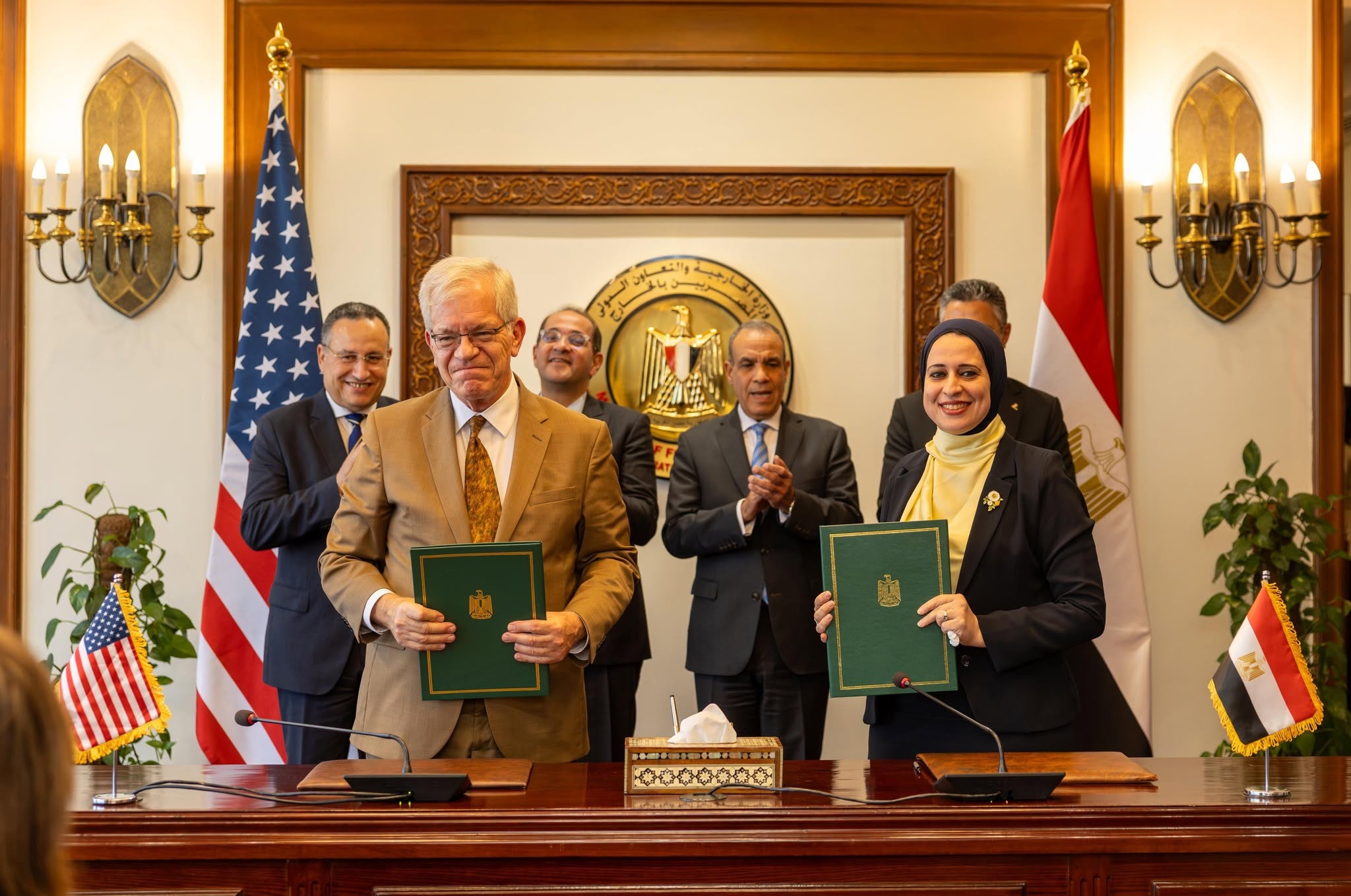

The first-ever bilateral Strategic Objective Agreement aims to deepen commercial ties, attract business opportunities, and strengthen cooperation across agriculture, education, healthcare, technology, and infrastructure.
Egypt and the U.S. have signed their first-ever bilateral Strategic Objective Agreement for Advancing Mutual Prosperity, committing $125 million in U.S. funding to expand economic cooperation, create opportunities for American companies, and support private-sector growth in both countries, according to a statement by the U.S. Embassy in Egypt.
Signed on November 4, 2026, in the New Administrative Capital, the agreement marks a new milestone in Egypt-U.S. economic relations, building on the countries’ longstanding partnership and opening further opportunities for collaboration across several strategic sectors.
The agreement was signed by U.S. Embassy Chargé d’Affaires Robert Silverman and Deputy Foreign Minister for International Cooperation Samar El-Ahdal, in the presence of Foreign Minister Badr Abdelatty, Minister of Finance Ahmed Kouchouk, Minister of Supply and Internal Trade Sherif Farouk, and Minister of Higher Education and Scientific Research Abdel Aziz Qonsowa.
According to the Egyptian State Information Service, the agreement seeks to strengthen economic cooperation in energy, water management, infrastructure, technology, education, healthcare, and food security, while supporting job creation and improvements in public services. It also envisages greater use of American technologies and expertise in developing Egypt’s economic and service infrastructure.
During the signing ceremony, Silverman highlighted Egypt’s economic potential and the opportunities available to American businesses, noting that the agreement would generate economic growth while expanding commercial opportunities in agricultural development, food security, basic and higher education, healthcare, artificial intelligence, water security, innovation, and workforce development.
The agreement also reflects a shared commitment to leveraging Egypt’s strategic geographic position, sizable workforce, and expanding markets to advance economic modernization and strengthen private-sector participation.
According to the U.S. Embassy, the framework is designed to promote greater Egyptian economic self-reliance while ensuring that U.S. foreign assistance programs deliver stronger impact, efficiency, and accountability.
Bilateral trade and investment ties
The agreement comes against a backdrop of expanding commercial relations between Egypt and the United States, with bilateral trade and investment providing an established foundation for further cooperation.
According to the Office of the United States Trade Representative (USTR), trade in goods and services between the two countries reached an estimated $16.1 billion in 2025, representing a 28.9% increase, or $3.6 billion, compared to 2024. Goods trade accounted for approximately $12.3 billion of the total, with U.S. goods exports to Egypt reaching $9.4 billion, up 47% year-on-year. Meanwhile, bilateral services trade amounted to an estimated $3.8 billion.
Egypt’s position as a major regional market further strengthens the commercial case for expanding this partnership.
According to the U.S. Department of Commerce’s International Trade Administration (ITA), Egypt is the largest export market for U.S. goods and services in Africa and the fourth-largest in the Middle East. The country also offers access to a consumer market of more than 118 million people, alongside an established industrial base, manufacturing capabilities, natural resources, and a strategic location connecting Africa, Asia, and Europe.
Investment ties also provide a significant starting point for the new framework. According to the ITA’s Egypt Market Overview, the United States ranked as Egypt’s third-largest foreign investor in 2024, with $3.2 billion invested. The total stock of U.S. foreign direct investment (FDI) in Egypt stood at nearly $25 billion, although approximately $21 billion was concentrated in the oil and gas sector.
This existing investment footprint highlights the potential to broaden bilateral business engagement into additional sectors, particularly technology, manufacturing, healthcare, renewable energy, education, and agricultural development.
Private-sector participation
A central feature of the agreement is its emphasis on private-sector participation as an engine of economic development, employment generation, and productivity.
This approach aligns with the growing importance of private businesses in Egypt’s economic structure.
According to the World Bank’s November 2025 report, More Jobs, Better Jobs: The Engine for Egypt’s Future Growth, the private sector already contributes approximately 75% of Egypt’s GDP and employs more than 80% of its workforce.
The World Bank identifies private-sector expansion as essential to generating employment opportunities and unlocking Egypt’s longer-term growth potential. It also highlights the importance of improving the business environment, expanding access to finance, and strengthening competition to enable businesses to invest and create more jobs.
Against this backdrop, the new U.S.-Egypt agreement could provide an additional platform for connecting Egyptian businesses with international expertise, technology, and commercial partnerships.
Its focus on workforce development and education is also particularly relevant given Egypt’s demographic profile. According to the World Bank, an average of 1.3 million young Egyptians enter the labor market annually, underscoring the importance of expanding investment in skills development, vocational training, and employment-generating industries.
Cooperation in agricultural development and food security could similarly support Egypt’s efforts to improve domestic production capabilities and strengthen the efficiency of its agricultural value chains through modern technologies and international expertise.
Outlook
The agreement represents a step toward translating Egypt and the U.S.’s longstanding strategic relationship into expanded economic and commercial opportunities.
For Egypt, the framework offers an opportunity to leverage its geographic advantages, large domestic market, industrial base, and workforce to attract further international engagement while supporting economic modernization.
For American businesses, it provides a framework to explore opportunities in sectors extending beyond traditional areas of cooperation, particularly as demand grows for technology-driven solutions, infrastructure development, healthcare services, modern agricultural systems, and human-capital investment.
The agreement’s ultimate impact will depend on how its funding is allocated, how projects are implemented, and the extent to which Egyptian and American businesses translate the framework into practical partnerships.