
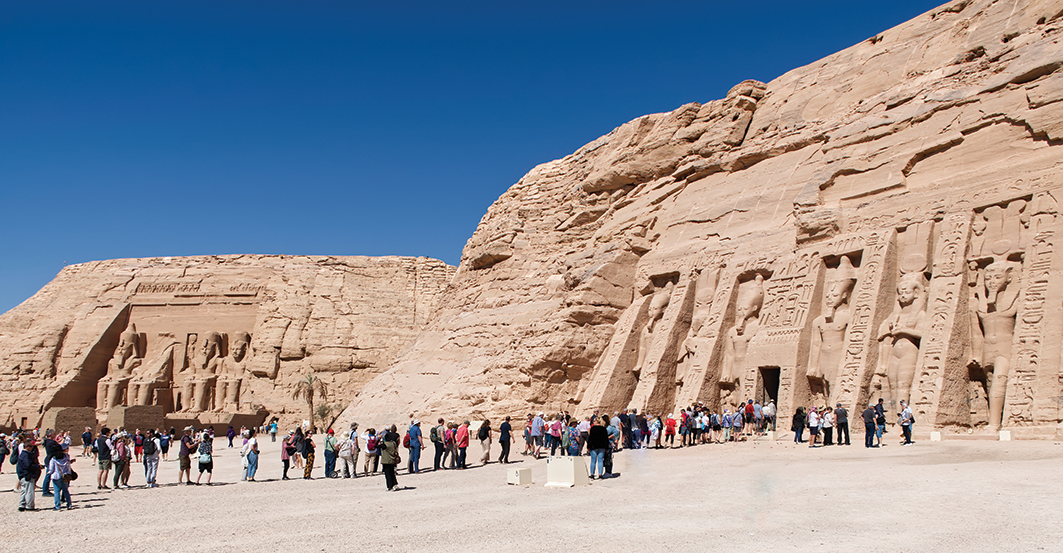

“Egypt is where tourism began,” British historian Thomas Holland said in 2022. “It is still one of the world’s favorite tourist destinations.”
The government aims to welcome 30 million tourists annually by 2030, requiring an average annual increase of 2.5 million visitors.
“Egypt received roughly 12.8 million tourists between January and September 2026, with arrivals expected to reach 20 million by year-end,” said Minister of Tourism and Antiquities Sherif Fathy at the Al Ahram Tourism Forum in September. “Maximizing the benefits of Egypt’s tourism potential requires genuine integration and continued coordination among all relevant ministries and state agencies.”
To support this growth, the government is focusing on developing several sectors that underpin tourism, including infrastructure and road networks, airport capacity, customs and regulations, hotel development, and private-sector investment.
However, attracting more visitors also brings challenges. Destinations that receive large numbers of tourists can face pressure on infrastructure, public spaces and local communities. According to Responsible Tourism, an educational hub, “A lot of problems, like the exhaustingly long queues in Rome and residents’ riots in Barcelona, can occur when there are too many visitors to a particular destination.”
Egypt’s Vision 2030 places environmental sustainability among its priorities, while the national tourism strategy aims to diversify tourism products and modernize infrastructure. According to Aaru Management, a tourism management firm, “Egypt’s Tourism Strategy 2030 underscores a unified national effort to diversify tourism products, modernize infrastructure, and ensure sustainable growth.”
The strategy also promotes environmentally conscious development and heritage preservation. According to Aaru Management, “Egypt’s tourism strategy promotes eco-friendly developments, heritage preservation, and community engagement, including desert lodges powered by solar energy and coastal resorts implementing zero-waste programs.”
Expanding capacity
The government has announced several infrastructure projects to accommodate rising tourist arrivals.
In August, it announced plans to build a fourth terminal at Cairo International Airport. “The new terminal aims to represent a qualitative shift in the airport’s capacity,” said presidential spokesperson Mohamed El-Shennawy.
The airport’s existing infrastructure handles more than 30 million passengers annually. This capacity is projected to reach 70 million once the new terminal opens, four years after construction begins. Local media have reported that construction is expected to start soon.
The government has not disclosed how the project will be financed. However, Construction Review estimates that “Cairo terminal four is expected to cost about $3.5 billion.”
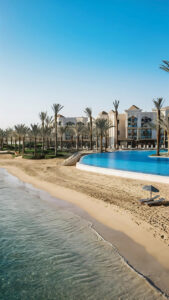
Hotel capacity is another requirement for meeting the government’s tourism target. According to a September statement by the Cabinet Media Center, “Egypt ranked first in Africa for hotel development for the ninth consecutive year in 2026, when the country’s hotel pipeline reached 185 properties and 46,000 rooms under construction, compared with 143 hotels and 33,900 rooms in 2025.”
Even with this pipeline, additional rooms will be needed. In an interview with local media in November 2025, Hossam El Shaer, chairman of the Egyptian Tourism Federation, said, “Egypt needs to add approximately 200,000 new hotel rooms to achieve the 30 million tourist target.”
International hotel operators are also seeking to secure a position in the expanding market. In the 2026 Africa Hotel Development Report, Trevor Ward, managing director of W Hospitality Group, said, “Egypt’s Vision 2030 target is creating real urgency among international operators to secure their positions now.”
Several local and international hotel groups have announced investments in Egypt. According to its website, Egyptian company Jaz Hotel Group has opened or plans to open eight hotels in Sokhna, Marsa Alam, Almaza Bay and Mansoura.
On October 12, IHG Hotels and Resorts signed a management agreement with Kleek Development for a 250-room Crowne Plaza hotel in Sixth Settlement, New Cairo, scheduled to open in 2031.
Marriott International also announced an agreement in July with Misr Italia Properties and People & Places to develop nine properties representing more than 1,500 rooms across Egypt, with an investment of around $1.1 billion, according to Construction Week.
Beyond traditional hotels, serviced apartments offer another accommodation option for visitors. Egypt has about 160,000 serviced apartments registered under the Egyptian Tourism Authority, according to Daily News Egypt.
Mordor Intelligence estimates that Egypt’s hospitality market will reach $21.5 billion in 2026, up from $20.1 billion in 2025. The research firm also forecasts that the serviced-apartment segment will grow at a compound annual rate of 13.9%.
The government is working to bring previously informal serviced apartments into the regulated tourism market. “A central pillar of the reform involves converting a portion of the 106,000 underutilized housing units into fully serviced, hotel-managed assets, a shift expected to improve operational efficiency and integrate idle inventory into the formal tourism ecosystem,” said Egyptian Tourism Authority CEO Mostafa Mounir.
Improving mobility
Transportation is another part of Egypt’s tourism development plans. Efficient connections between airports, hotels and tourist attractions can improve visitors’ experiences while reducing the time and costs associated with getting around.
According to Smartvel, a Spanish tourism company, “An efficient transportation system enhances the traveler’s experience. Intermodal transportation systems, which combine different types of transport (such as trains, buses, and bicycles), have proven effective in facilitating mobility and improving air quality.”
Traffic congestion has long been a challenge for visitors to Cairo and its historic sites. “Cairo’s traffic congestion is a known pain point for tourists trying to reach historic sites,” said Egyptian travel agency Tarot Tours Garanah.
The government has therefore focused on improving road and public transportation networks. The aim, according to Tarot Tours Garanah, is to ensure that “more time is spent experiencing Egypt, and less time is spent on logistics.”
Egypt’s National Road Project includes plans to build 3,300 kilometers of new roads at a cost of about EGP 36 billion ($662 million), according to the National Investment Bank. The government has also built around 945 bridges, Ahram Online reported.
The East Nile monorail is among the projects expected to improve Greater Cairo’s transportation network. In May, the State Information Service described it as “a qualitative leap in the concept of rapid mass transit, linking Greater Cairo with the new urban communities where the route has been carefully designed to pass through the most densely populated areas.”

Easier access and regulation
Regulatory changes are also intended to make travel to Egypt more accessible while improving standards across the hospitality sector.
Starting August 1, Cairo International Airport launched the first phase of an automated system for issuing visas on arrival across its arrival terminals. The initiative is intended to simplify and speed up the process, according to the Cairo Governorate Electric Portal.
The Ministry of Tourism and Antiquities has also introduced a Holiday Home licensing system to bring previously unregistered short-term accommodation under formal regulation. Under Ministry Decree No. 209 of 2025, individuals and companies cannot offer residential units for short-term or transient stays without an annual Holiday Home license.
The measure is intended to strengthen safety and quality standards. According to Amereller, a Dubai-based international law firm, “The decree provides a unified national framework, aimed at enhancing safety and quality standards consistent with Egypt’s hospitality sector, ensuring data review and transparency across the tourism ecosystem.”
The government is also seeking to encourage investment in the sector. In May, the Ministry of Finance approved an EGP 50 billion initiative to finance local travel agencies. The initiative forms part of broader efforts to support tourism, expand hotel and tourism capacity, and encourage new investment, local media reported.
Managing overtourism
As Egypt expands its tourism capacity, the pressure on popular destinations is becoming more visible. Overtourism occurs when visitor numbers exceed a destination’s capacity to manage them, potentially affecting the visitor experience, local communities and the sites themselves.
The Great Pyramids of Giza illustrate some of these pressures. According to Greek Reporter, “In 2024, about 17.5 million tourists visited the Great Pyramids of Giza, which resulted in chaotic surroundings with guides, tour buses, street vendors, scammers and sorry-looking camels making the Giza experience uncomfortable for tourists and unbearable for locals.”
The newly opened Grand Egyptian Museum has introduced two-hour visitation slots to help manage visitor flows and avoid congestion, according to its website. Similar pressures could emerge at other popular destinations, including Old Cairo and historical sites in Luxor and Aswan.
The effects could extend beyond heritage attractions. Higher visitor numbers may also place pressure on popular Red Sea beaches and marine environments, as well as desert destinations such as the White Desert.
Other international destinations offer examples of the challenges Egypt may face. In Rome, the Colosseum received 127,000 visitors in 2025, according to Italy-focused travel website Dolcevia. The website describes the resulting experience: “The Colosseum received 127,000 visitors in 2025. Security screenings create waiting times of two to three hours. You are standing in the sun, and you are waiting to enter a building that will then be full of other people also waiting.”
Barcelona has also faced growing resistance from residents concerned about the effects of mass tourism. Responsible Tourism estimates that “about 32 million visit the city every year. High demand for tourist accommodation has meant rents are soaring, and residents are struggling to afford the increases, which resulted in protests by locals to put limits on tourists’ arrivals.”
For Egypt, the challenge is to expand tourism without compromising the destinations and communities that attract visitors in the first place. Reaching the target of 30 million tourists by 2030 will depend not only on adding airport capacity, hotel rooms and transport links, but also on managing visitor numbers and protecting the country’s natural and cultural assets.