



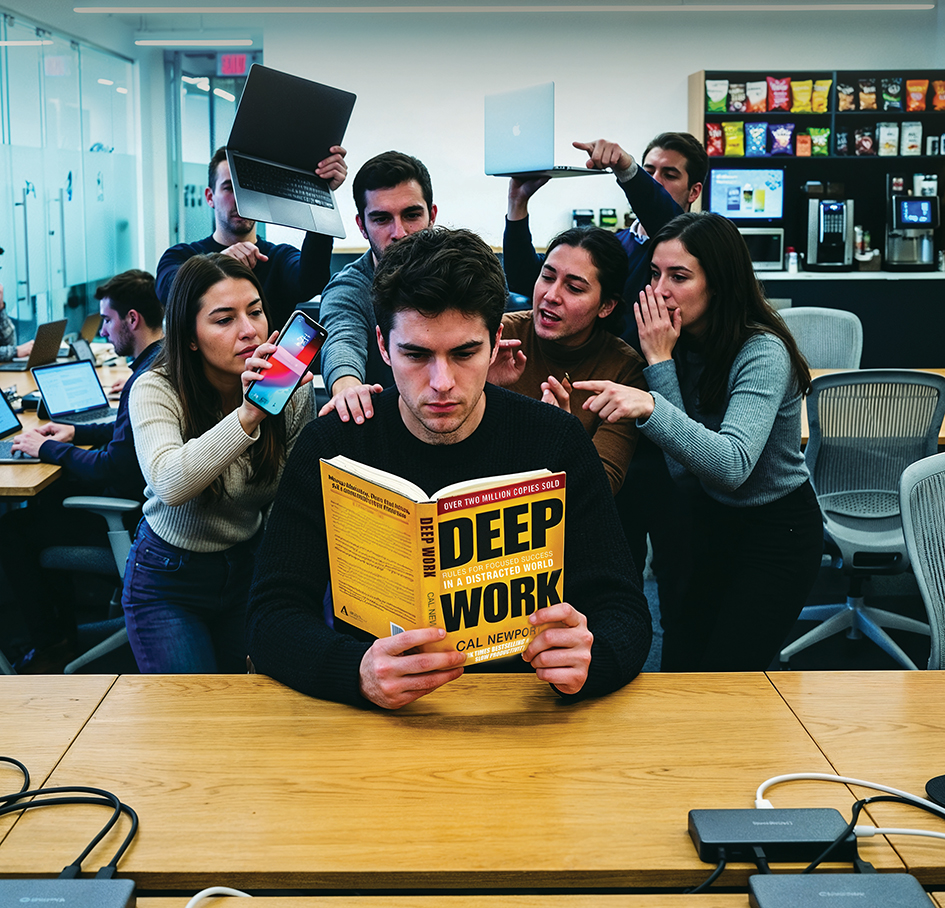
In today’s world, allocating several hours, let alone days, to focus on a single difficult, critical task is increasingly challenging. Instant notifications from digital apps and social media fight a ferocious war for users’ attention. Meanwhile, bosses are demanding immediate responses to their communications.
That reality promotes “shallow work” over “deep work.” In his book “Deep Work: Rules for Focused Success in a Distracted World,” Cal Newport defines the latter as “professional activities performed in a state of distraction-free concentration that push your cognitive capabilities to their limit. These efforts create new value, improve your skill, and are hard to replicate.”
“Shallow work” consists of “noncognitively demanding, logistical-style tasks, often performed while distracted. These efforts tend not to create much new value in the world and are easy to replicate.”
The change from deep to shallow work comes at a time when “deep work is more valuable than ever before in our shifting economy,” says Newport. “You would expect to see this skill promoted not just by ambitious individuals, but also by organizations hoping to get the most out of their employees. This is not happening [as] many other ideas are being prioritized as more important than deep work in the business world. Many of these trends actively decrease one’s ability to go deep.”
The book details mindsets that prioritize deep work, how to build willpower to tune out shallow work, and choose the most suitable deep work strategies to remain focused without being cut off from the outside world.

The mindset
Embracing deep work is essential to remain relevant in today’s digital workplace. “As intelligent machines improve, and the gap between machine and human abilities shrinks, employers are becoming increasingly likely to hire ‘new machines’ instead of ‘new people,’” the book says.
This transformation is “not driving down all jobs but is instead dividing them,” Newport notes. “Though an increasing number of people will lose in this new economy as their skills become automatable or easily outsourced, there are others who [are] becoming more valued (and therefore more rewarded) than before.”
Employees have to offer more value or a different value proposition than the machines poised to replace them.
The book highlights three mindsets that can thrive. First are “high-skilled workers [who] “use technology to augment their own performance” by feeding large databases, siphoning it and then using their own intelligence to make predictions. They realize “intelligent machines are not an obstacle to … success, but instead provide its precondition.”
The second category is “the superstars.” Their deep work surpasses today’s technology, and they have the foresight to anticipate the next big trend. “This … holds for the growing number of fields where technology makes productive remote work possible, [such as] consulting, marketing, writing, design, and so on,” the book says. “Once the talent market is made universally accessible, those at the peak of the market thrive while the rest suffer.”
The third category driving deep work is “the owners.” They have the capital and willingness to invest in new technologies developed by deep-work employees. “A venture capitalist in today’s economy can fund a company like Instagram, which was eventually sold for a billion dollars, while employing only 13 people,” Newport says.
Deep-work individuals master “two core abilities,” the book says. “The ability to quickly master hard things [and] the ability to produce at an elite level, in terms of both quality and speed.”
One way Newport highlights to increase capacity for deep work is “memorizing a deck of cards.” This approach helps “subjects’ ability to maintain their focus on essential information [as well as] improve [one’s] general ability to concentrate.”
Step one
Encouraging “deep work” over “shallow work” starts with the design and layout of the office space. “We … find ourselves in distracting open offices where inboxes cannot be neglected, and meetings are incessant. [This is] a setting where colleagues would rather you respond quickly to their latest email than produce the best possible results.”
Until employees can work in closed offices with no distractions, the book details several strategies to facilitate deep work.
These strategies require “moving beyond good intentions and adding routines and rituals to your working life designed to minimize the amount of your limited willpower necessary to transition into and maintain a state of unbroken concentration.” It also requires each person to “decide on [an ideal] depth philosophy,” the book says.
Time philosophy
One technique “prioritizes deep work by trying to eliminate or minimize other types of work.” Another is “a rhythmic strategy in which [a person] works [deeply] for the same hours every weekday morning, without exception, before beginning a workday punctuated by standard distractions.”
“Both approaches work,” stresses Newport, “but not universally.” Shutting out shallow work “might make sense for someone whose primary professional obligation is to think big thoughts.” However, if the job requires interacting with the outside world, “rejection of all things shallow” could cost employees their jobs.”
Newport also says rigorously eliminating shallow work could isolate practitioners, hindering the exchange of ideas and expertise with coworkers. Instead, he recommends alternating between deep and shallow work, calling it a “bimodal philosophy of deep work.”
“The decision between rhythmic [working more hours] and bimodal [philosophies] comes down to your self-control in such scheduling matters,” he says.
In today’s world, adopting a rhythmic philosophy “is one of the most common [strategies] among deep workers in standard office jobs. For many … it’s not just self-control issues that bias them toward the rhythmic philosophy, but also the reality that some jobs don’t allow you to disappear for days at a time when the need to go deep arises. For a lot of bosses, the standard is that you’re free to focus as hard as you want … so long as the boss’s emails are still answered promptly.”
Fit-it-in philosophy
Another deep work option is “the journalistic philosophy of deep work scheduling.” This approach sees individuals use any free time to switch to deep work. “This approach is not for [a] novice,” Newport says. “Rapidly switching your mind from shallow to deep [work] doesn’t come naturally. Without practice, such switches can seriously deplete your finite willpower reserves.”
This philosophy “also requires a sense of confidence in [one’s] abilities; a conviction that what you’re doing is important and will succeed. This type of conviction is typically built on a foundation of existing professional accomplishment.”
Another philosophy is to “ritualize” deep work by rigorously planning every hour of the day with hard deadlines, thereby cutting out potential “shallow work” opportunities. This “ritualization” includes how one “stacks … notebooks, what he puts on his wall, even what he wears to the office,” notes Newport. “Everything is specified by a routine that has varied little over a long time.” In essence, a person “trains himself to be organized.”
Nevertheless, sometimes, fitting deep work into a daily routine isn’t possible. The solution: “Make grand gestures.” Newport explains, “By leveraging a radical change to your normal environment, coupled perhaps with a significant investment of effort or money, all dedicated toward supporting a deep work task, you increase the perceived importance of the task. This boost in importance reduces your mind’s instinct to procrastinate and delivers an injection of motivation and energy.”
Its downside is that these positive effects fade whenever the individual resorts to a “grand gesture.”
Reassessment philosophy
The book says “not working alone” can be a deep work philosophy. “Properly leveraging collaboration can increase the quality of deep work in your professional life. [However] … the relationship between deep work and collaboration is tricky.”
This dilemma likely arises when the company’s workspace is designed to enable employees to easily exchange ideas and solutions, collaborate on projects, and stay attuned to the company’s vision and mission. The philosophy behind enabling deep work in such an environment is called “The theory of serendipitous creativity.” According to the book, it is most evident in mega tech companies like Meta.
Building such an environment, the office space design needs a “combination of soundproofed offices connected to large common areas, yielding a hub-and-spoke architecture of innovation in which both serendipitous encounter and isolated deep thinking are supported,” the book said.
To determine whether “serendipitous creativity” is working properly, the book stressed the importance of adopting the philosophy of “executing like a business.” That requires “focusing on the … important [issues], acting on … lagging measures and leading measures … keeping a compelling scoreboard [and] creating a cadence of accountability.”
Off-button philosophy
Newport believes “deep work” is easier if one is “lazy” between deep-work stints. “This strategy argues that you should … inject regular and substantial freedom from professional concerns into your day, providing you with the idleness paradoxically required to get deep work done. [Such] downtime aids insights … helps recharge the energy needed to work deep [and] the work that evening downtime replaces is usually not that important.”
However, the book details the conditions that can ensure such “downtime” yields the desired results. “Don’t take breaks from distractions [or when performing shallow work]. Instead, take breaks from focus.”
To avoid unnecessary breaks, the book stresses mapping out deep work stints and predetermining the amount of downtime between them.

Cutting out distractions
The book concludes by highlighting the most obvious deep-work strategy: “Quit social media,” whether it’s for interpersonal connections like Facebook and Instagram or for curated information like Business Insider and BuzzFeed.
Implementing that decision is hard, especially for younger people. To wean themselves off these distraction-filled portals, users need to impose upon themselves a “much more stringent … threshold for allowing a site regular access to your time and attention, and that most people should therefore be using many fewer such tools,” the book says.
Newport recommends “not using the internet to entertain yourself.” Instead, he advises engaging in real-world physical activities with real people. “When it comes to your relaxation, don’t default to whatever catches your attention at the moment, but instead dedicate some advance thinking to the question of how you want to spend your ‘day within a day.’”
Lastly, “drain” shallow tasks and work by “scheduling every minute of your day … quantify the depth of every activity, ask your boss for a shallow work [time] budget [aka, percentage of time spent on shallow work] … finish your [shallow] work [at] the same time every day, [and] become hard to reach.”
Committing to one or more of these philosophies is essential, Newport contends. “The ability to perform deep work is becoming increasingly rare at exactly the same time it is becoming increasingly valuable in our economy. As a consequence, the few who cultivate this skill and then make it the core of their working life will thrive.”