


Egypt’s processed-food exports to African markets reached $1.8 billion in 2024, up 10% year on year, as manufacturers pursue regional investments, distribution partnerships and integrated agricultural supply chains to capture a larger share of the continent’s market.
Egyptian food manufacturers are looking to expand their presence across Africa through increased exports, regional manufacturing investments and partnerships that connect the continent’s agricultural resources with higher-value food processing.
Egypt’s food-industry exports reached approximately $6.807 billion in 2025, compared with $6.097 billion in 2024, marking a 12% increase, according to the Food Export Council (FEC). Separately, the council’s October 2025 report on African markets found that Egypt’s processed-food exports to the continent reached $1.8 billion in 2024, up 10% from $1.6 billion in 2023. African markets accounted for approximately 30% of the country’s total processed-food exports that year.
According to the FEC report, Arab countries in North Africa accounted for $1.29 billion of these exports, while non-Arab African markets received approximately $512 million.
Sudan and Libya were among the largest African destinations for Egyptian food products, receiving $412 million and $333 million, respectively, in 2024, according to the council’s country-level export data. Their combined imports of $745 million represented approximately 41% of Egypt’s processed-food exports to African markets, highlighting the opportunity to diversify into additional destinations.
The expansion strategies vary by company. While some manufacturers are using Egypt as a production base for exports, others are investing in facilities closer to their target consumers or exploring partnerships to source agricultural inputs from other African markets.
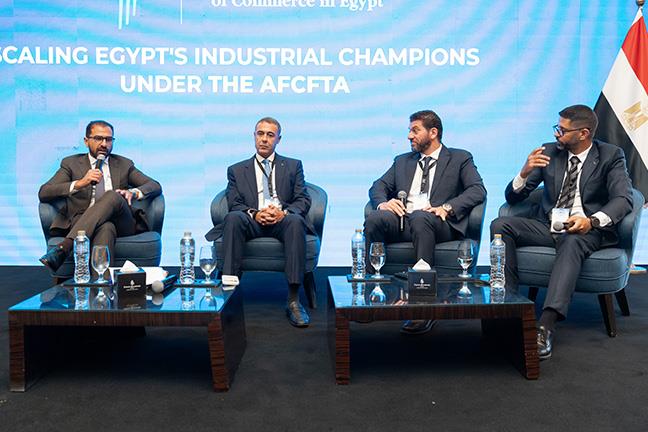
These opportunities were discussed during a panel on agro-food processing at the International Cooperation Conference, jointly organized by the American Chamber of Commerce in Egypt (AmCham) and the African Export-Import Bank (Afreximbank). The session was held under the theme “Scaling Egypt’s Pharmaceutical & Agro-Industrial Champions: Trade, Industrialisation, and Regional Expansion under AfCFTA.”
The panel brought together Ahmed Fahmy, Managing Director, Africa & Trade, and Egypt CEO at The Kraft Heinz Company; Eng. Ahmed Samy, CEO of Edita Food Industries’ Snacking and Bakery Business Unit; and Seif Eldin El Sadek, Founder and CEO of Agrocorp for Agriculture Investment.
Egypt’s Manufacturing Base Supports Export Growth
Kraft Heinz sees Africa as its next growth engine, with its Egyptian operations providing an established manufacturing base for regional expansion, Fahmy said.
“We believe in Africa, and recently our CEO used to say this is our next growth engine,” he said, explaining how the company views Egypt as a manufacturing base for serving other African markets.
Approximately 25% of the turnover generated by the company’s Egyptian operations comes from exports, according to Fahmy, reflecting the role of local production and agricultural partnerships in serving regional markets.
The company has also expanded its manufacturing capacity in Egypt. According to Daily News Egypt’s coverage of the September 2024 factory expansion, the project involved approximately $50 million in investment, adding seven production lines and targeting annual production capacity of 53,000 tons. At the time, 12% of factory production was exported, with a target of increasing that share to 20%. The reported production share and Fahmy’s 25% turnover figure refer to different measures and periods.
The company’s approach combines domestic manufacturing facilities with vertically integrated agricultural supply chains and partnerships with local growers. This enables it to manufacture products in Egypt for distribution across other markets.
At the factory expansion’s inauguration in September 2024, company representatives highlighted the facility’s regional role, with exports serving Arab, African and European markets, according to Ahram Online.
However, Fahmy stressed that companies need to understand the characteristics of individual African markets rather than treating the continent as a single destination.
“We cannot look at Africa as one country. Each country has its own specifics, and you look at the consumption occasion in each and every country,” he said.
Manufacturers must define consumer profiles to develop suitable product offerings and pricing strategies for individual markets, he added.
Fahmy also emphasized the importance of working backwards from the final consumer price to ensure competitiveness throughout the value chain.
“It’s not only about the manufacturing. It’s how you will work out the competitive price and work it backward through your own entire value chain,” he said, highlighting the importance of selecting the right partners, distribution margins and logistics providers.
Edita Invests in Morocco to Reach West Africa
Edita has adopted a different approach, investing in manufacturing capacity outside Egypt to address the logistical challenges of exporting packaged bakery products over long distances.
Samy said the relatively short shelf life of the company’s products was one of the factors behind its decision to establish a secondary manufacturing hub in Morocco. He put the investment at approximately $40 million.
“Products in general have very limited shelf life compared to some other products within the food segment. This creates a lot of limitation in terms of expanding on a regional level,” Samy said.
According to Edita’s 2024 annual report, the company first entered Morocco in 2018 through a joint venture with local distributor Dislog Group. The facility initially operated a production line for HOHOs cakes, followed by a second line for Twinkies in 2022. In 2024, the Moroccan operation introduced a third brand, TODO, as it expanded its presence in African markets.
The annual report lists the Moroccan operation’s paid-in capital at MAD140 million and its production capacity at 14,400 tons. It also records revenues of EGP476 million for the subsidiary in 2024, indicating that the manufacturing operation is established and generating revenue.
Morocco was selected based on its consumer demand, financial stability and infrastructure, which can support manufacturing and regional distribution, Samy said.
He also emphasized the importance of identifying unmet consumer needs before entering a new market.
“My only and most important advice to any Egyptian company that tries to expand its operation beyond borders is to always not look into the market and identify what’s working there and let’s try to meet the demand. It’s actually finding the gaps. What do they lack in this market? What are the consumer needs?” he said.
The company studies these gaps and adapts its products to local preferences, he added.
Samy said Morocco offered the right combination of market size, financial stability and infrastructure to support the company’s regional ambitions.
“It has the proximity and the infrastructure to cater to all the West African countries, so it made only sense to us to start our expansion model by being there,” he said.
The Moroccan operation complements Edita’s direct export business, which accounts for approximately 10% of its total turnover, according to Samy. The company is also considering establishing further subsidiaries and manufacturing facilities in other African and Middle Eastern markets.
African Agriculture Offers Opportunities for Processing
Beyond expanding finished-product exports, African agricultural resources could provide another route for Egyptian companies to grow their regional operations and strengthen their international competitiveness.
El Sadek highlighted opportunities to develop partnerships with African agricultural producers, particularly in fruit processing, drawing on Agrocorp’s experience in Egypt’s canned-food industry and its exports to the U.S.
Agrocorp processes around 30 varieties of vegetables and operates its own agricultural activities to secure raw materials, according to El Sadek. Approximately 50% of its raw-material supply comes from Egypt, while certain products and inputs that are not sufficiently available domestically are sourced from other markets.
“50% of our raw material is actually coming from Egypt. We are growers. We are growing our own vegetables,” El Sadek said, explaining the company’s approach to securing agricultural inputs and meeting the requirements of international markets.
The company also imports certain agricultural inputs, including pulses that are not sufficiently available in Egypt, from South America and Europe before processing and exporting products to North America and Europe.
El Sadek sees opportunities to extend this model through partnerships with producers in other African countries, particularly in fruit processing.
“I see Africa as a hub for fruits, a grower of fruits,” he said, pointing to the potential for African agricultural producers to supply the global canned-fruit industry.
He argued that stronger collaboration between Egyptian and African companies could help develop these supply chains and expand the continent’s role in international food processing.
El Sadek also highlighted changing sourcing strategies among international supermarket buyers as an opportunity for African manufacturers.
“Supermarket buyers will change suppliers every 10 or 20 years,” he said. “They are now changing suppliers. They are looking to diversify the countries where they’re buying from. They’re looking for new origins.”
However, he noted that African businesses remain more prominent in supplying raw materials than finished consumer products to international retailers.
“Most of the African business is B2B. It’s raw material going to factories in Europe or Asia or the U.S. But I have not seen any African producer or factory in retail,” he said.
He argued that establishing a stronger presence on international supermarket shelves would help African manufacturers capture more value from their agricultural production.
“Retail is the name of the game going forward,” El Sadek said, adding that African producers need stronger representation and a coordinated strategy to develop internationally competitive brands.
He also stressed that building an export-ready food industry requires a longer-term commitment rather than short-term initiatives.
“To be ready for export in the international market is not something you do over a year. It’s a plan that has to start today to materialize in five years, but you have to start somewhere,” he said.
Logistics and Financing Shape Expansion Plans
Reliable logistics and predictable delivery remain essential to export competitiveness, particularly for food products with limited shelf lives, Fahmy said.
“Logistics contributes not only to cost but also to the reliability of the channel that you’re using and predictability as well,” he said.
He explained that delays and uncertainty in delivery can affect product shelf life, increase inventory requirements and ultimately weaken a company’s competitiveness.
“Selecting the right channel and the right shipping partner is really important when it comes to logistics,” Fahmy said.
He also suggested that manufacturers explore shared warehousing and inventory arrangements with other companies in selected African markets to reduce distribution costs and improve access to more remote destinations.
Financing needs also vary according to the expansion model. Exporters working through distributors may rely on advance payments, while companies establishing subsidiaries or manufacturing facilities require longer-term investment financing.
Samy explained that Edita follows a cash-in-advance model in its agreements with distributors across African markets. However, he said manufacturers also need financing programmes that support distributors and enable them to expand their businesses.
For companies establishing manufacturing facilities or subsidiaries abroad, longer-term financing remains essential.
“Having more agile and more flexible terms that you can set in order to meet the business needs” is particularly important in an environment shaped by geopolitical developments and changing market conditions, Samy said.
Fahmy also highlighted the importance of financial support and risk mitigation for distributors operating in African markets.
He said payment defaults sometimes result from foreign-currency shortages rather than the financial strength or performance of the distributor.
“Having something that can help in covering these risks will enable the business to grow in the target countries,” he said, pointing to the potential role of risk guarantees and commercial insurance.
Samy also identified financing for regional subsidiaries, warehousing and distributors as areas where Afreximbank could support Egyptian companies expanding across the continent.
Matchmaking Could Unlock Regional Partnerships
El Sadek called for platforms that connect Egyptian manufacturers with African entrepreneurs interested in establishing food-processing operations, including canning, freezing and other agricultural processing facilities.
He argued that a lack of information about available agricultural resources, potential partners and investment opportunities remains a barrier to developing regional supply chains.
“A lot of the raw material that’s going out of Africa, if processed and labelled and going out of Africa as a finished good, will probably double the price, creating more jobs and increasing the GDP of the country,” he said.
He encouraged the development of business matchmaking platforms that could connect manufacturers with entrepreneurs interested in investing in food-processing facilities across African markets.
“Who in Africa wants to build the canning factory? I don’t know. Who in Africa is interested in the frozen factory? I don’t know,” he said, emphasizing the need for greater information exchange between potential investors and local businesses.
Such partnerships could combine Egyptian companies’ manufacturing expertise, technology and commercial networks with agricultural resources available in other African markets, helping local businesses retain more value from agricultural production through processing and packaging.
Afreximbank also highlighted the Intra-African Trade Fair (IATF) as a platform for connecting manufacturers, investors and buyers across the continent. According to the fair’s official website, the next edition is scheduled to take place in Lagos, Nigeria, from November 5 to 11, 2027.
The strategies discussed at the conference point to several routes for expanding Egypt’s food industry across Africa, from exporting locally manufactured products to investing in regional production and developing cross-border agricultural supply chains. Their success will depend on companies’ ability to adapt to local demand, manage distribution costs and build partnerships that support long-term growth.