


With Africa’s total merchandise imports reaching $781.5 billion in 2025, Egyptian manufacturers are pursuing opportunities to expand regional exports as AfCFTA implementation and development finance support stronger industrial and commercial links.
Egyptian manufacturers are looking to expand their presence across Africa as the African Continental Free Trade Area (AfCFTA) advances, targeting opportunities in pharmaceuticals, agro-industries, building materials and engineering products.
Africa’s total merchandise imports increased by approximately 6% to $781.5 billion in 2025, up from $737.3 billion in 2024, according to Afreximbank’s African Trade Report 2026, which draws on the International Monetary Fund’s (IMF) Direction of Trade Statistics 2026. The figures cover imports from trading partners worldwide, highlighting the scale of demand that African manufacturers could increasingly serve.
Egypt already maintains significant commercial ties with the continent. Trade between Egypt and African Union member states reached approximately $9.6 billion in 2025, including $7.6 billion in exports and around $2 billion in imports, according to data from the Central Agency for Public Mobilization and Statistics (CAPMAS).
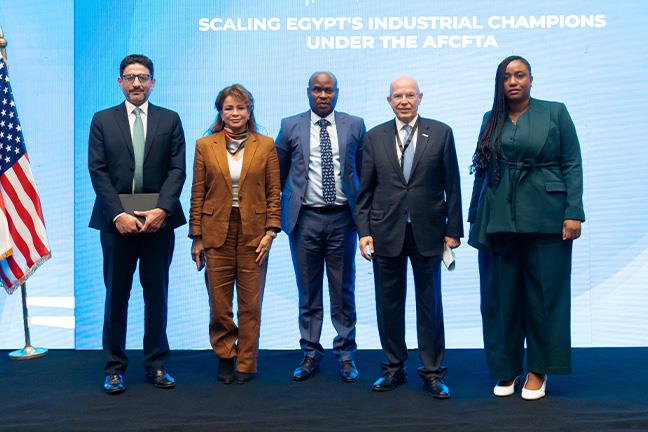
The opportunities for expanding these flows were discussed during an executive dialogue at the International Cooperation Conference, jointly organized by the American Chamber of Commerce in Egypt (AmCham) and the African Export-Import Bank (Afreximbank). Business leaders and development finance institutions examined how manufacturers could capitalize on regional trade arrangements, financing facilities and stronger industrial partnerships.
Mohamed Kassem, Chairman of the Egyptian Exporters Association (ExpoLink), said Egyptian exports already include food products, refined sugar, wheat flour, pasta, cement, clinker, marble, iron products, chemicals and agricultural commodities.
While North African markets, particularly Libya, Algeria, Morocco, Sudan and Tunisia, remain important destinations, he identified opportunities to expand into East and West Africa, where Egyptian manufacturers could develop new commercial relationships and diversify export destinations.
AfCFTA Opens Market Access
Progress in implementing the AfCFTA is creating a framework for Egyptian companies to access additional African markets under preferential trade arrangements.
Godfrey Walakira, Senior Trade Expert at the AfCFTA Secretariat, said 26 of the 50 countries that had ratified the agreement had expressed interest in trading under its framework. The figure reflects countries that have expressed interest in participating rather than the number already conducting preferential trade.
As of September 2026, 50 of the agreement’s 54 signatories had deposited their instruments of ratification, according to the trade law centre tralac.
The agreement’s rules of origin, which establish the criteria for determining whether products qualify for preferential treatment, have also advanced. In February 2026, the African Union Assembly adopted the outstanding rules covering the automotive, clothing and textiles sectors, bringing the rules of origin negotiations to completion.
Pharmaceuticals, classified under Chapter 30 of the Harmonized System, are among the sectors covered by agreed rules of origin, providing a framework for regional trade in medicines.
Walakira identified pharmaceuticals and fertilizers as sectors with considerable potential, given Africa’s dependence on imported medicines and agricultural inputs.
He noted that pharmaceutical manufacturing across the continent remains heavily reliant on imported active ingredients, while domestic production is concentrated largely in generic medicines. Egypt’s established pharmaceutical industry could therefore support regional supply chains through the production of active pharmaceutical ingredients and finished medicines.
He also highlighted opportunities to expand fertilizer manufacturing within Africa to reduce dependence on imports and strengthen agricultural input supplies.
Beyond tariffs, the AfCFTA Secretariat is working on mechanisms to address non-tariff barriers, allowing exporters to report trade obstacles and facilitating communication between countries to resolve them. Mutual recognition and conformity assessment arrangements could also reduce duplication in product testing and compliance procedures.
Development Finance Supports Exporters
Access to financing, market intelligence and technical expertise will be important in helping Egyptian companies translate preferential market access into actual exports.
Ree El Saady, Deputy Head of Egypt at the European Bank for Reconstruction and Development (EBRD), said the bank’s expansion into six additional African countries, with Nairobi serving as its regional hub, could support stronger commercial connections between Egypt and other African markets.
The six countries are Benin, Côte d’Ivoire, Ghana, Kenya, Nigeria and Senegal.
She identified mid-sized Egyptian businesses as an important source of potential export growth, noting that companies already operating in international markets could expand further into Africa with support in assessing market demand, developing export strategies and accessing financing.
The EBRD has partnered with ExpoLink to develop consultants who can help businesses assess product competitiveness and identify suitable export destinations. It has also worked with the Export Development Bank of Egypt to establish an Export Club supporting mid-sized companies through technical assistance, expertise and financing.
El Saady cited the example of a company that developed into a major exporter of corn starch and glucose to African markets through a specialized export platform that identifies demand, sources products from Egyptian manufacturers and manages the export process.
She also highlighted the potential for cooperation between the EBRD and Afreximbank, with the former supporting exporters through trade finance and the latter helping finance African buyers through risk-sharing and insurance solutions.
IFC Sees Potential In Regional Supply Chains
Saad Sabra, Egypt Country Head at the International Finance Corporation (IFC), highlighted the importance of development finance in supporting infrastructure, utilities and other sectors connected to regional trade.
IFC’s fiscal 2026 reporting recorded $5.593 billion in long-term investment commitments from its own account across Africa, alongside $8.556 billion in long-term private capital mobilized in the region. The figures cover the fiscal year ended June 30, 2026, distinguishing the institution’s own financing commitments from private capital mobilized alongside it.
Sabra argued that Egypt could strengthen its position by developing more integrated two-way trade relationships, sourcing raw materials and intermediate inputs from African countries and incorporating them into domestic manufacturing before exporting higher-value products.
Such an approach could strengthen regional supply chains while increasing the value generated by Egyptian manufacturers.
He identified predictable demand, competitive businesses, clear regulatory frameworks and effective risk-sharing mechanisms as important conditions for attracting export-oriented investment.
Sabra also highlighted the role of blended finance, concessional funding and de-risking instruments in mobilizing private capital and encouraging greater participation from local banks and investors.
Banks Consider Export Pilot Programme
The discussion concluded with a proposal from El Saady for the EBRD, IFC and Afreximbank to collaborate on a pilot initiative involving one to three mid-sized or large Egyptian companies in pharmaceuticals or agro-industries.
The proposed programme would combine export-readiness support, banking facilities, buyer-side financing and risk-sharing mechanisms, alongside assistance in addressing logistical barriers.
Kassem also highlighted ExpoLink’s Export Academy, which provides training to small and medium-sized enterprises in Arabic, English and French, and its Destination Africa exhibition, which connects African manufacturers and exporters with international buyers.
He called for greater participation from African exporters and support from Afreximbank to strengthen commercial connections and promote African products in international markets.
Sabra said the AfCFTA’s success should ultimately be measured by the commercial activity it generates, including repeat orders, productive investments and measurable trade outcomes.
For Egypt, capturing a larger share of African demand will depend not only on preferential market access, but also on manufacturers’ ability to compete on price, meet regional standards, secure financing and establish reliable distribution networks across the continent.