


Artificial intelligence (AI) is moving from an emerging technology to an increasingly embedded part of the workplace, forcing companies to rethink how they organize work, develop talent and prepare their next generation of leaders.
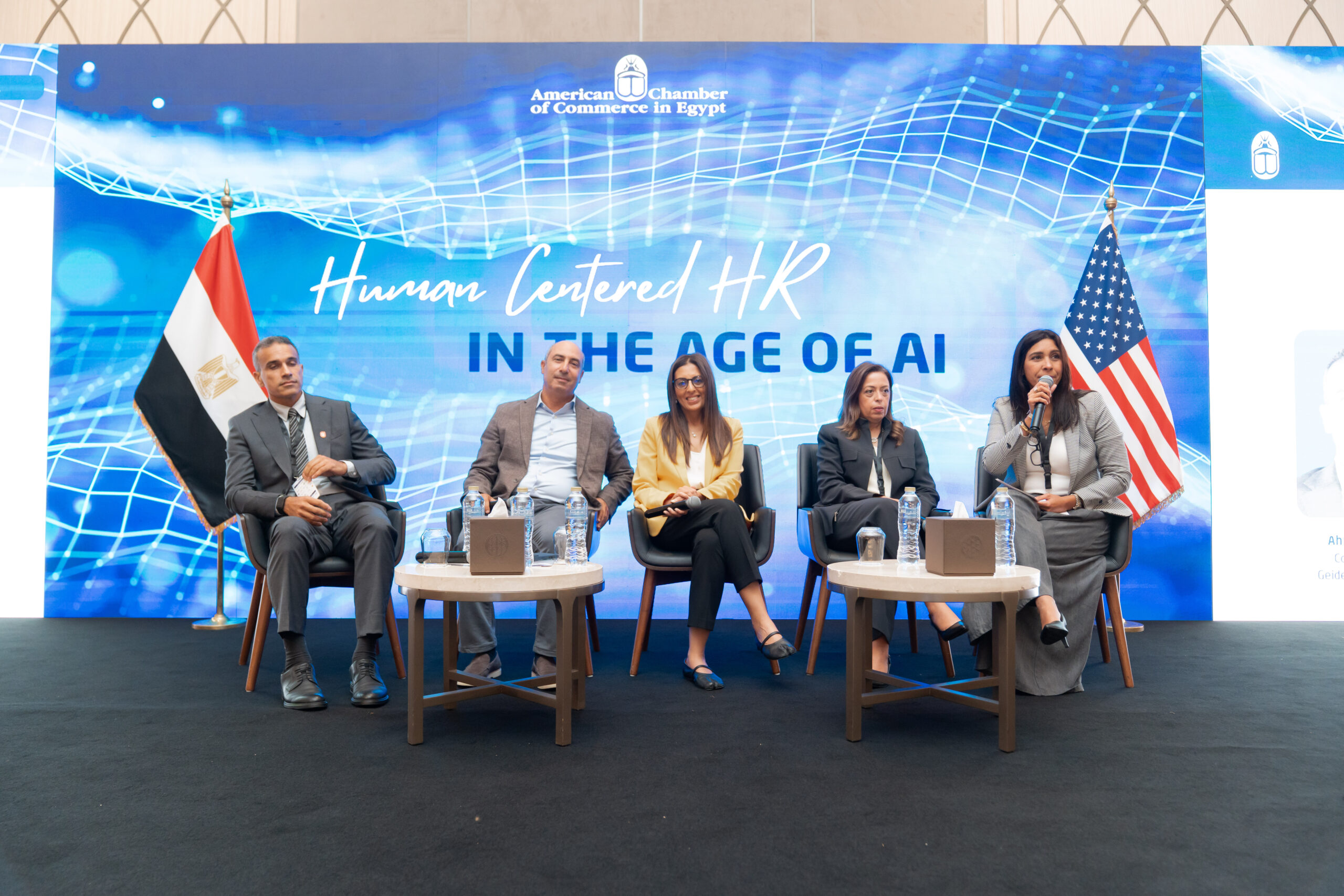
At the 12th Annual AmCham HR Day, Session I, “Leading the AI Revolution: Talent, Innovation & the New World of Work,” brought together business and technology leaders to examine how organizations can move beyond AI experimentation and turn the technology into measurable business value.
The panel featured Ahmed Nader, Country CEO, Geidea Technology; Hossam Seifeldin, AmCham Co-Chair, Digital Transformation Committee, and CEO, Capgemini; Marwa Abbas, AmCham Board Member and CEO, Raya Information Technology; and Dr. Samhaa El-Beltagy, Chief AI Officer, Nawy. The discussion was moderated by Rowaa El Dajani, HR Country Director, Valeo Egypt.
Opening the session, El Dajani captured the shift underway in a single line: “AI will not replace you. But actually, the thought will replace you with someone who uses AI.” Her message was that AI adoption is no longer a distant consideration for organizations. It is already changing how work gets done and what skills employees need.
From automation to augmentation
AI’s most immediate impact may be on repetitive work, but the panel argued that its larger opportunity lies in augmenting people rather than simply replacing them.
For Marwa Abbas, AI can automate routine tasks while giving organizations access to new streams of data that can improve decision-making.
“You need to look at the augmentation, the data points around it and be able to read the overall landscape.”
That shift will require companies to rethink roles and identify the skills employees will need as technology takes over parts of existing jobs.
“The tools are there to help you, but it will never eliminate you. It may shift some of the roles,” Abbas said.
The distinction is important for HR departments. Rather than viewing AI primarily through the lens of headcount reduction, companies will need to consider how employees can move into higher-value work as routine processes become increasingly automated.
AI will reshape tasks, not entire professions
Seifeldin placed the current transformation within a longer history of technological change, describing the next phase of work as a progression toward human-machine collaboration, or what he termed “human plus AI.”
He argued that AI is more likely to replace parts of jobs than entire professions. In operational roles, for example, technology could take over a large share of routine activities while people remain responsible for oversight, intervention and more complex decisions.
“AI will completely take the human part of this when it comes to the operational side, there will still be some humans that we need to intercept or support,” Seifeldin said.
That does not mean traditional technical roles will disappear. Companies will continue to need engineers, AI specialists and data scientists, particularly as they integrate new technologies with legacy systems.
The more immediate challenge is determining how employees can move up the value chain as routine work becomes automated.
Start with strategy, not tools
The speed at which new AI tools are entering the workplace can create another risk: adoption without a clear business purpose.
El-Beltagy argued that organizations should establish an AI strategy before rolling out tools across the business.
“Everyone knows that they want to use AI. But they don’t know how or why,” she said, emphasizing that companies should first identify the problems they want AI to solve.
For El-Beltagy, the starting point is straightforward: “The first question you need to answer is why, and how, and where.”
That process also requires leadership teams to develop a common understanding of what AI can and cannot do. “I have to educate an entire executive team on what AI is because a lot of people use the term loosely,” she said.
For HR leaders in particular, this means moving beyond AI as an employee productivity tool and considering how it can support recruitment, learning, workforce planning and other core functions.
Egypt’s talent advantage
The conversation also turned to Egypt’s technology talent and how the country can capitalize on a growing global demand for digital skills.
Seifeldin described Egypt’s talent base as a major competitive advantage, arguing that the country should continue developing and exporting that expertise while strengthening the local ecosystem.
“Egypt has the biggest asset, and we need to continue to export this and to continue to do this,” he said.
He also pointed to the enthusiasm of younger workers, particularly Gen Z, and their willingness to learn new technologies and apply them quickly.
“The young talent and the Gen Zs and everyone, they’re very eager and excited about the future, about their agility, their ability to showcase what they learned and implement it and bring it to life.”
For employers, that enthusiasm creates an opportunity, but also a responsibility: organizations need to give employees access to continuous learning and meaningful opportunities to apply new skills.
AI could disrupt the leadership pipeline
One of the less obvious consequences of AI could be its impact on how companies develop future leaders.
Nader argued that traditional organizational structures rely on younger employees progressing through increasingly complex roles, building the experience that eventually prepares them for leadership.
As AI removes some of the repetitive work that traditionally formed the foundation of those early-career roles, companies could face a new challenge: how to develop the experience needed to produce future leaders.
“The organization structure will change as we know it, which will put lots of pressure on how you generate the next leaders and how you generate experience,” Nader said.
The issue remains unresolved. “I don’t have an answer. It’s a challenge. It’s a big challenge,” he added.
For HR leaders, this raises a critical question: if AI performs some of the work through which employees traditionally learned how organizations operate, companies will need to deliberately create new pathways for employees to gain judgment, context and leadership experience.
Turning time saved into innovation
Automation can free employees from repetitive work, but saving time only creates value if organizations know how to use it.
El-Beltagy argued that companies need to deliberately create room for employees to experiment, learn and develop new ideas.
“With the innovation tools across HR, especially the AI tools… we have to create time,” she said.
That could mean creating safe environments where employees can test new technologies, make mistakes and explore practical applications without the pressure of immediate results.
The goal is to ensure that productivity gains from AI translate into innovation rather than simply more capacity for routine work.
Giving HR the power to build
El-Beltagy offered a practical example of how AI and accessible technology can change the role of HR professionals.
She described a senior HR professional who had traditionally depended on technology teams to develop digital solutions for workplace challenges. After taking a short coding course, the HR professional was able to build a web application herself.
“She took a very, very, very short course on coding. And she, this is a person in HR, she coded on a web app that does what she wants.”
The broader lesson, El-Beltagy argued, is that HR professionals do not necessarily need to become technology specialists. They can use increasingly accessible tools to build solutions for problems they understand firsthand.
“They are the ones who know what the problems are. And they can actually build solutions.”
That shift could give HR teams greater autonomy while bringing technology development closer to the business problems it is meant to solve.
The discussion at the 12th Annual AmCham HR Day made clear that AI’s impact on the workplace will extend well beyond automation. It will reshape roles, skills, career paths and the way organizations develop talent.
For HR leaders, the challenge is no longer simply deciding whether to adopt AI. It is determining where technology can create genuine value, how employees can adapt to changing roles and how companies can preserve the human experience and judgment that technology cannot easily replicate.
As AI takes on more routine work, the organizations that benefit most may be those that use the resulting capacity to develop people, strengthen leadership pipelines and create more room for innovation.