

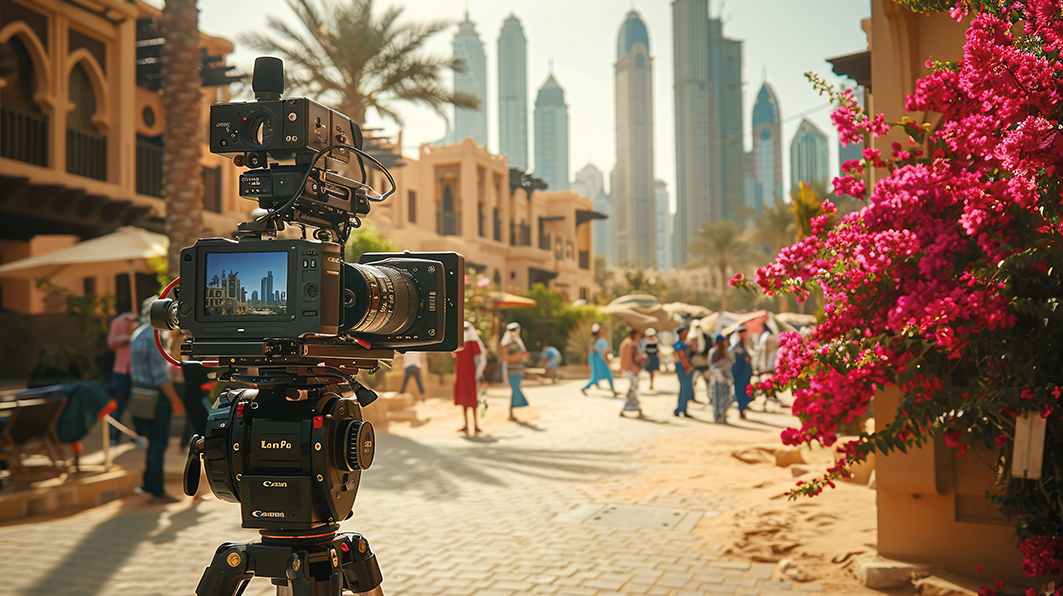

Worldwide, the movie industry faces a nuanced crisis. While “the box office is on pace for its best year since the pandemic,” Reuters reported in August, “fewer people are going to the movies.” That is because of “higher ticket prices, premium-format screenings and a handful of blockbuster releases, rather than a broad return of moviegoers.”
By contrast, MENA’s movie business is booming. “For the better part of the 20th century, the region scarcely registered in discussions about the global film industry,” Intaj Co, a MENA-based film and entertainment networking hub, said in August. “Today it’s a headline. Behind the numbers … lies the narrative of structural change.”
The region “is now among the fastest-expanding entertainment markets worldwide,” Intaj Co. noted. It added that, with a slowing global box office, it could become the next frontier for international film producers and investors.
Egypt and Saudi Arabia’s film industries are at the forefront. The former has the legacy, having produced the region’s first movie in 1896. The latter aims to become the region’s movie-making hub.

Arab movie boom
In March, Wired Magazine reported, “Arab cinema’s filmmakers are increasingly moving beyond the long-standing dependence on Western festivals, studios and distributors. A new generation of creators [is] beginning to rebuild the industry’s infrastructure – from financing and production to grassroots distribution networks.”
Saudi director Haifaa Al Mansour told Wired in August, “What we are witnessing now, with the boom of governmental and public support for film, is the result of a new era of structural change that finally aligns with the creative energy that was always present.”
From 2023 through 2025, Egypt produced 118 feature films (42 in 2023, 36 in 2024 and 40 in 2025), according to the state-owned Al Ahram newspaper. As of 2025, the country “accounted for 75% of total MENA film production over the last century,” according to WifiTalents, an independent market research company
According to multiple GCC news sources, Saudi Arabia led movie production with around 100 feature films from 2023-2025. The U.A.E. ranked second with 53 movies during that period, while the other Gulf countries combined to produce 49 films.
In North Africa, Morocco produces 25-30 movies annually and Tunisia about 15, according to WifiTalents.
It likened Egypt’s film industry to “a long-running box office blockbuster.” Meanwhile, the rest of the region is like “a dynamic ensemble drama starring Morocco’s consistent output, Jordan’s booming foreign appeal, the U.A.E.’s glossy infrastructure and the resilience of filmmakers from Palestine to Sudan, all proof of a diverse and determined cinema.”
Streaming platforms are another powerful market for film. Omdia, a movie industry think tank, estimates MENA had 27 million streaming subscribers in 2025. The sector is also becoming more self-sustaining, with eight streaming platforms wholly Arab-owned, with five producing original content. “The MENA streaming wars are heating up, fueled by … rampant password-sharing empires and a voracious appetite for Arabic content,” said WifiTalents.
Foreign movie producers have long eyed the region. “Over 80 international productions were filmed in Abu Dhabi,” noted WifiTalents. Meanwhile, “15% of GCC films are co-productions with European entities … more than half of North African films are co-produced with France [and] Jordan has hosted more than 10 major Hollywood blockbusters including ‘Dune,’” a 2021 movie that grossed $411 million against a $165 million production budget.
Flagship player
MENA’s movie-making potential is sparking interest from Saudi filmmakers, producers and government. In 2021, the government created the Cultural Development Fund (CDF) “to nurture Saudi Arabia’s vibrant cultural scene and empower all who belong to it, [including] enterprises, entrepreneurs and creators. Its mission is to ensure the sector’s steady growth and maximize its positive impact on the economy and society,” the CDF blurb said.
As of 2026, it has “AI incentives for cultural projects [that] advance the adoption of technology and artificial intelligence within the cultural sector, aiming to enable enterprises to leverage advanced technologies and drive innovation across their services and products,” the blurb said. At the top of the list are film and visual arts.
The Saudi government also increased its subsidy to domestic filmmakers from 40% of the production budget in 2022 to 60% in 2026. The Saudi Film Commission (SFC), which handles the disbursement process, said in a press release published during this year’s Cannes Film Festival that the process introduces a set of practical enablers, such as improved and accelerated disbursement, enhanced cash flow efficiency for production companies and a more supportive operating environment for project delivery in line with production timelines.
“We want to be not just the most generous incentive, but also the most agile one,” Nasser Al-Qahtani, SFC’s CEO, told Variety,
Other factors favoring the Saudi film industry include “rising cinema infrastructure and investments … cultural shifts and increased demand for entertainment, [and] emergence of local film productions and international collaborations,” said Global News Wire.
In July 2025, MBC Group, a Saudi Arabian entertainment empire, announced a partnership with Netflix that merges both services’ subscriptions across the region. “It means MBCNOW, [MBC’s] content aggregation platform, will provide seamless access to the full Netflix catalog alongside Shahid, a leading Arabic streaming platform, as well as MBC’s award-winning linear TV channels,” Arab News reported.
Research and Markets, a research firm, forecast in May 2025, the Saudi movie industry would grow from $584 million to over $950 million by 2030.
Changing of the guard?
Saudi Arabia’s movie-making ambitions are already encroaching on Egypt’s nearly 130-year-old movie industry. In 2024, Saudi Arabia’s General Entertainment Authority launched the Big Time Film Investment Fund in cooperation with Egypt’s United Media Group, pledging $50 million for Egyptian movies.
Saudi Arabia’s Public Investment Fund, the Kingdom’s sovereign wealth fund, also is betting big on Egypt’s movie industry. This year, it produced the region’s most expensive film, “7 Dogs” ($70 million for production, marketing and distribution), starring two A-list actors with the story partially set in Egypt and in the Egyptian dialect.
This movie dwarfs Egypt’s biggest production to date, “Kira & El Gin” (2022), which cost $10 million to make, according to IMDb, a global movie database.
The main factor favoring Saudi movie makers is their currency is pegged to the dollar, while the Egyptian pound has gone from EGP 9 to the dollar in 2016 to over EGP 50 at press time.
Devaluation increases local production costs, with “the high cost of film production due to the reliance on imported equipment, thereby increasing rental costs and filming expenses,” noted a 2024 research paper from Egypt’s Modern Sciences and Arts University. This ultimately hurts local box office revenue, as ticket prices need to remain affordable to attract viewers.
Safe, for now
For now, the rise of the Saudi movie-production machine has had limited impact on Egypt’s film industry. According to WifiTalents, Egypt’s huge pool of talent remains intact. But it warned that “leakage” is happening among the biggest stars, especially those who can carry big-budget movies.
Furthermore, Saudi filmmakers are seeking more know-how. “If we bring in external talent, we mandate that two or three Saudi professionals train directly under them,” Aymen Khoja, founder of Saudi production studio AK Pictures, told EnterpriseAM’s Saudi edition. “It allows local talent to absorb the know-how and ultimately spearhead their own projects.”
On the flip side, “Egypt currently lacks true market competition,” Egyptian film critic Gamal Abdel-Kader told the EnterpriseAM Saudi Edition.
However, Saudi Arabia’s spending on movies starring Egyptian actors, dialect and backend talent has a silver lining. Abdel Kader explained, “We are spending at this massive production scale [as in ‘7 Dogs’] and bringing all these big names together to distribute the film globally – not because it’s a cinematic masterpiece – but to tell the world, ‘Look, we have … top-tier … studios [and] logistics capabilities.’”