


Egypt is increasingly positioning education reform as a central pillar of its long-term economic strategy, as government officials, business leaders, and education experts call for deeper alignment between education outcomes, labor market needs, and future competitiveness.
The push forms part of a broader reform wave that has accelerated in recent years, as Egypt seeks to modernize its education system to better prepare students for an economy increasingly shaped by technology, digital transformation, and evolving workforce demands. Authorities have introduced a new curriculum framework designed to move beyond rote memorization toward critical thinking, creativity, problem solving, and digital literacy, reflecting a wider effort to equip younger generations with skills viewed as essential for the future economy.
At the same time, the government has expanded applied technology schools in partnership with private sector companies and industrial groups, creating more direct links between education and employment opportunities. These schools are intended to provide students with practical, industry-relevant training across sectors ranging from manufacturing and engineering to information technology and renewable energy, while also helping address longstanding gaps between graduate qualifications and labor market needs.
Efforts to modernize technical and vocational education pathways have also gained momentum, with policymakers increasingly emphasizing that technical education should serve as a driver of productivity, innovation, and economic competitiveness rather than being viewed as a secondary alternative to traditional academic routes. Officials and business leaders alike have argued that Egypt’s future growth will depend heavily on its ability to develop a workforce equipped with adaptable, market-relevant skills capable of supporting investment, industrial expansion, entrepreneurship, and technological adoption.
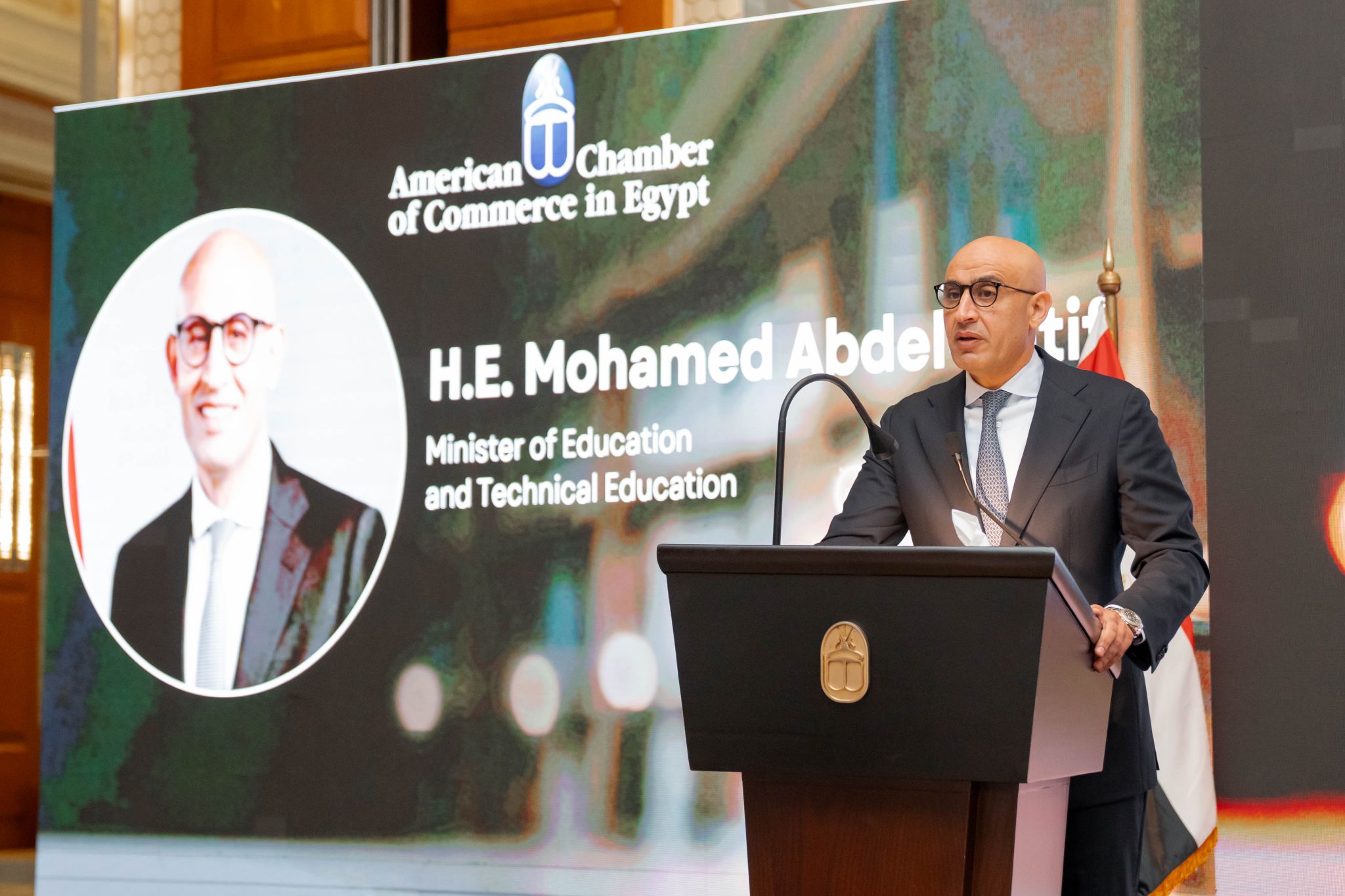
That message was central to discussions at the American Chamber of Commerce in Egypt Education Conference on May 10, where speakers argued that Egypt’s economic trajectory will depend increasingly on human capital rather than traditional growth drivers.
Speaking at the conference, Mohamed Abdel Latif, Egypt’s Minister of Education and Technical Education, outlined what he described as a structural transformation aimed at aligning education with labor market needs, technological change, and future economic growth. Joining him at the conference were Hossam Badrawi, Chairman of the Badrawi Foundation for Education and Development, and Omar Mehanna, President of AmCham Egypt.
Abdel Latif framed human capital as the country’s most important economic asset in an era defined by artificial intelligence and global competition for skills. He stressed that the growing number of young Egyptians entering the labor market each year makes employability a defining economic challenge, arguing that education investment should be viewed as a growth strategy rather than a social cost.
Mehanna echoed the broader shift, noting that education has moved firmly into the realm of economic policy and competitiveness.
“Education today is no longer simply a social priority. It has become a strategic economic imperative,” Abdel Latif said.
A central theme throughout the conference was the government’s effort to move from credential-based education to competency-based learning, with a stronger emphasis on applied skills, workplace readiness, and innovation.
Abdel Latif said the system is being redesigned to better reflect real labor market needs, including stronger links between curricula and industry, expanded workplace learning, and broader adoption of applied technology schools in partnership with industry stakeholders.
He also highlighted ongoing efforts to strengthen sector skills councils to ensure education content reflects actual demands across factories, offices, laboratories, and digital industries.
Technical and vocational education was presented as a core pillar of economic competitiveness rather than a secondary pathway. Abdel Latif emphasized that future economic success will depend less on the number of graduates and more on the quality and relevance of skills produced.
“The economies that succeed in the next decade will not be those that simply produce degrees, they will be those that produce skills,” he said.
Artificial intelligence and digital transformation were also key topics, with speakers noting their growing impact on how education systems must evolve. Abdel Latif said digital literacy, AI fundamentals, and entrepreneurial thinking are being integrated into learning pathways to ensure students can actively shape technology rather than passively consume it.
He also cautioned that technology alone cannot deliver reform, stressing the role of institutions, teachers, and governance in driving meaningful change.
“The private sector is not an observer in this transformation, you are co-architects,” Abdel Latif noted.
He added that employers, investors, and industry leaders must play a direct role in shaping curricula and defining the competencies required in the modern economy.
Meanwhile, Badrawi emphasized the social dimension of education reform, warning that inequality of opportunity remains one of the most serious long-term risks to development. He underscored the importance of continuity in reform implementation, stressing that progress must not be reversed with political cycles.
“The most dangerous form of poverty is not the poverty of money, but the poverty of opportunity,” he said.
He also argued that public education must remain the foundation of the system, with the private sector playing a complementary rather than substitutive role.
“A strong public education system is not the enemy of the free market. It is the foundation on which a productive market economy is built,” he said.
The conference ultimately reflected a broader policy consensus: Egypt’s long-term competitiveness will depend on its ability to build a modern, inclusive, and skills-driven education system capable of producing a workforce aligned with global economic and technological change.