

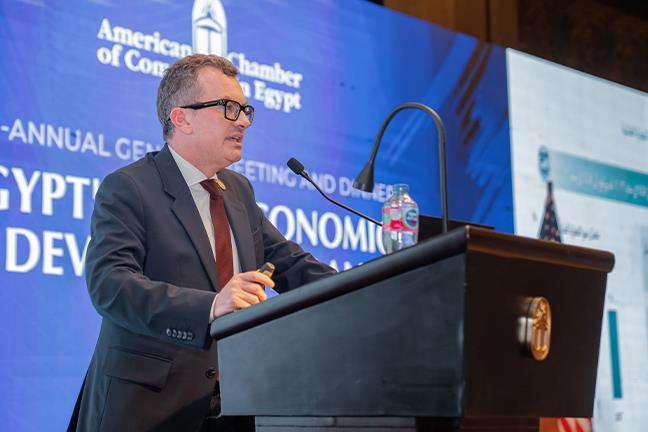

Egypt is targeting a 59% private sector share of total investments next fiscal year, equivalent to approximately EGP2.2 trillion (approximately $41.7 billion) out of a planned EGP3.7 trillion (approximately $70.2 billion) in total investments, Minister of Planning and Economic Development Dr. Ahmed Rostom said this during the American Chamber of Commerce in Egypt’s (AmCham Egypt) pre-annual general meeting dinner in Cairo on 5 May.
Speaking before business leaders and policymakers, Rostom outlined the government’s economic outlook, reform priorities, and investment strategy, emphasizing that stronger private sector participation remains central to Egypt’s long-term growth plans.
“Our investment plan targets total investments of 3.7 trillion Egyptian pounds,” he said. “Out of the 3.7 trillion Egyptian pounds, we’re looking for the private sector to invest around 2.2 trillion pounds next year. This is almost 59 percent of the total investments for next year.”
By 2030, private sector investments are expected to account for approximately 64% of total investments nationwide, he added.
“Without the private sector we cannot achieve our ambitious growth targets,” Rostom said. “Without the private sector we would not be able to weather what we’re seeing.”
Egypt positions for growth despite global uncertainty
During his keynote remarks, Rostom said Egypt is pursuing a more resilient and private sector-driven economic model aimed at sustaining growth, expanding investments, and strengthening implementation mechanisms despite ongoing global and regional uncertainty.
He described the current global environment as fundamentally different from previous crises because of its direct impact on global energy markets, supply chains, and inflation.
“The type of crisis that we’re seeing is hitting the core and center of energy markets that is basically energizing the entire globe,” he said.
Rostom explained that rising energy prices are affecting transportation, freight, agriculture, manufacturing, and business operations globally, creating significant forecasting uncertainty.
“The nature and the randomness of this crisis is basically causing trouble on forecasting,” he said.
Citing IMF projections, Rostom noted that global growth is expected to slow from 3.4% to 3.1%, while Middle East and North Africa economies are projected to decline from 3.2% to 1.1%.
Despite those pressures, Rostom said Egypt’s economy has demonstrated resilience after navigating “five shocks in the past six years.”
“This economy has been resilient. It withstood five consecutive shocks in six years,” he said.
Government highlights proactive economic measures
Rostom said the government moved early to contain the economic impact of regional instability through fiscal and administrative measures focused on preserving stability.
“What happened is we proactively acted,” he said.
According to Rostom, Egypt began implementing precautionary measures on March 10, focusing on rationalizing government spending, preserving fiscal discipline, maintaining exchange rate flexibility, and reassessing fuel subsidies.
The government also introduced work-from-home measures in some public institutions, reduced certain universal subsidy expenditures, and accelerated digital integration between the Ministries of Planning and Finance to strengthen spending oversight and monitoring.
“We proactively acted because when we saw the level of uncertainty that was about to hit the financial markets and the commodity markets, if we do not take proactive steps and actions to preserve where we stand on fiscal discipline, then that was what has really slipped us on a slippery slope,” Rostom said.
Growth, employment, and inflation indicators improve
Rostom said Egypt expects growth between 4.8% and 5.2% during the current fiscal year, with projections ranging between 5.4% and 5.9% next fiscal year if conditions stabilize.
The country’s longer-term target remains approximately 6.8% growth by 2030 under Egypt Vision 2030.
Manufacturing, tourism, construction, trade, and agriculture remain the economy’s primary growth drivers, according to Rostom.
He also highlighted recent labor market and inflation indicators, noting that the economy generated nearly two million jobs while unemployment declined from 6.6% to 6.3%.
Youth unemployment fell from 14.9% to 13%, while unemployment among educated youth declined from nearly 19% to 17%, according to CAPMAS figures cited during the event.
“The economy was able to generate more jobs and that the dynamism in the growth numbers is translating into job creation,” Rostom said.
On inflation, Rostom said annual inflation came in at 13.5%, below the government’s earlier projection of 14%.
“The numbers proved me wrong which I’m so happy that the numbers proved me wrong and we’re lucky to record 13.5 percent,” he said.
Renewable energy investments to rise 261%
Rostom said public investment in healthcare will increase by 25% next fiscal year, while education spending is expected to rise broadly in line with inflation at around 11.5% to 12%.
The government is also increasing investments in research and development, drinking water infrastructure, social housing, and electricity grid upgrades.
Public investment in renewable energy is expected to rise by 261%, alongside efforts to encourage greater private sector participation in clean energy projects.
“We are almost tripling our investments in renewable energy,” Rostom said.
He added that projects failing to meet implementation benchmarks could face funding reallocations toward faster-performing projects as part of broader efforts to improve accountability and spending efficiency.
Business community calls for faster reform implementation
The event opened with remarks from AmCham Egypt Chairman Omar Mehanna, who highlighted Egypt’s recent engagement with international institutions and policymakers during the IMF and World Bank Spring Meetings in Washington and AmCham Egypt’s annual Door Knock Mission to the United States.
“Our message was clear and consistent. Egypt is stable, open for business and investment, and ready to receive tourists despite the turbulence in the region,” Mehanna said.
He added that Egypt’s private sector is prepared to play a larger role in driving investment, growth, and job creation, while encouraging the government to continue reforms “at an accelerated pace, including divestiture and privatization to strengthen the investment climate and ensure a true level playing field.”
Mehanna also announced the launch of “Youth AmCham Egypt Inc.” in Washington, an initiative designed to connect Egyptian students in the United States with the business community through mentorship, professional exposure, and structured career pathways, with plans to launch a parallel initiative in Egypt.
The event also featured a discussion moderated by Abla Abdel Latif, Chair of the Presidential Advisory Council for Economic Development and Executive Director and Director of Research at the Egyptian Center for Economic Studies (ECES).
Abdel Latif raised questions regarding implementation mechanisms, institutional coordination, decentralization, labor market quality, and whether the business environment is fully prepared to support the government’s private sector investment targets.
In response, Rostom reiterated the government’s commitment to creating more space for private investment through streamlined licensing procedures, labor market reforms, technical education partnerships, renewable energy expansion, and decentralized monitoring systems.
“We are committed to ensuring that the private sector has the room and the space to achieve a 59% growth for investment share for next year,” he said.
Toward the close of the discussion, the event reflected growing alignment between policymakers and the business community around the need to accelerate reforms, expand private sector participation, and strengthen implementation capacity to support Egypt’s long-term economic transformation.