

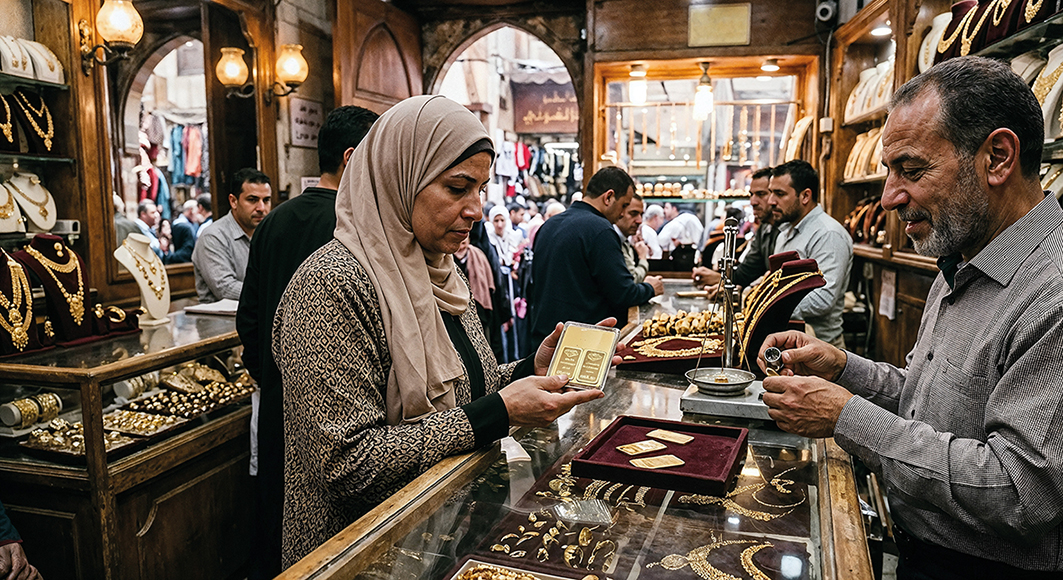

As a store of value during volatile times, few assets can match gold. Its advantage stems from outright ownership. “It is not a claim against a third party, as is the case with shares or bonds,” according to a note from the Austrian National Bank. “Physical gold … has no counterparty risk. Physical gold carries no entrepreneurial risk and can never become worthless.”
Additionally, its value is stable because “the existing quantity of gold cannot be expanded in an inflationary manner over a short period,” the note said.
However, in the past two years, gold prices have soared, rising 144% from January 2024 to January 2026. The U.S. S&P 500, Dow Jones Industrial Average, and Nasdaq Composite increased nearly 48% over the same period. In January, Heath Stewart, economics editor at The Guardian, said buyers see gold as “the ultimate safe haven asset.”
These increases were driven by central banks going on a gold-buying spree since the start of 2025 to diversify their international reserve portfolios. “Central bank gold buying has fundamentally transformed the approach to gold reserves worldwide,” said Discovery Alert, a research platform, in January. “That represents the most aggressive institutional buying behavior in modern monetary history.”
That growing demand for gold could be an opportunity for Egypt to attract exploration and mining investments, especially after it announced a near 60% increase in gold reserves in 2021.
Raising defenses
While there are many hedging strategies, buying gold outperforms them all. “Confidence in historically safe assets, such as fixed income assets, has diminished considerably given the extraordinary debt levels across most Western countries,” Nicky Shiels, head of research and metals strategy at MKS PAMP, a research firm, told World Finance in December. “This has forced investors to reconsider their options or to rethink the traditional 60:40 portfolio, and to turn to assets such as gold.”
According to the World Gold Council (WGC), gold’s 2025 run set 53 new all-time highs, yielding unprecedented 45% growth year-over-year. Giuseppe Sersale, a strategist at Italy’s Anthilia, told The Guardian in January this market had “all the hallmarks of a mania.”
And despite “dropping sharply [13.7% between Jan. 28 and Feb. 2] as speculation swirled about possible U.S. action in Iran, [gold prices] remain almost double” what they were when Donald Trump’s second term began,” noted Stewart of The Guardian.
These price drops should be short-lived. In the United States, buying gold hedges against inflation from the Trump administration tariffs. Overseas, the precious metal will insulate investors from contractions in foreign markets as companies lose business in the United States due to higher trade barriers.
Stewart also cited U.S. “threats to annex or bomb other countries such as Greenland and Iran, and increasing pressure on the Federal Reserve to make it cut interest rates” as “sending investors scurrying for the precious metal.”
Ugo Yatsliach, founder of Gold Policy Adviser, told World Finance in December, “Central banks are paying a premium for gold, as it creates a politically neutral, seizure-resistant reserve portfolio. Dollar dependence is the underlying vulnerability.”
While “treasuries and U.S. funding still anchor reserves,” said Yatsliach, “demand is falling, as competing blocs, parallel payment systems and supply-chain realignment are eroding fiat reserves and complicating monetary policy.”
Multiyear strategy?
Speaking to The Guardian, Daniela Hathorn, a senior market analyst at Capital.com, a trading platform, said: “Gold and silver are reflecting more than short-term market stress; they are signaling a re-pricing of trust. Trust in currencies, in institutions and in the stability of the post-Cold War economic order.”
That sentiment is the result of investors’ “perception of risk [being] greater than the perception of opportunities in the market,” Hugh Morris, senior research partner at Z/Yen Group, a think tank, told World Finance in December. “Investors are having to rethink where opportunity and risk may lie.”
He explained the shift is because “Trump’s view of economics is based on a zero-sum outlook, which is driven by a fundamental belief that the pie of opportunity is limited, and if I have a bigger bit, you have a smaller bit, and vice versa.” Trump’s last term in office will end 2028.

Big gold buyers
In 2025, the National Bank of Poland (NBP) was the world’s top gold buyer, purchasing 102 tons, increasing its reserves of the precious metal by 18.5%. Government data shows gold accounting for 28.22% of Poland’s reserves, up from 16.85% in 2024. As of January, Poland owned more gold (550 tons) than the European Central Bank (506.5 tons).
“The target is to have 700 tons of gold, [as] it is an asset free of credit risk, independent of the monetary policy decisions of other countries and resistant to financial shocks,” Adam Glapiński, NBP’s president, said. In January. “High gold reserves … contribute to the stability of the Polish economy.”
The National Bank of Kazakhstan (NBK) bought 57 tons of the precious metal, making it the second-largest buyer in 2025. “It’s the highest level of annual buying [for Kazakhstan] on record back to 1993,” noted the WGC. In June, NBK Governor Timur Suleimenov told media, “We want to stay a net gold buyer” until global tensions ease.
The Central Bank of Brazil was the third-largest buyer last year, according to the WGC, and was the first bank to increase its reserves since 2021. According to the IMF, the bank’s gold holdings as of 2025 were the highest in 11 years.
“Turmoil in currency markets and concerns over the global financial crisis and fiat currencies in general have given Brazil’s authorities even more reason to diversify their holdings,” said Investing.com, a research platform.
Central banks in China and Russia have outsized influence on the global market, despite the former buying only 27 tons of gold in 2025, while the latter bought none. Eric Strand, founder and portfolio manager of AuAg Funds at AIFM Group, an investment firm, told World Finance those two nations “are big gold producers and so they keep all their gold to add to their reserves.”
Opportunity: Egypt
To meet global demand, gold exploration and mining have been booming. According to S&P Global, almost 50% of the world’s mining budget in 2025 was allocated to gold extraction. Africa saw the second-largest increase in mining investments last year after the Pacific region, rising 10% from 2024 to account for 12% of global mining activity.
Egypt’s government has been promoting gold exploration and mining since 2018, when the Ministry of Petroleum and Mineral Resources announced it aimed to increase the sector’s contribution to GDP from 1% to 5% by 2030.
In January, the government created the Gold Supreme Committee, chaired by Prime Minister Mostafa Madbouly, to increase exploration and mining investment. The committee’s goal is to “transform Egypt from a raw gold exporter into a global industry hub,” said a Cabinet memo. Topping its agenda is reviewing the 2014 Mineral Resources Law, which was amended in 2019, and its executive regulation, published in 2020.
As it stands, El Sukari Gold Mine in the Eastern Desert extracts more that 95% of Egypt’s gold, according to data aggregator CEIC Data and the mine owner’s public announcement.
In July, the government awarded exploration blocks to two gold exploration and mining companies: AngloGold Ashanti, the new majority owner of Sukari Mine, and Barrick Mining Corp.
In August, the Ministry of Petroleum and Mineral Resources announced “significant progress in geological studies to confirm new reserves of gold … west of Elba Mountain [in Abu Marawat area].”
Environmental question
In Egypt, the Arabian Nubian Shield (ANS), which stretches along most of the Red Sea’s coastline and nearly all the southern portion of the Eastern Desert, “is usually labeled as the last unexplored frontier,” Ossama El Maghraby, managing director of Resolute Egypt Pty Ltd, a gold mining firm, told Egypt Oil & Gas, a publication, in 2020. “It has all the right signs and definitely has a few world-class mines, but its full potential has not been realized yet.”
However, unchecked exploration and mining expansion in this region could damage the natural ecosystem, including flora, fauna, birds, and reptiles, diminishing its tourist appeal.
According to Egypt Heritage, a research platform, “Elba [Mountain] is the most important area for flora and fauna in Egypt and is the centerpiece of the Elba Protected Area … in the most southeasterly corner of Egypt.” It has the “richest biodiversity of any area of comparable size in Egypt [with] a surprising number of the species found on Gebel Elba that are not found anywhere else in Egypt.”
Egypt Heritage also noted the importance of the Eastern Desert valleys (wadis). “Plant and animal life is generally restricted to the wadis … because rain on the mountains drains into [them], it tends to do so in the form of torrential floods.”
Research from Cairo University published in 2013 found “328 species representing 206 genera in 55 families.” Meanwhile, a survey of the Eastern Desert’s three largest valleys found 28 reptile species.
Opening this region to unlimited exploration and mining could destroy these valleys, wrecking wildlife and putting mines at risk of flooding during the rainy season. “These floods … carry with them rocks, sometimes very large ones,” Egypt Heritage noted.
Sustainable, careful mining
To protect the Eastern Desert’s ecosystem while accelerating gold mining, the government needs to enforce sustainable mining practices. “While traditional mining often fuels jobs and growth, it also brings significant environmental degradation, health hazards, and social disruptions,” noted Farmonaut, a mining services company. “As global demand for gold continues to rise … we must shift focus to sustainable practices that balance economic growth with responsibility and stewardship for natural resources, ecosystems, and communities. Before any mining project begins, a comprehensive Environmental Impact Assessment is crucial.”
Other sustainable mining practices Farmonaut highlighted include reduced use of toxic chemicals, waste management, water management and conservation, land rehabilitation and biodiversity conservation, community engagement and social responsibility, and technology and innovation.
To adopt sustainable mining practices, the government should regulate and incentivize investment, as environmentally friendly mining often increases exploration and costs, adds regulatory complexity, and delays project timelines, noted Farmonaut.
The business case for sustainable mining is it can ensure long-term financial, environmental, and societal benefits. “The future of gold mining,” said Farmonaut, “lies in our collective responsibility to harmonize economic development with the highest standards of sustainability, preserving value for generations to come.