

“The stock market is a device for transferring money from the impatient to the patient.”
This famous observation, widely attributed to Warren Buffett, feels particularly relevant in Egypt today. With Egyptian investors facing a rapidly expanding array of options, choosing where to allocate capital has become increasingly complex. That complexity comes at a time when preserving purchasing power is paramount, as Egypt’s annual urban inflation rate accelerated to 14.9% in July 2026.
Perhaps the most transformative shift in Egypt’s financial ecosystem is that the stock market is no longer just a place to buy individual company shares. Today, the exchange and modern digital platforms serve as a centralized gateway to virtually every major asset class. Whether an investor wants exposure to traditional equities, government fixed income, physical gold, or commercial real estate, almost everything can now be accessed, traded, and liquidated directly through capital market infrastructure.
Breaking down barriers at the exchange
For decades, many Egyptians favored traditional safe havens like physical bank deposits or direct property purchases. However, the capital market is evolving rapidly to challenge that status quo, driven heavily by structural reforms at the Egyptian Exchange (EGX).
Omar Radwan, Chairman of the EGX, in an exclusive interview with Business Monthly, stresses that the market is actively shedding its exclusionary reputation.
“One of the main misconceptions is that investing in the capital market is only suitable for experienced or professional investors,” Radwan states in an exclusive interview with Business Monthly. “In reality, there are investment products suitable for different levels of experience, objectives, and risk appetites.”
Radwan points to technology as the great equalizer in modernizing investor demographics, noting that online trading and digital onboarding are driving youth participation. His fundamental advice centers on systematic consistency over attempting to time the market: “Every Egyptian should have an incremental investment plan where they invest a fixed amount of their monthly income according to their risk tolerance to create wealth in the long run.”
The EGX has proactively expanded its instruments to facilitate this. “ETFs are another particularly important product, as they align well with the concept of long-term, incremental investing and passive investment through the Exchange,” Radwan explains, noting the strong push to introduce more diversified funds to the market.
Assessing the alternatives: By the numbers
Following Radwan’s push for accessible, diversified instruments, how do these options actually stack up? Ahmed Hammouda, Co-Founder and CEO of Thndr, anchors the decision-making process in core economic fundamentals.
“Egypt should be evaluated like any other emerging market: on the return it offers relative to inflation, currency risk, liquidity and the investor’s time horizon,” Hammouda tells Business Monthly in an exclusive interview.
However, he cautions that investors must be clear-eyed about the landscape. “I would classify these as company-specific risks, such as liquidity risk; macroeconomic risks, such as currency and interest-rate risk; and transactional risks, such as the repatriation of capital.”
For investors aiming to outpace inflation, the asset classes available through the capital market reflect distinct risk, return, and liquidity profiles.
-
Equities & Shariah benchmarks: The engine for long-term growth
“For the medium term, equities become more relevant because they allow investors to participate in business growth and benefit from potential dividends,” Hammouda notes. “For equities, the two main drivers are earnings growth and dividend yield. Investors should assess each company and sector on its own fundamentals, alongside the broader macroeconomic outlook.”
As of mid-August 2026, the market’s core indices show strong momentum across the board, per data compiled by TradingView:
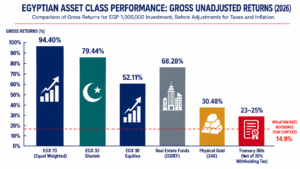
- EGX 30: up 52.11% YoY and 30.28% YTD
- EGX 70: up 94.4% YoY and 59.43% YTD, reflecting strong momentum among small- and mid-cap stocks
- EGX 33 Shariah: up 79.44% YoY and 44.05% YTD
The headline performance, however, does not necessarily translate one-for-one into real returns. According to MubasherTrade Research’s January 2025 strategy note, 2025 – Drifting Through Uncertainties: Back to Fundamentals, the EGX30 rose 18% in EGP terms in 2024 but declined 28% in USD terms. Mubasher concluded that the market’s performance had not adequately compensated investors for the prevailing high-inflation environment, underscoring the importance of looking beyond nominal EGP returns.
The distinction is particularly important in a market where currency movements can significantly affect the value of EGP-denominated assets. Investors therefore need to consider not only the headline index gain, but also inflation, exchange-rate movements, dividends and the underlying earnings growth supporting the market’s performance.
-
Real Estate Funds (REITs): Bricks and mortar on the exchange
While physical real estate has historically required massive upfront capital and suffered from illiquidity, real estate investment funds have brought property exposure directly to the capital market. Instead of buying an entire unit, investors can purchase liquid certificates traded like stocks.
Performance metrics: The listed Egyptian Real Estate Fund (EGREF) has demonstrated this strength, recording approximately 68.28% YoY growth on the EGX, according to TradingView.
The comparison with physical property, however, also highlights the importance of distinguishing between nominal and real returns. Egypt’s nationwide residential real estate price index rose 13.25% year-on-year in October 2025, according to Aqarmap data compiled by Global Property Guide.
Rather than requiring investors to purchase and manage an entire property, real estate funds can provide exposure to property-related assets with lower minimum capital requirements and potentially greater liquidity. They can also reduce the direct responsibilities associated with physical ownership, such as property management, maintenance and tenant relations. However, returns remain dependent on the underlying assets, fund structure and market conditions.
-
Fixed income: Predictability and high yields
“The starting point is the investor’s time horizon,” Hammouda says. “On the fixed-income side, short-term investors may favor Treasury bills, while those with a longer horizon may consider Treasury bonds.”
While underlying government Treasury bills currently offer benchmark yields between around 23% and 25%, subject to applicable taxes, according to the CBE, corporate debt carries distinct trade-offs. Corporate bonds “may offer higher yields but carry additional issuer risk and remain less liquid in the secondary market,” Hammouda explains.
For investors seeking easier liquidity, money-market and fixed-income funds offer professionally managed exposure to short-term and fixed-income instruments. Such products can provide investors with flexible exposure to professionally managed portfolios without requiring them to select individual securities or manage maturities themselves, Hammouda notes.
The trade-off is that fixed-income investments may offer greater predictability than equities, but their returns still need to be assessed against inflation. A nominal yield that appears attractive can translate into a considerably smaller real return once inflation and applicable taxes are taken into account.
-
Gold: Digital access to a tangible safe haven
While equities yield business earnings and real estate produces rent, gold operates primarily as a store of value. “Over the very long term, gold can serve as a hedge against inflation and currency movements,” explains Hammouda. “A modest gold allocation, often 5% to 15%, depending on the investor, may support portfolio diversification.”
Local 24-karat gold prices rose more than 30.48% YoY, according to goldprice.org
Rather than buying and storing physical bullion, investors can also gain exposure through regulated precious-metal funds and physically backed digital gold products.
Hammouda notes that digital products can provide investors with an alternative way to gain exposure to gold without directly purchasing and storing physical bullion.
As with other assets, however, gold’s nominal price increase should be viewed alongside inflation and currency movements. Its role in a portfolio is generally less about generating business income and more about diversification and preserving value during periods of inflation or currency volatility.
The arrival of short selling
Alongside new asset classes, the market is also expanding the tools investors can use to manage risk in either direction.
The Financial Regulatory Authority (FRA) has issued the regulatory framework for short selling, establishing the rules governing the borrowing and subsequent sale of securities. The FRA said in August that the new framework is intended to diversify investment avenues and deepen the Egyptian capital market.
The mechanism enables investors expecting a stock price decline to borrow shares, sell them at current prices, and repurchase them later at lower levels to pocket the spread.
The framework introduces a centralized lending system managed by Misr for Central Clearing, Depository and Registry (MCDR), connecting share lenders—who earn a yield close to the risk-free rate on their lent assets—with borrowers. To ensure market stability, the regulations mandate strict parameters: borrowing is capped at 40% of a listed company’s free-float shares, individual borrowers cannot exceed 2%, and a mandatory cash margin of at least 50% is required, with strict margin calls triggered if collateral drops below 140%.
Short selling therefore adds another dimension to the market: rather than limiting investors to strategies that benefit only from rising prices, the mechanism gives eligible investors a regulated way to position for declines while potentially improving price discovery and market liquidity.
Expanding what Egyptians can invest in
The ability to access equities, bonds, real estate, gold, and derivatives from a single brokerage account represents a major leap in Egyptian capital market maturity.
“The biggest opportunity is to expand not only how Egyptians invest, but also what they can invest in,” Hammouda emphasizes. “This is an important part of why Thndr secured its asset-management and portfolio-management licences: to design regulated investment products around the needs of individual investors, making opportunities that were traditionally built for institutions or larger investors more accessible.”
Looking ahead, he notes that “these could include funds offering exposure to real estate and other alternative assets, as well as opportunities linked to sectors such as art, film and sports. With the right structures, disclosure and investor protections, these products could help individuals build more diversified portfolios.”
Radwan echoes this future-focused vision: “We also look forward to the introduction of sophisticated roboadvisors, hedge funds, and new private insurance funds to benefit from new regulations.”
Ultimately, Egypt’s financial markets in 2026 will reward investors who look beyond headline returns, understand the trade-offs between different assets, and build strategies that can adapt as market conditions evolve.