

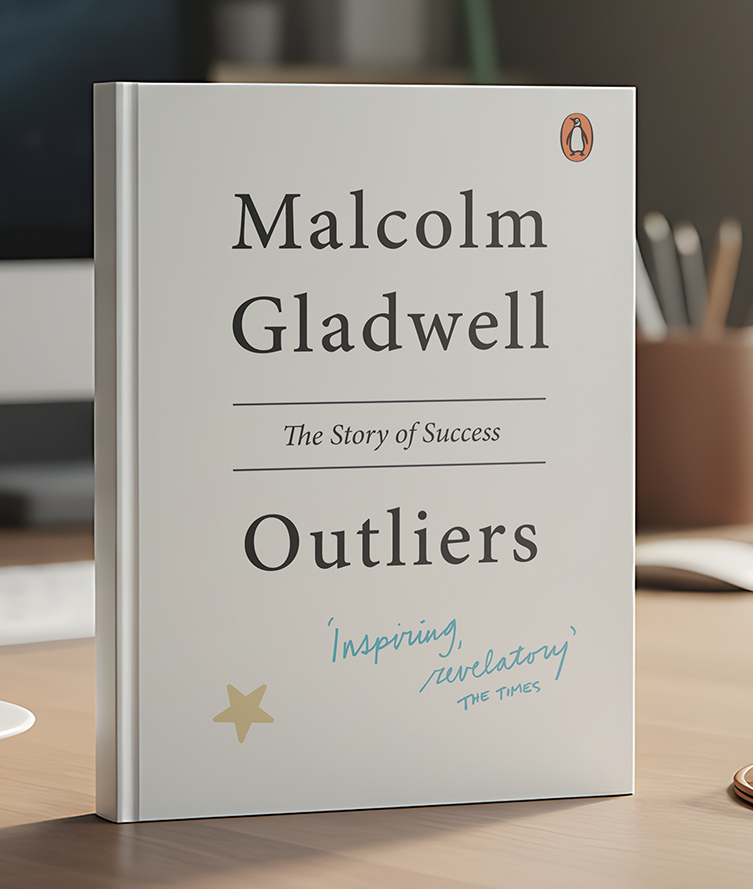

In his book “Outliers: The Story of Success,” Malcolm Gladwell points out that people who achieve remarkable accomplishments “follow a particular and unexpected logic.”
One story that continues to inspire is of a “brilliant immigrant kid who overcomes poverty and the depression, can’t get a job at the stuffy downtown law firms, and makes it on his own through sheer hustle and ability,” Malcolm Gladwell says in “Outliers: The Story of Success.”
“Successful people don’t do it alone. Where they come from matters. They’re products of particular places and environments,” the book says. “We do owe something to parentage and patronage. The people who stand before kings may look like they did it all by themselves. But in fact, they are invariably the beneficiaries of hidden advantages and extraordinary opportunities and cultural legacies that allow them to learn and work hard and make sense of the world in ways others cannot.”
The book highlights some of the biggest “advantages” that can support an individual’s pursuit of “outlier” success.
The ‘when’ advantage
A pattern Gladwell highlights is that most successful hockey players in Canada are born between January and March, while the least successful are born in November and December. “It has nothing to do with astrology, nor is there anything magical about the first three months of the year,” Gladwell says. “It’s simply … that the eligibility cutoff for age-class hockey is Jan. 1. A boy who turns ten on Jan. 2 … could be playing alongside someone who doesn’t turn ten until the end of the year — and at that age … a 12-month gap in age represents an enormous difference in physical maturity.”
That age advantage snowballs into other benefits (cumulative advantage). Gladwell notes that older (and bigger) kids get better early coaching, have better teammates who push them to perform, and play significantly more games.
Similarly, schoolchildren born just after the academic year cutoff date can better understand what they are learning than those born just before it. That logic applies to almost all other areas of life, the book stresses.
The danger of this logic is “we make rules that frustrate achievement. We are too much in awe of those who succeed and far too dismissive of those who fail. We become much too passive, [as] society … overlooks just how large a role we all play in determining who makes it and who doesn’t.”
Cumulative advantage
According to Gladwell, achieving “outlier” success mainly depends on whether instructors recognize a standout student early on. He cites a survey by Berlin’s Academy of Music, where professors categorized violinists into three groups: potential world-class performers, average players and moderate players likely to become teachers.
Survey researchers asked students how many hours they spent practicing. “Everyone from all three groups started playing at roughly the same age … In those first few years, everyone practiced roughly the same amount, about two or three hours a week,” Gladwell notes.
However, those in the “elite performers” group reported they “each totaled 10,000 hours of practice” by the time they were 20. “By contrast, [all] merely good students [combined] had totaled 8,000 hours, and the future music teachers had accumulated just over 4,000 hours.”
These patterns appear across nearly all fields and walks of life, leading “researchers [to] settle on what they believe is the magic number for true expertise: 10,000 hours.” Gladwell also mentions that expanding categorization to distinguish students with equal potential by nationality reveals another difference in the number of hours practiced.
The limitation of this approach is that it “couldn’t find any ‘naturals’ musicians who floated effortlessly to the top while practicing a fraction of the time their peers did. Nor could they find any ‘grinds,’ people who worked harder than everyone else, yet just didn’t have what it takes to reach the top ranks.”
The ‘market’ advantage
Another pattern that influences the likelihood of outlier success is the stage of market development across geographic locations. Gladwell lists the “75 richest people in human history [with] the net worth of each … calculated in current U.S. dollars” adjusted for inflation.
“Of the 75 names, an astonishing 14 are Americans born within nine years of one another in the mid-19th century.” That means almost 20% of the names are from a single generation in a single country.
“In the 1860s and 1870s, the American economy went through perhaps the greatest transformation in its history. This was when the railroads were being built and when Wall Street emerged. It was when industrial manufacturing started in earnest. It was when all the rules by which the traditional economy had functioned were broken and remade.”
“If you were born in the late 1840s,” Gladwell writes, “you were too young to take advantage of that moment. If you were born in the 1820s, you were too old: your mindset was shaped by the pre-Civil War paradigm.”
Geniuses and outlier success
Lewis Terman, a psychology professor at Stanford University, pioneered the use of standardized (IQ) tests to measure intelligence to predict the likelihood of achieving “outlier” success. “There is nothing about an individual as important as his IQ, except possibly his morals,” he famously said.
Today, “schools have programs for the ‘gifted.’’ Elite universities often require that students take an intelligence test for admission. High-tech companies like Google or Microsoft carefully measure the cognitive abilities of prospective employees out of the same belief: they are convinced that those at the top of the IQ scale have the greatest potential,” the book notes.
However, “Terman made an error,” says the book. “The relationship between success and IQ … works only up to a point. Once someone has reached an IQ of somewhere around 120, having additional IQ points doesn’t seem to translate into any measurable real-world advantage.”
The book also points out that while some top scorers on IQ tests have won Nobel Prizes and achieved “outlier” success, “the majority had careers that could only be considered ordinary, and a surprising number ended up with careers that even Terman considered failures,” Gladwell notes.
Additionally, Terman’s “fieldworkers actually tested two elementary students who went on to be Nobel laureates – William Shockley and Luis Alvarez – and rejected them both,” Gladwell says. “Their IQs weren’t high enough.”
The book highlights how “Pitirim Sorokin showed that if Terman had simply put together randomly selected groups of children from the same kinds of family backgrounds … and dispensed with IQs … he would have ended up with a group doing almost as many impressive things as his painstakingly selected group of geniuses.”
The ‘background’ advantage
Another crucial point Gladwell highlights is the extent to which “cultural shocks” impact those seeking “outlier” success. In essence, “culture shocks” reflect an incompatibility between a person’s ethnicity, beliefs, upbringing, and perceptions and those of the society around them, he explains.
Another “background” issue is the type of intelligence the seeker of “outlier” success has – practical or analytical. The former is “knowing what to say to whom, knowing when to say it, and knowing how to say it for maximum effect. It’s knowledge that helps you read situations correctly and get what you want.” The latter stems from academic excellence.
“One can have lots of analytical intelligence and very little practical intelligence,” or vice versa,” Gladwell says. A noticeable mismatch hampers efforts to achieve “outlier” success. “In the fortunate case of someone like Robert Oppenheimer, [who led the development of atomic weapons], you can have plenty of both.”
Then there is the role of family wealth. “Wealthier parents are heavily involved in their children’s free time, shuttling them from one activity to the next, quizzing them about their teachers and coaches and teammates.”
However, with poor children, “play for them [is] making up games outside with their siblings and other kids in the neighborhood.”
Meanwhile, “middle-class parents talk things through with their children, reasoning with them,” he says. “They don’t just issue commands. They expect their children to talk back to them, to negotiate, to question adults in positions of authority.”
Divergent social levels also influence how “outlier” success seekers overcome challenges. Wealthier families use their resources to solve problems; poorer families tend to avoid confrontation and follow others; middle-class families, by contrast, engage in negotiation and exploration, the book explains.
The ‘communication’ advantage
How seekers of “outlier” success communicate is also crucial. Gladwell describes two types of societies. The first is “low-power distance culture,” most evident in the United States. “They don’t see any hierarchical gap between themselves and [others], and … mitigated speech from [someone] doesn’t mean the speaker is being appropriately deferential to a superior. It means [they] don’t have a problem.”
At the other end is “high-power distance culture,” where power hierarchies are clearly defined. The book cites Colombians as a case in point. “High-power distance communication works only when the listener is capable of paying close attention, and it works only if the two parties in a conversation have the luxury of time, in order to understand each other’s meanings.”
Ultimately, organizations and individuals need to “appreciate the idea that the values of the world we live in and the people around us have a profound impact on who we are,” Gladwell notes. “They have to understand the culture he or she was a part of.”