

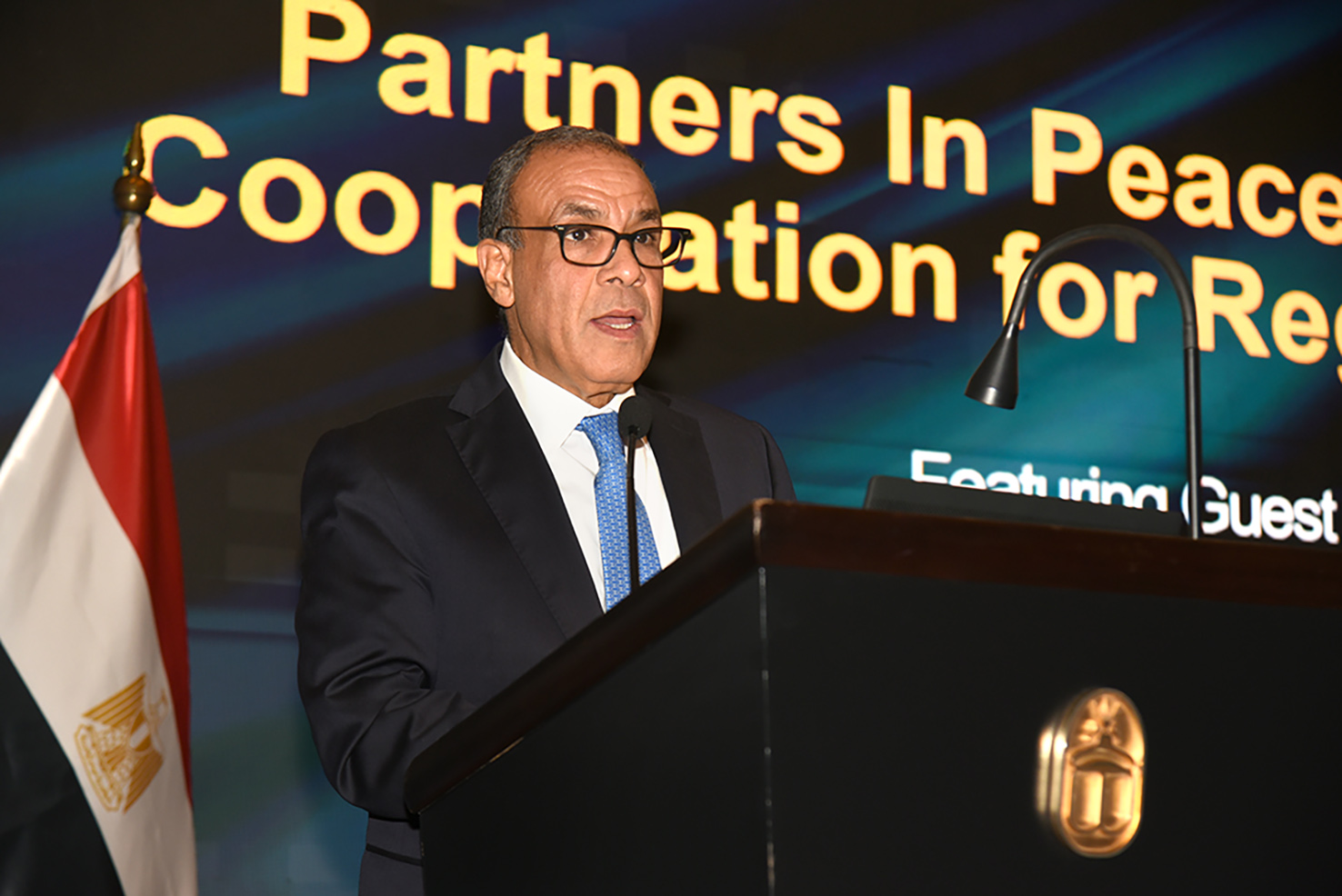

Over the past four years, the Middle East and Africa (MEA) have faced turbulent, unpredictable geopolitical events. These developments continue to challenge Egypt’s diplomatic prowess in resolving conflicts among neighboring countries, influencing negotiations over Nile water rights, and managing economic fallout.
“This year marks 80 years since the founding of the United Nations, an organization created … to prevent war, uphold international law, and protect the rights and dignity of all people,” Minister of Foreign Affairs Badr Abdelatty told AmCham members in December. “Yet despite its founding goal, the international system faces fragmentation, polarization and major challenges.”
In this shifting world order with its shifting alliances, Egypt is using its diplomatic muscle to navigate and temper volatility in Ethiopia, the Gulf of Aden, Red Sea, the Gaza Strip, and Sudan, while establishing itself as a trustworthy international partner.
“At the regional level, … MEA stands today at a historical crossroads,” Abdelatty stressed, “certainly rich with opportunities, yet severely challenged by unresolved conflicts.” Egypt’s diplomatic priorities are maintaining geopolitical stability in neighboring countries, establishing balanced political relations, and positioning itself as a trusted partner by fostering economic ties.
Fundamental priority
An existential concern for Egypt is safeguarding its historic rights to the Nile River, which amount to 55 billion cubic meters of water annually. “Egypt is the most populated water-scarce country in the world,” Abdelatty said. “The Nile has been the source of life for Egyptians for millennia. It’s a matter of survival, as it supplies over 95% of the water needs of more than 110 million Egyptians and 10 million refugees.”
Since mid-2020, Nile water security has been in the spotlight after Ethiopia unilaterally announced an accelerated timeline to fill its Grand Ethiopian Renaissance Dam (GERD), built on the Blue Nile, the Nile’s largest tributary. “We never oppose Ethiopia’s right to development and to harness its natural resources and pursue growth,” said Abdelatty. “But we believe this must be done in accordance with international law within a cooperative, legally binding framework that ensures no harm to downstream countries.”
That has led to diplomatic friction. “For over a decade, we have negotiated in good faith from our side seeking an agreement on the filling and operation of the dam,” he said. “Unfortunately, Ethiopia opted to act unilaterally in clear violation of international law, undermining trust and threatening regional stability.”
Egypt “will continue to closely monitor the developments on the Blue Nile and we will take all appropriate measures and steps to protect our existential interest in the Nile in accordance with international law and the U.N. Charter, especially if any harm happens to our water rights,” said Abdelatty.
Preventing more war
Bordering the Gaza Strip and Sudan, Egypt finds itself at the center of upheavals and conflicts that could threaten its own stability.
According to Abdelatty, Egypt’s priority in the Gaza Strip is to uphold the current ceasefire agreement, signed in Sharm El Sheikh in October. He stressed that current efforts focus mainly on preventing Israel from resuming attacks. “We are coordinating with the U.S. leadership to ensure the ceasefire is sustainable.”
The foreign minister said another priority is to ensure that humanitarian aid reaches Gaza Strip residents. “Medical response is of great importance, along with Israel’s withdrawal,” he said. “It is important to follow [U.S. President Donald] Trump’s 20-point peace plan.”
Abdelatty also noted the ongoing volatility in Syria since Bashar al-Assad was ousted from the presidency in December 2024. Meanwhile, Lebanon remains another hotspot of instability. “We are very, very worried about Lebanon, very worried about the fragility of [its] situation, and how that would impact the entire region.” He also cited the need to de-escalate the situation in Iran and reach some level of resolution regarding its nuclear capability.”
Finally, Abdelatty said he is involved in negotiations to end the war in Sudan, stressing, “It is our responsibility, and we will continue to do what we can to end this conflict.”
Red Sea diplomacy
Another political issue Egypt is addressing is the rising conflict at the southern entrance to the Red Sea and the Gulf of Aden. “We are closely monitoring what’s happening [south of the] Red Sea,” Abdelatty said. “We will not allow any landlocked country access to the sea against the will of the countries overlooking the Red Sea.”
Since 1991, Ethiopia, a landlocked country, has supported Somaliland’s efforts to gain independence from Somalia in exchange for direct access to the Gulf of Aden. The two countries signed an MoU to that effect in January 2024.
Another political situation Egypt is navigating in the Red Sea is the ongoing threat of Yemen’s Houthi rebels attacking freighters entering the waterway from the Bab el-Mandab Strait. “Egypt remains deeply concerned about the escalation in the Red Sea,” Abdelatty said. “Disruptions have cost Egypt more than $9 billion in Suez Canal revenue and threatened the stability of global supply chains.”
Supporting Africa
For Abdelatty, “Africa is at the top of our agenda,” whether politically or economically. “Egypt prioritizes sovereignty, legality and the pursuit of peaceful solutions. We stand ready to work with all responsible actors.”
A case in point is “the Horn of Africa, [where] Egypt views Somalia’s security and territorial integrity as essential,” Abdelatty said. “We support stabilization efforts, including Egypt’s intention to participate in the African Union-led mission to Somalia.”
He stressed the importance of U.S. diplomacy “to build a more stable and cooperative region and world.”
On the economic front, Abdelatty urged Egypt’s private sector to “strengthen its presence in African countries … especially through public-private partnerships based on win-win strategies. We believe that Africa is the future because it’s the only continent in the world that will double its population by 2050 and has an expanding middle class, with increasing purchasing power.”
U.S. partnership
Abdelatty stressed that “[the] central pillar of our bilateral partnerships is with the United States,” adding that this “strategic relationship” is a “pivotal element” for both nations’ “shared future.”
That “strategic partnership” has enabled the U.S. to become “one of Egypt’s largest economic partners, with bilateral trade exceeding $8.4 billion last year alone,” Abdelatty said. “That brings total U.S. investments in Egypt to $24.4 billion, with over 2,000 American companies operating locally.” That makes Egypt America’s largest trading partner in Africa and the fifth-largest in MENA.
For the Egyptian government, “increasing investment and trade between the two countries remains one of the top priorities,” Abdelatty said. “That is why it was important to convene the Egypt-U.S. Economic Forum. Its latest meeting in May saw over 60 U.S. companies participate, including newcomers to Egypt.” The next meeting is scheduled for May 2026.
“Our priority during that gathering is to ensure discussions lead to contracts and that interest translates into action,” the foreign minister said. “Even though the Egyptian-American strategic partnership is solid and mutually reinforcing, we still have not fully capitalized on the significant business and economic opportunities in several promising sectors.”
Economy and politics
To further strengthen diplomatic ties with the United States and other nations, the Egyptian government needs to ensure its economy is resilient and attractive to foreign investors.
The government began implementing structural reforms in 2016 to stabilize Egypt’s macroeconomic environment, strengthen the banking sector, modernize infrastructure, boost private-sector competitiveness at home and abroad, and empower the private sector to lead economic growth and development, Abdelatty noted.
“These reforms have supported [Egypt’s] resilience [after] global shocks from the [COVID-19] pandemic to geopolitical disruptions,” Abdelatty said. Since March 2024, “Egypt adopted a new wave of decisive reform measures that restored predictability to the foreign exchange market, increased foreign reserves, and aligned monetary policy with global standards.”
“Egypt now maintains a market-driven exchange rate policy without intervention from the Central Bank, a sign of financial transparency and confidence for investors,” he noted.
These reforms and efforts “led to an increase in FDI inflows and a rise in the annual [GDP] growth rate to 4.5% in fiscal year 2024-2025, up from 2.4% in 2023-2024,” Abdelatty said. “These results received international recognition and contributed to a recent upgrade in Egypt’s credit rating.”
What next?
On the economic side, Abdelatty stressed, “Our goals [in 2026] are to expand and deepen business-to-business ties in sectors where collaboration can quickly grow with appropriate enabling measures. The aim is to generate more investment opportunities, boost exports and create better-quality jobs.”
On the political front, Abdelatty said Egypt will aim to strengthen its collaboration with the EU. “We value our cooperation with the EU … The convening of the first-ever summit between Egypt and the EU is a testament to the strategic importance of our relationship.”
Egypt already has a six-pillar strategic partnership with Europe, which includes security and defense, economic cooperation, and scientific research, with think tanks and scientific centers in Europe gaining access to Egyptian universities.
Egypt also will seek to further strengthen ties with the United States. “Our commitment is clear. Egypt will remain a dependable partner for U.S. investors, and we will continue engaging in a structured, transparent manner to address concerns and improve the business environment here in Egypt,” he said. “The Egypt-U.S. strategic partnership is not only built on shared priorities and values, but also on mutual interest and responsibility to foster a regional environment where stability fosters prosperity, peace replaces conflict and cooperation overcomes polarization.”