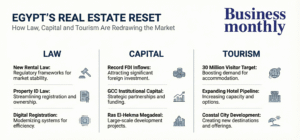


Egypt’s real estate market is entering a new phase. For years, frozen rental laws, fragmented property records, and limited transparency kept much of the sector outside the formal economy, favoring new cities and high-end projects while older urban areas stagnated. That balance is now shifting, driven by legal reform, foreign capital inflows, and tourism strategies reshaping demand.
*All data is from the latest real estate industry insight by the American Chamber of Commerce in Egypt.
Real estate as a strategic economic pillar
The sector now contributes roughly 10–11% of GDP, alongside manufacturing and tourism.
In H1 FY 2024/25, it generated EGP 441.4 billion in value added, with investments reaching EGP 65.7 billion.
Construction and real estate-related activities support nearly 12% of total employment, making the sector a core driver of income and social stability.
Rewriting the rules
New Rental Law (Law 164 of 2025): Moves pre-1996 contracts toward market-aligned rents while preventing forced evictions during the transition, unlocking dormant assets and encouraging reinvestment.
Property ID Law (Law 88 of 2025): Creates a unified digital identity for every property, improving transparency, simplifying transactions, and enabling better urban planning.
Capital flows and regional interest
Foreign direct investment is rising, led by Gulf markets. FY 2023/24 saw FDI surge, including the $35 billion Ras El-Hekma deal with Abu Dhabi Developmenِtal Holding Company (ADQ) — Egypt’s largest-ever FDI.
Gulf investors are increasingly co-developing large-scale, mixed-use projects, rather than standalone residential units, supported by residency-linked ownership and streamlined approvals.
Tourism as a demand anchor
Egypt’s National Strategy for Sustainable Tourism 2030 aims for 30 million visitors annually by 2028, driving investment in hotels, resorts, and mixed-use developments.
Coastal and urban destinations along the North Coast and Red Sea are seeing integrated developments combining hospitality, residential, retail, and leisure.
A market in transition
Challenges remain: annual demand for affordable housing is ~500,000 units, yet most developers still target middle- and upper-income buyers.
The sector’s long-term growth depends on execution, governance, and inclusivity.
Bottom line: Real estate in Egypt is no longer just responding to economic change; it is helping shape it, linking legal reform, capital inflows, and tourism into a coherent growth model. Structural change, rather than headlines, now defines the market