



This year and next, Egypt’s GDP growth should match and surpass its record highs. According to the IMF, the country’s economy will grow 4.7% in fiscal year (FY) 2025/2026, matching the pre-2008 global financial crisis all-time high. For FY 2026/2027, GDP should rise 5.4%, a new record.
Such unprecedented growth inevitably “requires more resources, raw materials, energy and water, generating more waste,” according to the Pollution Sustainability Directory (PSD), a research platform.
“Many of our current production processes are linear, following a ‘take-make-dispose’ model that extracts resources, transforms them into products and then discards them after use,” PSD noted.
For Egypt to sustain such a growth pace, it must ramp up recycling, becoming a circular economy. “The circular economy emphasizes sustainability and efficient resource utilization, providing a viable alternative to conventional practices,” said research published in July by the School of Intellectual Property at Jiangsu University in China. “It has the potential to significantly reduce environmental harm and promote long-term ecological sustainability.”
The government has lofty ambitions to boost recycling over the coming years. However, the informal sector dominates conventional recycling, while recycling electronics (e-waste) and single-use plastics is not scaling up fast enough.
Circularity ambitions
The government’s headline target is to recycle 60% of Egypt’s municipal waste by 2027, up from 37% in 2024. In 2020, it approved Law (No. 202/2020), which aims to create a system to reduce waste, safely dispose of trash, and encourage sustainable recycling, according to the law’s blurb.
Enacting the law is the Waste Management and Resources Authority (WMRA), established in 2015 to “regulate and determine the roles and responsibilities of all stakeholders, [propose] developing and updating legislation, laws and regulations; issue guidelines on the implementation of strategic plans at the governorate level; [and] develop controls, standards and guiding forms for all contracting phases,” its blurb said.
To attract investments in recycling, the WMRA “proposes economic and financial mechanisms, provides technical support to public awareness and societal commitment programs, and creates investment opportunities in … waste management.”
Also, the authority would “make waste sector data and information available” for private investors, and “develop key performance indicators for monitoring, follow and evaluate waste management activities.”
Formal attempts
Waste management remains divided between the formal sector (private investors and government-led projects) and the informal sector, concentrated in Mansheyet Naser, nicknamed Garbage City (Hayy El Zabaliyen).
One of the latest formal projects is the Ministry of Local Development signing a cooperation agreement in October with the Japan International Cooperation Agency (JICA) to reduce and recycle waste in Port Said Governorate. The project will run until 2028.
That same month, the government also extended the national initiative to reduce single-use plastic consumption from 2026 to 2027. The project involves the Local Development Ministry, Ministry of Environment, JICA, and U.N. Industrial Development Organization.
During the initiative’s launch in 2021, Minister of International Cooperation Rania El-Mashat said, “This agreement … will … focus on integrating the private sector and SMEs into this field.”
There are also private-sector waste-to-energy (WtE) projects feeding the national grid under the national feed-in-tariff program. Between 2020 and 2025, these projects contributed 300 megawatts of electricity.
WtE projects should increase further in 2026 and beyond, as Prime Ministerial Decree No. 4096 for 2025 split the feed-in-tariff into two. The first is denominated in Egyptian pounds. The second is a dollar amount paid in local currency based on the exchange rate at the time the invoice is submitted.
Informal dominant
Egypt’s greater success in waste management and recycling lies in the informal sector. “Germany [has] the highest recycling rate in the world, recycling about 66% of its waste. [Garbage City’s] informal networks that manage refuse … are estimated to recycle over 80% of garbage they collect,” reported Jaclynn Ashly for research platform African Argument.
These informal operations gather roughly 60% of Greater Cairo’s waste, according to a report by EcoMENA, a volunteer-driven initiative that raises environmental awareness. That is a significant amount, as the metropolis is home to over 20% of Egypt’s population.
Despite their large scale, El Zabaleen operate outside government oversight, despite continued attempts to formalize Garbage City through regulation, relocation to a purpose-built location, and incentives under the 2020 Waste Management Law.
Formalization efforts began in the early 2000s, when the government allowed only registered private corporations to collect trash and required them to work with formal recyclers. This proved financially unfeasible for formal garbage collection investors.
The government also unsuccessfully tried to create a syndicate for informal collectors. It mainly targeted Garbage City workers, as syndicate registration opens the door to requiring them to register as micro-enterprises.
Formalization failed because of the way Garbage City operates. SDI Net, a network for African slum dwellers, explained in a note that Egypt’s garbage collectors are poor men and boys who gather garbage from the streets and in front of buildings. Some are paid by households or gated compound management companies. Once they finish their rounds, they head to Garbage City, where most live.
Resident women and children sort the incoming trash. “They separate the garbage into different categories, but mainly they separate organic from inorganic waste,” explained SDI Net. “Inorganic waste, like paper, plastic [and] metal, is then [sold] to recycling workshops owned by members of the Zabaleen community who have been able to afford to buy the machinery over time.”
EcoMENA’s report said once rubbish is recycled, it is either crafted into finished products and sold to shops or bought by factories as semi-finished goods. Organic waste is used as livestock feed or compost.
That setup is significantly more effective than formal efforts. “Corporations recycle 25% of the garbage they collect and put the rest in landfills,” noted SDI Net’s paper. El Zabaleen recycle 80%. The gap is due to their significant experience. Their predecessors began collecting garbage and reusing what they could in 1910, when oasis dwellers migrated to major cities seeking work.
To maximize their output, Garbage City dwellers organized their operations organically. “Over the last few decades, the Zabbaleen have refined their collection and sorting methods, built their own labor-operated machines and created a system in which every man, child and woman works,” SDI Net explained.
Given their scale, “the involvement of Zabbaleen is essential to the success of any waste management plan, and the Egyptian government must involve all stakeholders when putting together a sustainable waste management [plan] for Cairo,” EcoMENA’s note stressed.
Emerging opportunity
The economy’s rapid digital transformation and emergence of new technologies require the latest electronic equipment. “Because of the quick introduction of new electronics to the global market, many people discard electronic devices after only a few years of use,” said AEI, a producer of recycling machinery.
The main sources of e-waste are computers, speakers, mobile phones, TVs, music players, keyboards, other computer peripherals, and home appliances.
Recycling these devices is challenging. AEI cited the “complexity” of e-waste, which includes glass, various plastics, metals, and non-metal materials, as well as chemicals that can be hazardous if exposed to heat.
To process them correctly, recyclers must avoid mixing different materials, which is a “resource-intensive” process, AEI explained. It also requires advanced machinery to dismantle electronics, remove batteries and other hazardous waste, shred or crush the remaining components into smaller sizes, separate fine materials like small plastic or glass pieces from larger scrap metals, sort the metals into various types, [and] remove glass fines from plastic fines.”
The latest equipment is necessary to ensure efficiency and scalability. “Processing outputs must increase to match demand, and cost-efficient processes must be developed to decrease the cost of sorting e-waste,” noted AEI. “Sorting and screening solutions must be able to handle large volumes of waste and do so with minimal downtime.”
For Egypt to cope with projected e-waste growth in the coming years, the Sustainable Recycling Industries initiative, under the Swiss State Secretariat of Economic Affairs, said the government needs “regular reviewing and updating e-waste management policies and regulations; [upgrading] infrastructure, monitoring, and management practices; [and] work on achieving complete and consistent datasets through standardized collection methods and methodologies, to allow data comparability across different regions and time scales.”
Plastics in the room
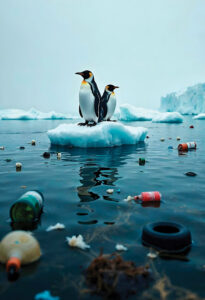
Single-use plastics are the world’s biggest and most persistent waste problem. First, demand keeps rising. “It offers a quick and easy solution to everyday needs, from packaging food to carrying groceries,” noted EnvoPAP, a sustainability consultancy, in December. “About 40% of plastic produced globally is used for packaging, most of which is single-use.”
Second, it doesn’t decompose naturally, meaning “from the bustling city streets to the serene ocean depths, the problem of single-use plastic pollution is far-reaching and deeply concerning,” EnvoPAP warned.
When thrown into any body of water, “marine animals often mistake plastic debris for food, leading to ingestion and entanglement,” EnvoPAP said. “Over 700 marine species have been affected by plastic pollution.”
On land, “single-use plastics … take hundreds of years to decompose, occupying valuable landfill space and releasing harmful chemicals into the environment,” noted EnvoPAP. “When exposed to sunlight and water, plastic breaks down into tiny particles called microplastics.” These microplastics can enter the food chain and pose a threat to human health. “Humans ingest an average of 5 grams of microplastics per week, roughly the weight of a credit card,” added EnvoPAP.
Lastly, the process of producing single-use plastics “contributes to greenhouse gas emissions, exacerbating climate change,” said EnvoPAP.
EuP Egypt, a consultancy on plastics production, noted contamination issues in recycled plastics from food remains, “such as oils and other unwanted materials.”
Materials used in single-use plastics also vary in consistency and quality from one producer to another. “This inconsistency happens because the source materials come from different products with different additives and properties,” said EuP Egypt. “[When] different plastic types mix during recycling, they often don’t blend well, creating weak or unstable materials.”
They might also “contain harmful chemicals that were added to the original products … during the recycling process, these chemicals can be released or concentrated.”
Additionally, single-use plastics “can only be recycled a few times before they lose their quality,” said EuP Egypt.
Finally, “the … resources and energy … costs of recycling plastics are often higher than making new plastics,” EuP Egypt noted. “Virgin plastics are relatively cheap to produce, especially when oil prices are low.”
Ultimately, the consultancy stressed, “without government incentives or consumer demand for eco-friendly products, many companies choose virgin plastics for economic reasons.”
Keys to circularity
As a 2025 paper from the European Commission (EC) noted, while “Egypt’s transition toward circularity is gaining momentum, … significant economic challenges [are] constraining household consumption and corporate investment.”
The transition to a circular economy, the paper said, will be fueled by “green growth driven by regulation, [giving importance to] resources, [building] demand for green products [and promoting] private investments in regional clusters.”
Given that Egypt is “seeking to boost foreign investment and private sector participation,” the EC added, a viable option would be to attract them to circular projects. “These [circular projects] offer opportunities for further diversification in green and economy sectors [beyond just renewable energy] and introduce [further] growth.”