

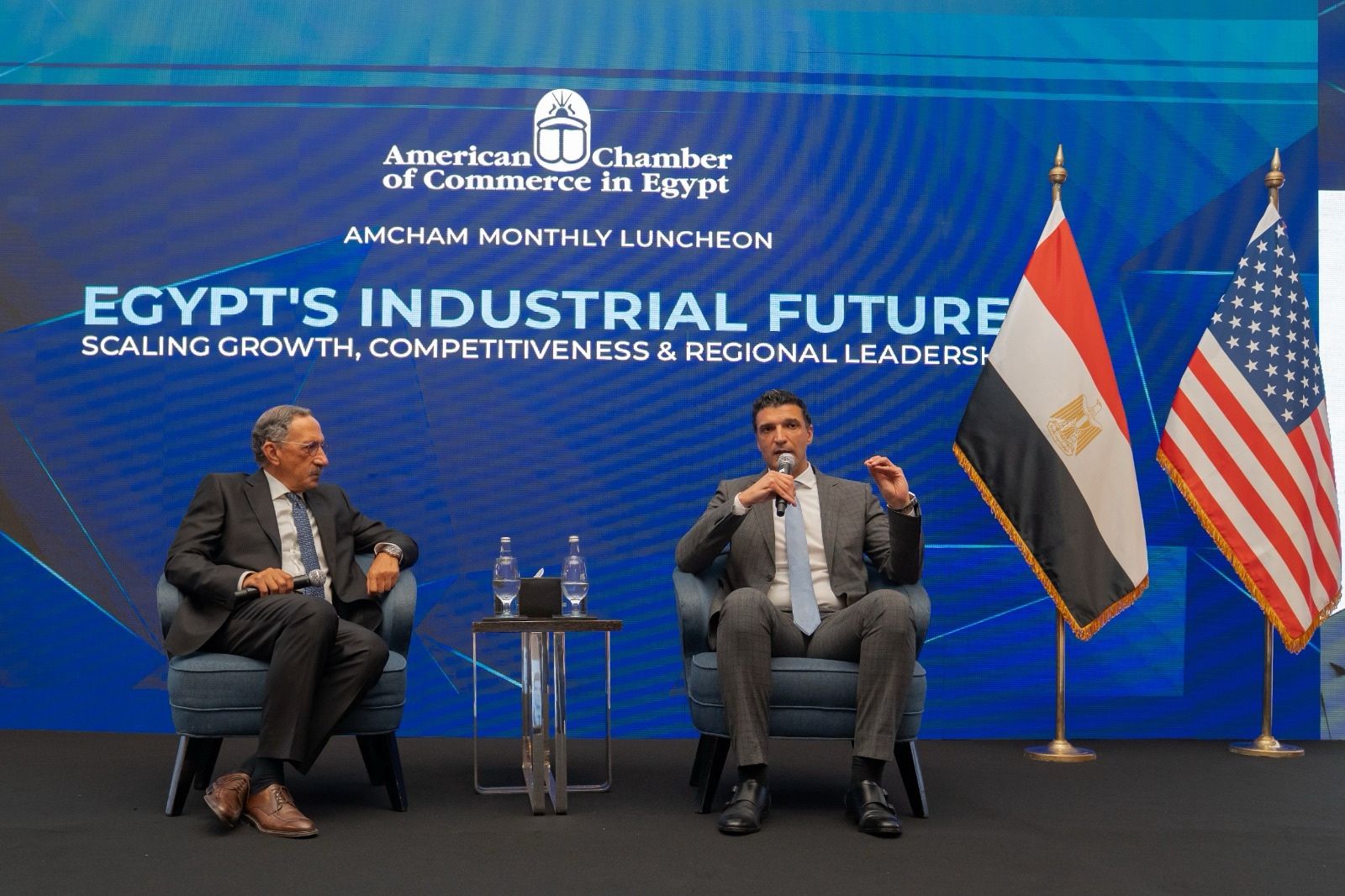

Egypt is shifting its industrial strategy away from broad import substitution and toward integrating into global supply chains, with plans to increase non-oil exports from approximately $48 billion today to $100 billion by 2030, Minister of Industry Khaled Hashem said during an American Chamber of Commerce in Egypt luncheon on June 9 titled “Egypt’s Industrial Future: Scaling Growth, Competitiveness & Regional Leadership”.
“We’re not going to localize everything. It doesn’t make sense. Nobody does that,” Hashem said.
Instead, the Ministry of Industry is identifying highly specific industrial opportunities down to the eight-digit Harmonized System (HS) code level to determine which products and components can realistically be manufactured competitively in Egypt.
“It’s more about being integrated into the global supply chain of the industry,” Hashem said. “Egypt is going to be one of the top five players in those industries over the tenor of five to seven years.”
The strategy focuses on seven priority sectors: apparel and textiles, food processing, automotive manufacturing, electrical equipment, electronics, pharmaceuticals and medical supplies. These will be supported by enabling industries including machinery, water treatment technologies and energy-related manufacturing, as well as complementary industries such as motors, compressors, circuit boards and foundries.
The minister said the strategy aims not only to boost exports but also to deepen domestic manufacturing and increase local value addition.
“We need to ensure that we focus on the feeding industries and deepening the industry in the country,” he said.
At the center of the strategy is a push to localize technology and strengthen domestic industrial capabilities.
“We’re going to pivot to technology,” Hashem said. “What we care about today is localizing technology.”
Speaking to business leaders, the minister argued that Egypt has spent years competing for foreign direct investment without paying sufficient attention to technological localization and supplier development.
“Our problem is in technology localization and technical assistance,” Hashem said. “This is where we are lacking today.”
Hashem identified small and medium-sized enterprises as a critical component of the industrial ecosystem, saying the country needs a broader supplier base to support industrial expansion.
“SMEs lie at the heart of our focus and our strategy,” he said.
Among the initiatives under development is a digital industrial marketplace that would connect manufacturers and suppliers through a business-to-business platform, allowing companies to identify local producers, compare capabilities and build domestic supply chains. The ministry is also introducing supplier-development programs aimed at helping multinational corporations and large manufacturers cultivate local suppliers capable of meeting global standards.
To address investor concerns over industrial land, the government plans to introduce a leasing model that would enable manufacturers, particularly SMEs, to access industrial land without significant upfront costs and eventually purchase it over a 21-year period.
At the same time, authorities intend to reclaim undeveloped industrial plots allocated to investors who have failed to implement projects.
“Brokerage into the industrial land is not going to happen again,” Hashem said.
The ministry is also working to expand infrastructure-ready industrial zones and encourage greater private-sector participation through industrial developers.
Hashem said the Industry Modernization Center will be restructured and technology centers placed under its umbrella to accelerate innovation, industrial digitalization, sustainability initiatives and technology transfer.
“We’re after technology,” he said. “Technology is the most sustainable thing.”
Throughout the discussion, the minister emphasized execution as the key determinant of success, arguing that resolving licensing bottlenecks could unlock much of Egypt’s industrial potential.
“If we simply solve our own issues of licensing, this is today more than 70% of the exercise,” he said.
To improve accountability, the ministry is establishing a dedicated follow-up unit that will monitor implementation of decisions and investor complaints, with unresolved cases escalated directly to the minister.
Concluding his remarks, Hashem described himself as a representative of the private sector within government.
“I represent you,” he said. “Use that leverage to get things done because time is our biggest challenge.”