


Egypt’s startup ecosystem is entering a new phase. Launched in February 2026, the Egypt Startup Charter consolidates policies, incentives, and support mechanisms under a single national framework. For founders, investors, and ecosystem players, it is more than a strategy document—it reshapes how startups are defined, regulated, taxed, scaled, and even exited.
At a time when entrepreneurship is increasingly seen as a driver of economic growth, the Charter signals a decisive shift in how the state positions startups within the broader economy.
A roadmap, not a law
The Charter functions as a national roadmap for entrepreneurship, developed by the Ministerial Group for Entrepreneurship in collaboration with founders, investors, accelerators, universities, and over fifteen government entities.
It is not legally binding, but directly informs legislation, executive regulations, incentive frameworks, and government procurement policies. In practice, it provides coherence to initiatives that were previously scattered across institutions.
Defining a startup
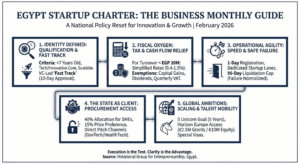
One of the Charter’s most consequential moves is defining what qualifies as a startup. Under the framework, a startup is a company that:
- – Is less than seven years old
- – Operates on innovation or technology
- – Is structured to accommodate investors
- – Is designed for scalable growth through a new or improved product, service, or business model
This definition is practical: it determines eligibility for tax incentives, fast-track approvals, government support, and public programs.
Formal recognition
Startups must be formally recognised through MSMEDA to access Charter benefits.
- – Regular track: Companies are reviewed through staged evaluation by a multi-stakeholder committee.
- – Fast-track route: Reserved for startups nominated by accredited VCs, incubators, or accelerators.
Approved status lasts two years and can be renewed until a company reaches the seven-year limit. A grievance mechanism exists for rejected applications.
This system formalizes support while preserving flexibility for high-growth companies.
Tax relief and simplified administration
For founders, the immediate impact is financial and procedural:
- – Startups with annual revenues below EGP 20 million qualify for a simplified turnover-based tax, ranging 0.4–1.5%
- – Exemptions include capital gains, dividend tax, stamp duty, and registration fees
- – VAT filings are quarterly, and advance payments are removed
Procedural reforms include:
- – Dedicated startup desks in major tax offices
- – Company registration in one working day
- – Startup liquidation capped at 90 days, lowering the cost of failure
Access to public procurement
The Charter opens doors previously considered inaccessible:
- – A significant portion of government procurement is allocated to SMEs
- – Egyptian companies get pricing preference in tenders
- – Startups have clearer access to procurement information
- – Public entities are encouraged not to crowd out private innovation
Sectors like GovTech, HealthTech, and EnergyTech benefit directly from these reforms.
Scaling beyond Egypt
The Charter also focuses on international growth:
- – Streamlined visas and work permits for foreign founders and talent
- – Support for participation in international exhibitions
- – Access to European funding, including Horizon Europe grants and equity, especially for deep-tech startups
A dedicated Scaleups Program targets companies that have raised more than $10 million, aiming to:
- – Enable five unicorns
- – Create 500,000 jobs over five years
Why it matters
The Egypt Startup Charter is the most comprehensive attempt to unify the country’s entrepreneurial ecosystem. By defining, supporting, and scaling startups under a single framework, it shifts the narrative: startups are no longer peripheral—they are core drivers of Egypt’s economic growth.
For founders, the Charter provides clarity, financial relief, faster processes, and access to new markets. For investors and ecosystem players, it offers a predictable and structured environment to identify, support, and scale high-potential ventures.
Egypt’s startup ecosystem has finally received a blueprint that turns policy into practice.