

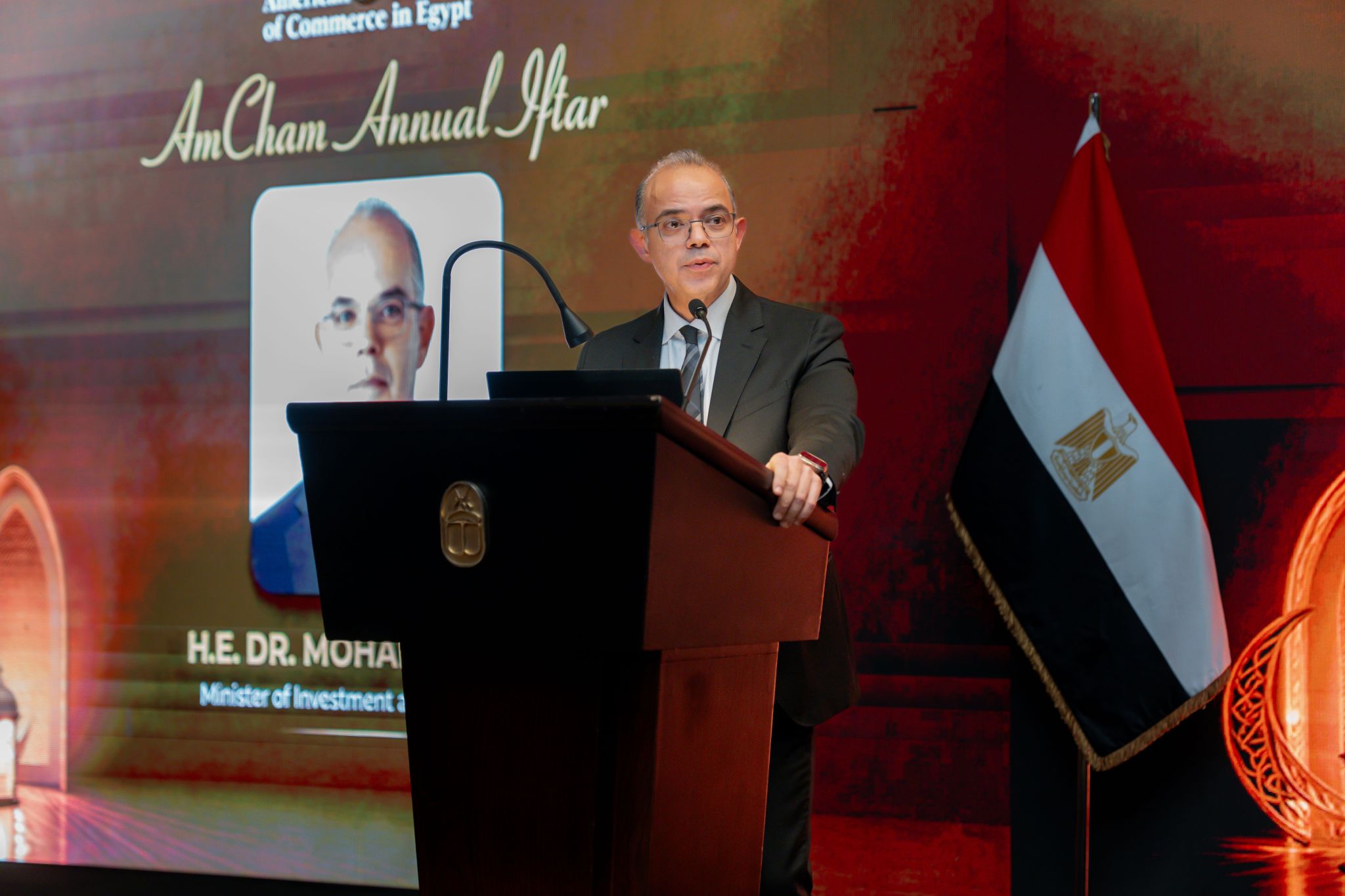

Egypt’s Minister of Investment and Foreign Trade, Mohamed Farid, outlined the government’s strategy to deepen capital markets, boost private investment, and expand retail investor participation during the American Chamber of Commerce in Egypt’s (AmCham Egypt) annual Iftar at the St. Regis Cairo Hotel.
Speaking at the event, titled “Investing in Egypt’s Future: The Way Forward,” Farid emphasized the importance of incremental reforms and data-driven policymaking in navigating an increasingly volatile global economy.
“Uncertainty nowadays is not something that we get to see every 5 or 6 or 7 years, actually, uncertainty is embedded in our daily lives as we speak today. So every couple of years, every 12 months, we get to see some changes.” Farid told attendees gathered at the Astor Ballroom.
“So, without having the proper macroeconomic setup, I would say we as investment promoters, and we as personnel trying to improve the economic environment and the investment environment in Egypt, will find it very difficult without having this proper macroeconomic setup being in place”. He added
Improving macroeconomic fundamentals
Farid highlighted improvements in Egypt’s macroeconomic position, noting the country has shifted from a net foreign asset deficit of $27.2 billion to a surplus of $25.5 billion.
Economic growth has also rebounded, reaching between 5.2% and 5.3% in the most recent quarter, compared with lows of roughly 2.4% to 2.6% in previous periods.
The structure of investment is also gradually shifting toward greater private sector participation. Between 2020 and 2024, public investment accounted for roughly 65% of total investment, while private investment ranged between 35% and 45%. Following recent financial sector reforms, private investment has risen to approximately 53% to 54%, Farid said.
To sustain a growth rate of 5.5% to 6.5%, he stressed the importance of raising Egypt’s national savings rate.
“A savings ratio is equal to the investment ratio,” Farid explained. “To achieve growth of 6% to 6.5%, we need an investment ratio of about 25% of GDP.”
If domestic savings remain closer to 10%, he added, the gap must be filled through foreign direct investment or external financing.
Expanding capital market participation
A key pillar of the government’s strategy is expanding retail participation in Egypt’s capital markets.
Historically, the market attracted roughly 20,000 new investors annually. However, digital reforms and financial inclusion initiatives have significantly accelerated participation.
“In previous years we used to see about 20,000 new investors annually,” Farid said. “Recently, that number jumped to around 300,000. Last year we recorded 250,000, and this year we expect to close at approximately 280,000 new investors.”
Digitization and regulatory reforms
To support this expansion, the government is implementing a two-phase digitization initiative aimed at streamlining regulatory processes.
The first phase will connect five regulatory authorities electronically, reducing the time required for capital increases from up to four months to just three or four days.
“When investors put money into a company, they should be able to receive their shares within days,” Farid said.
He acknowledged that achieving full integration across all regulatory bodies could take two to two and a half years.
Supporting startups and carbon markets
Farid also addressed Egypt’s growing startup ecosystem, noting that the country ranked second in Africa for attracting startup capital last year, according to a report by Magnitt.
To address a shortage of long-term local investors, the ministry plans to launch a “BC SPAC” investment vehicle that will co-invest alongside venture capital funds.
Meanwhile, Egypt is preparing to transition its voluntary carbon market into a compliance-based system aligned with Articles 6.2 and 6.4 of the United Nations Framework Convention on Climate Change (UNFCCC).
The shift could raise carbon credit prices from roughly $5 to between $15 and $20, Farid said.
Strengthening public-private dialogue
Farid concluded by emphasizing the importance of continued dialogue between policymakers and the private sector to ensure reforms translate into sustainable economic growth.
“Let’s be realistic—this is a reality we need to face for a better future for Egypt,” he said.
The minister added that maintaining transparency and engagement with businesses will remain essential as Egypt works to strengthen its investment climate and economic resilience.