

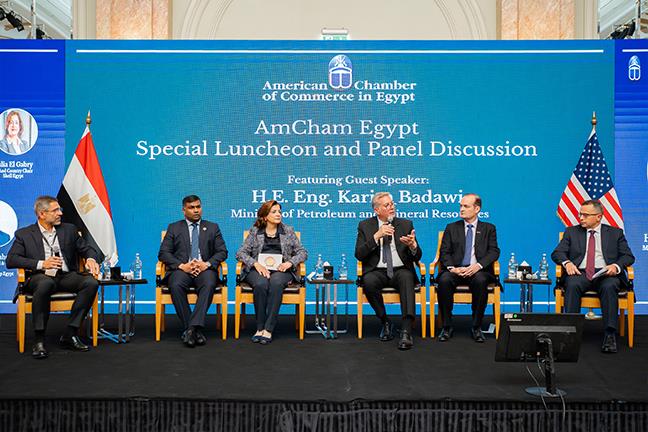

At a time when global energy systems are being reshaped by geopolitical tension and structural volatility, the American Chamber of Commerce in Egypt (AmCham Egypt) convened its April 7, 2026 Special Luncheon, “Energy Security Amid Regional Instability: Egypt’s Strategy for Resilience and Sustainable Growth,” bringing together policymakers and industry leaders to reflect on Egypt’s evolving energy strategy.
The discussion unfolded against a backdrop of mounting regional uncertainty, yet the tone remained forward-looking, anchored in the conviction that Egypt is not merely weathering disruption, but actively redefining its position within the global energy landscape.
Opening the session, Omar Mehanna, Chairman of AmCham Egypt, set the stage with a stark assessment of the global context. He emphasized that energy challenges are no longer cyclical shocks but structural realities, noting that energy security, affordability, and resilience have become central to national economic strategy.
He underscored that Egypt is simultaneously navigating immediate pressures, ranging from disrupted gas flows to rising energy costs, while advancing a longer-term vision that positions the country as a regional hub.
“The question is not whether the landscape is changing, but how quickly and how effectively we position ourselves within it,” Mehanna said.
From crisis management to strategic reform
At the heart of the discussion was H.E. Eng. Karim Badawi, Minister of Petroleum and Mineral Resources, who outlined a policy framework that moves beyond short-term stabilization toward structural transformation.
The minister explained that Egypt’s approach is rooted in two foundational principles: diversifying the energy mix and restoring investor confidence. He noted that the government has prioritized expanding renewable energy to reduce dependence on gas-fired power generation, while simultaneously addressing longstanding financial obligations to international partners.
He reiterated that Egypt’s energy transition is not a reactive measure, but a deliberate shift years in the making, stating: “Egypt needs to have the right energy mix to optimize its natural resources… with 42% of our energy needs to be from renewable energies by 2030.”
Equally significant, Badawi stressed that rebuilding trust with investors has been central to unlocking new capital flows. He emphasized that the government views private sector success as integral to national progress, noting that partnership is no longer a policy aspiration but a guiding principle.
A key indicator of this shift has been the rapid reduction of arrears owed to international oil companies where the balance has fallen significantly from $6.1 billion at the end of June 2024 to approximately $1.3 billion, with a goal of fully clearing it by next June. The minister framed this as a decisive break from past cycles, explaining that the government is committed not merely to reducing outstanding payments, but eliminating them entirely.
Industry alignment and renewed investor confidence
Industry leaders echoed the significance of these reforms, highlighting a tangible shift in both operational momentum and investor sentiment. Amr Abou Eita, Chairman of the AmCham Oil & Gas Committee and Managing Director of ExxonMobil Egypt, described the committee’s role as a bridge between policymakers and industry stakeholders, emphasizing its contribution to shaping reform through structured dialogue and technical collaboration.
From an operational standpoint, Wael Shaheen, Vice President for Egypt at bp, indicated that the resolution of arrears and improved fiscal terms have directly enabled project acceleration. He noted that bp is moving forward with new drilling activity expected to contribute significantly to Egypt’s gas supply in the near term, adding: “Resolving… the arrears enables us to continue to invest and to push forward with our projects.”
For Greg McDaniel, Executive Vice President at Apache Corporation, the shift has been equally evident at the investor level. He explained that conversations with stakeholders have evolved, from concerns about risk to a focus on opportunity, reflecting growing confidence in Egypt’s long-term outlook.
“Our investors are asking not so much about the risk associated with investing in Egypt, but what are those subsurface opportunities.”
Meanwhile, Dalia ElGabry, Vice President and Country Chair of Shell Egypt, pointed to the role of trust and policy consistency in sustaining long-term commitments. She noted that Shell’s continued investments across production, exploration, and infrastructure are underpinned by the strengthened relationship with the government, observing that recent progress has been driven by tangible policy implementation rather than rhetoric.
At Chevron, Channa Kurukulasuriya, Country Manager for Egypt, highlighted the importance of institutional accessibility and regulatory clarity. He suggested that the ability to engage directly with senior government stakeholders has become a critical enabler of investment decisions, reinforcing Egypt’s competitiveness as an energy destination.
Technology, integration, and the regional opportunity
Beyond immediate reforms, the discussion turned to the role of technology and regional integration in shaping Egypt’s energy future.
Minister Badawi emphasized that advanced technologies, ranging from seismic imaging to horizontal drilling, will be essential in unlocking new reserves and improving efficiency. He noted that Egypt is actively working to deploy these technologies at scale, while also introducing more flexible contractual models to incentivize investment across different basins.
At the same time, regional collaboration is emerging as a cornerstone of Egypt’s strategy. From cross-border gas development with Cyprus to electricity interconnection projects with Saudi Arabia, the country is leveraging its geographic and infrastructural advantages to position itself as a central node in regional energy flows.
Stability amid uncertainty
Despite ongoing regional tensions, the government sought to reassure stakeholders regarding supply continuity. Minister Badawi emphasized that Egypt has built sufficient infrastructure and diversification to withstand external shocks, explaining that recent conservation measures are driven by pricing dynamics and precautionary planning rather than logistical constraints.
“There is no logistical impairment to be able to ensure continuity of providing gas to all the sectors of the economy.”
A strategic point
What emerged from the discussion was a clear narrative, Egypt is transitioning from a reactive energy model to a proactive, integrated strategy that aligns policy, investment, and technology.
The convergence of government reform and private sector engagement is creating a foundation for long-term growth, one that extends beyond energy security to encompass economic resilience and regional leadership.
In this context, Egypt’s current challenges may ultimately serve as a catalyst. As the conversation at AmCham made clear, the country is no longer simply adapting to a changing energy landscape, it is positioning itself to shape it.