

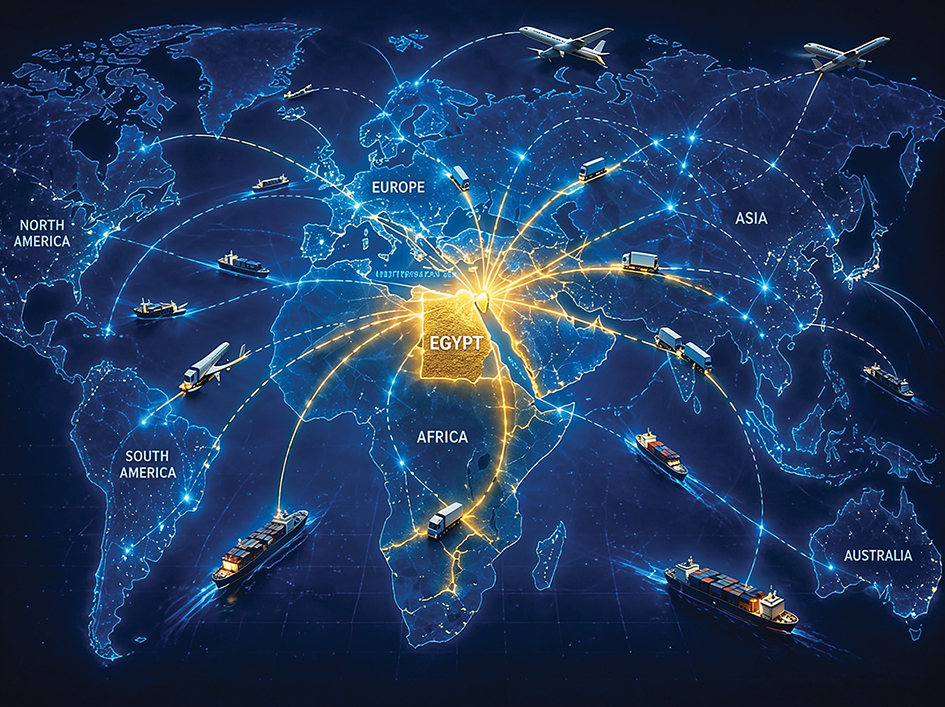

Disruptions in transportation and global supply chains present Egypt with new opportunities to emerge as a key transit and logistics hub.
The changing dynamics of global supply chains require countries to stay vigilant, as periods of volatility can quickly disrupt international trade. Such disruptions often arise when maritime chokepoints are affected by unforeseen events. According to ALG, a logistics and transport consultancy, in March, “More than 80% of global trade travels by sea. Yet the system hinges on a handful of narrow maritime chokepoints, and when one fails, the shock is immediate and global.”
In the meantime, global supply chains are being re-evaluated, signaling a shift away from the long‑standing focus on efficiency through predictability. The World Economic Forum highlighted in January that “Supply chains have become instruments of economic security, where governments and companies are reassessing where critical goods are made, who controls key inputs and how resilience can be safeguarded in an increasingly global system.”
The Iran war is probably the biggest threat to global shipping and supply chains since COVID-19. Antonella Teodoro, a senior consultant at MDS Trans-modal, a U.K.-based transport economics consultancy, notedin March, “The conflict is less of a systemic demand-and-supply shock than the pandemic, but it represents a persistent and potentially long-lasting disruption affecting all shipping segments – container, dry bulk, and oil tanker.”
Mohamed Nadim, group CEO for commercial and operations at Egytrans NOSCO, told AmCham members in March, “It is the right time to begin reassessing all global maritime chokepoints. The situation in the Strait of Hormuz cannot be addressed simply by creating a bypass, as happened with Red Sea traffic being diverted around the Cape of Good Hope. Rather, it requires new solutions, new frameworks, and new investments, particularly in multimodal transportation and integrated logistics solutions.” He added, “Egypt is ready for that and can be the best option globally.”
Spillover effect
Since the start of the war, the global economy has been severely affected. While disruptions may be uneven, economic costs remain substantial. “The global economy had been on course for stronger-than-expected growth before the war in Iran erupted, but that prospect has now all but disappeared,” said the Organisation for Economic Co-operation and Development (OECD) in March.
In the meantime, global GDP growth is projected to “ease from 3.3% last year to 2.9% in 2026, as rising energy prices and conflict‑related uncertainty outweigh the benefits of strong technology investment, lower effective tariff rates and growth momentum carried over from 2025,” the OECD noted.
These growth projections remain subject to change amid rapidly evolving developments. “There’s a high level of uncertainty around the duration and the magnitude of the current conflict in the Middle East, and that means this outlook is subject to significant downside risks that could result in lower growth and higher inflation,” OECD Secretary-General Mathias Cormann told journalists.
Not only does the conflict affect oil supply and demand, but the closure of the Strait of Hormuz risks disrupting global food security. “While the closure has acutely affected oil and gas supplies and prices, it could soon send convulsions through supply chains for other commodities, such as plastics and fertilizers, that are foundational to the global economy and food supplies,” said the Atlantic Council, an American think tank, in March.
Food prices rose sharply as the war drove up energy and freight costs worldwide, a U.N. report says. According to Oxford Economics, an advisory firm, global food prices are now forecast to rise by 6% this year, with further pressure likely as lower fertilizer use feeds into reduced yields. The full impact is therefore likely to extend beyond 2026.
With 20% to 30% of global fertilizer exports passing through the Strait of Hormuz, the closure is significantly impacting the global agricultural output, with prices skyrocketing. As reported by CNBC, Oxford Economics’ Alpine Macro said, “Urea and ammonia prices had surged by around 50% and 20%, respectively, since the war began. Other fertilizers, like potash and sulfur, have also risen in price.”
Notably, urea, a nitrogenous fertilizer produced from LNG, has been adversely impacted as LNG plants shut down, Deloitte noted. Qatar, for instance, has stopped production at its largest urea manufacturing facility.
The war is also having a direct impact on tourism in the region ahead of the 2026 travel season. According to Euronews in April, the conflict in Iran is costing the Middle East travel and tourism industry 515 million euros ($603 million) a day. This estimate is based on the World Travel and Tourism Council’s pre-war 2026 forecast, which projected international visitor spending of 178 billion euros across the region this year.
Alternate routes
In 2025, about 20 million barrels per day of crude oil and petroleum products passed through the Strait of Hormuz, noted Akrur Barua, associate vice president, Deloitte Services India. Its strategic location connecting the Gulf of Oman with the Persian Gulf has become the focal point of energy tensions.
Notably, the Strait of Hormuz is the primary export route for oil produced by Saudi Arabia, the U.A.E., Kuwait, Qatar, Iraq, Bahrain, and Iran. While Saudi Arabia and the U.A.E. have some alternative export routes, other countries, including Iran, Iraq, Kuwait, Qatar, and Bahrain, rely on the strait.
Barua added that alternate routes for oil exist from Saudi Arabia through the Red Sea, and from the United Arab Emirates through Fujairah. However, he noted that “their existing capacity is just about 3.5 million to 5.5 million barrels per day – that too, with certain logistical constraints.”
A potential alternate route to the Strait of Hormuz, if the threat of closure persists, is around the Cape of Good Hope in South Africa. Yousri El-Sharkawy, international investment adviser and chairman of the Egyptian African Businessmen’s Association, told Ahram Online, “The shift to the Cape of Good Hope route, if risks expand, could in some cases triple shipping costs, in addition to a noticeable rise in cargo insurance premiums.”
Emphasizing the growing importance of multimodal solutions, Mohammad Shihab, executive vice president for the North Africa Cluster, MENA & SCO Region at DP World Sokhna SAE, told AmCham members in March that ongoing disruptions are prompting a reassessment of logistics models long dominated by maritime shipping, which has been viewed as the simplest and most efficient option.
He explained this reassessment includes re‑evaluating whether sourcing must continue from the Far East or whether near‑shoring to North Africa – such as Türkiye, Egypt, or Morocco – offers a more efficient and resilient alternative, a perspective shared by many European businesses. “At the same time, there is renewed discussion around creating land bridges and cross‑border solutions that were previously overlooked because the focus was almost exclusively on cost and efficiency,” he said.
Opportunity emerges
For a country like Egypt, which is bearing the costs of the current crisis on multiple fronts, the government continues to take measures to mitigate its repercussions. “Current events largely outside Egypt’s control are creating unexpected economic pressures that warrant careful monitoring,” said James Harmon, chairman of the Egyptian-American Enterprise Fund and former chairman of the U.S. Export-Import Bank.
Hisham Ezz Al-Arab, CEO and board member of Commercial International Bank (CIB), told Global Finance Magazine in March, “the conflict provides an opportunity for Egypt as it hosts alternatives to the Hormuz Strait: the Sumed pipeline (2.5 million barrels per day capacity), as well as being a possible bridge to Saudi Arabia’s Red Sea pipelines (5 million barrels per day capacity).” This, he said, helps position Egypt as a strategic partner in the current crisis, providing the country with preferential access to a congested oil market.
The Sumed pipeline – originally designed as an alternative route when oil shipments face obstacles passing through the Suez Canal – offers a vital opportunity for enhancing the flexibility and resilience of regional oil supply flows. According to Egypt’s Minister of Petroleum and Mineral Resources, Karim Badawi, in March, Egypt is prepared to cooperate with Gulf states to facilitate oil transport from the Red Sea to the Mediterranean through the line.
To offer alternative routes while also maximizing economic returns, Nadim of Egytrans NOSCO said Egypt should start “acting in a more proactive, revenue‑generating role by fully positioning itself as a regional and global logistics hub.”
He underscored that over the past decade, the state has laid solid foundations through a long‑term strategy that included developing new sea terminals and dry ports, expanding terminal capacity, investing in railways and high‑speed trains, and upgrading more than 4,000 kilometers of roads. “We, as a trucking company, feel the difference in reduced operating and maintenance costs. Regulatory reforms and digitalized customs clearance have also eased paperwork,” said Nadim.
However, he reaffirmed that maritime transport would remain critical, given that its economies of scale are far superior. A single coastal feeder vessel carrying 500 TEUs – the equivalent of 250 40‑foot containers – would otherwise require 240 trucks with far higher costs, risks, time, and accident exposure, he noted.
Aviation resilience
The aviation sector in Egypt remains resilient. As reported by the Egyptian Gazette, the Wego platform, a global travel search engine, has identified Egypt as a “vital corridor for international flights, serving as a reliable alternative for airlines rerouting to avoid closed airspace elsewhere in the Middle East.”
There is a clear and time‑sensitive opportunity to expand the market and redirect a significant share of global travel flows into tourism and transit through the country. “Capacity can be increased not only by growing the national fleet, but also by leasing aircraft – on short- or long-term arrangements – from carriers that have suspended or reduced operations,” said Ahmed Adel, chairman & CEO, EgyptAir Holding Co
Adel emphasized that geopolitical disruptions and airspace closures have severely affected connectivity between Europe and the Far East, forcing traffic that once transited through major global hubs to seek alternative routes. “Egypt is well-positioned to capture this diverted traffic, including flows between the U.K. and India,” he said.