


Regional instability is driving the Egyptian government to strengthen its strategy for resilience and sustainable growth, anchoring its role as a regional energy hub.
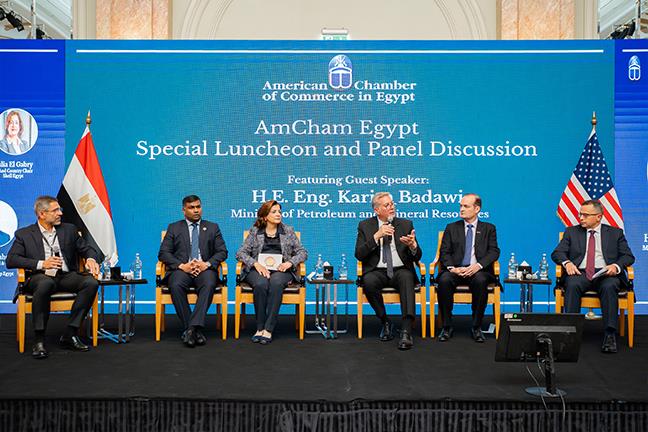
On April 7, AmCham Egypt hosted its monthly luncheon featuring the Minister of Petroleum and Mineral Resources, Karim Badawi, as the keynote speaker. Badawi addressed Egypt’s strategy for resilience and sustainable growth. The meeting also hosted a panel discussion that featured senior executives from international energy companies operating in Egypt, including Apache Egypt, BP, Chevron, and Shell Egypt.
Panelists included Dalia El-Gabry, chair of Shell Egypt; Wael Shahin, regional vice president of BP in Egypt; Greg McDaniel, senior vice president of international assets at Apache Corp. and general manager of its Egypt operations; and Channa Kurukula Surya, country manager of Chevron Egypt.
Since March, the U.S.-Israel war against Iran has significantly impacted global energy markets, disrupted supply chains, and pressured domestic production. Such developments have prompted the Egyptian government to adopt certain energy-saving measures, raising public questions about their cost‑benefit justification and role in energy security.
“Looking ahead, the opportunity lies in how Egypt leverages this moment as it emerges from the crisis,” said Amr Abou Eita, chairman and managing director of ExxonMobil Egypt and chair of the AmCham Oil and Gas Committee. “The country holds a clear structural advantage through its infrastructure, geographic positioning, regional connectivity, and capabilities embedded within the energy sector.”
He added that by strengthening partnerships and investment frameworks, Egypt is well-positioned to become more resilient and to solidify its role as a regional energy hub.
That said, the government offers incentives to the private sector, reinforcing a spirit of unity and partnership.“When the private sector thrives, the government can unlock potential in the most cost‑effective way for the benefit of the people of Egypt and regional partners,” said Badawi.
Strategic readiness
In the meantime, participants agreed that Egypt entered the current crisis better prepared than many others. Badawi said the government had already reached a foundational realization built on two key principles. First, pursuing the right energy mix to optimize Egypt’s natural resources, supported by active policy measures – most notably revising the energy strategy to target 42% of energy needs from renewable sources by 2030. “This shift is critical to reducing reliance on gas for power generation, which currently accounts for around 60% of gas use,” he said.
Secondly, the government has emphasized partnerships, while recognizing that the success of its partners is crucial. “Ensuring timely payments and honoring commitments are not optional, but essential obligations that underpin investor confidence,” said Badawi.
Together, these two key principles contribute to shaping policies that foster a secure long‑term investment environment. This, in turn, “increases local oil and gas production to mitigate declines caused by past underinvestment and accelerates renewable energy deployment to ease pressure on gas supplies,” the minister noted.
The government’s key goal is to minimize the cost of oil and gas. Badawi explained that the government has been working closely with partners to reassess key commercial terms, including gas pricing. This effort aims to make gas projects attractive investments in areas where development was previously constrained by pricing structures in legacy agreements that no longer reflect current market conditions. He cited partnerships, such as Apache’s operations in the Western Desert, as examples.
Another key policy is reviewing, extending, and merging agreements, allowing partners to invest and recover their money during the duration of their agreements. “The five‑year structure was a key challenge leading to reduced investment due to limited recovery potential, minimizing shareholder returns and local production,” said the minister.
Other policies include offering additional production and exploration blocks close to existing infrastructure, enabling partners to scale up activities while leveraging that infrastructure to reduce development costs.
Badawi emphasized the importance of cross-border collaboration, particularly with Cyprus. “Together, we worked to unlock gas discoveries most cost-effectively by leveraging existing facilities in Egypt, either through export terminals or industrial infrastructure to serve industries such as fertilizers, value‑added derivatives, or the growing local market.”
The impact of the policies has been reflected in the government’s commitment to deliver on receivables, driven by top leadership. “This is why arrears declined from $6.1 billion in June 2024 to $1.3 billion by March 2026, with arrangements in place to reach zero by June 2026,” said Badawi.
On regional collaboration, the ministry is also advancing renewable energy and electricity connections. This includes the Egypt–Saudi Arabia grid connection, which is progressing on the ground.
Partners work
Shahin underscored that as of March, BP had already deployed the new DS12 rig, an advanced drill ship currently in Egypt’s Mediterranean waters, for a multi-well campaign, and the company is in the process of spudding its first well. “This well will add 100 million scuffs of gas that Egypt will need by the summertime,” Shahin noted.
BP’s rig campaign, he said, includes spudding wells that will bring production as soon as possible, while also investing in exploration to meet Egypt’s gas demand in 2028 and 2030. In April, BP and ENI, a global energy tech company, celebrated a significant gas and condensate discovery offshore following the successful drilling of the Denise W-1 exploration well in the Temsah Concession in the eastern Mediterranean.
For Apache, McDaniel emphasized Egypt’s strategic role in recognizing the importance of energy security and the changes the ministry made many years ago. The government’s active pursuit of reform has allowed Apache to secure a competitive gas price that enabled investment and exploration in the Western Desert, where the company had traditionally focused on oil.
This, he said, “created a win‑win scenario for Apache, our investors, and Egypt. We have seen a shift in discussions with our executives, where investor questions are no longer centered on the risk of investing in Egypt, but rather on subsurface opportunities and the future outlook.”
Shell Egypt, as El-Gabry noted, has been committed to Egypt for more than 110 years. “We have been very active on the production side, increasing production from West Delta Deep Marine, putting phases 10 and 11 in place, and progressing on phase 12.”
El-Gabry highlighted that Shell deployed a four-dimensional seismic survey in the West Delta Deep Marine (WDDM), revealing promising opportunities, the first of its kind in Egypt. This stems from the company’s belief that the WDDM concession in the Mediterranean Sea still has significant potential. On the exploration side, the Stena IceMAX drillship in the Mediterranean Sea was the first drillship to come to Egypt in 2026 and is currently drilling a West Mina well, which is expected to come onstream before year-end.
Additionally, in partnership with Chevron, Shell is working on the frontier Herodotus basin, the first basin of its kind in Egypt, projected to bring significant value to the country.
Having been in Egypt for nearly 90 years, primarily on the downstream side, Chevron has entered Egypt’s upstream sector through exploration blocks since 2020. According to Surya, “Chevron currently holds three exploration blocks and is in negotiations with the government to secure three additional blocks, while drilling two high‑impact wells. One is operated by Shell in North Cleopatra, and in the Nargis discovery, we are drilling another appraisal well.”
On the exploration front, Chevron holds significant acreage and is active in the regional gas supply. In partnership with the ministry, EGAS, and Chevron’s Cyprus asset, Aphrodite, the company successfully negotiated several critical enabling agreements to ensure gas is delivered to Egypt. This outcome was made possible through the ministry’s efforts to remove key barriers, ensuring benefits for both Cyprus and Egypt, strengthening investor confidence, and ultimately delivering value to the Egyptian people, Surya noted.
Looking forward
Badawi has emphasized the role of technology in advancing progress and unlocking new opportunities. “I am an optimist and a strong believer in technology, partnership, and collaboration to unlock what was previously unseen, and a key focus is enabling the deployment of technologies already used globally, but not yet scaled effectively in Egypt,” he said.
The government also aims to expand existing technologies not yet widely applied at scale, such as horizontal drilling and hydraulic fracturing. This, he said, would be supported by appropriate financial structures to accelerate investment while ensuring safety, efficiency, and scalability.
In parallel, the ministry is promoting more flexible contractual models—such as lump‑sum turnkey and performance‑based contracts – to improve efficiency and accelerate production. Given the differences between economies in the basin and region, the ministry introduced tailored models like the R‑factor for deepwater and frontier areas in partnership with ExxonMobil and expanded them across the western Mediterranean, Red Sea, and the Southwestern Desert. “This enables earlier investment recovery for the private sector, while accelerating exploration and unlocking Egypt’s full resource potential through collective effort with our partners,” said Badawi.
Overcoming Challenges
BP’s 63 years in the country have shown how the industry has naturally progressed from easy oil and gas to more complex resources. According to Shahin, the main challenge companies currently face is long lead times, which require earlier planning for equipment.
Shahin noted that a recurring question is whether service providers can localize more manufacturing within the country rather than relying on overseas production. Doing so would significantly reduce waiting times caused by shipping delays and represents a genuine opportunity for collaboration. He argues that R‑factors have enabled oil companies to re‑examine development approaches, particularly when combined with technology. This is evident in BP’s first well, which is expected to deliver around 100 million standard cubic feet and is effectively near‑horizontal, with ambitions to progress toward multilateral wells in the near future.
He emphasized that aligning all stakeholders around a single objective – speed and rapid delivery – is critical. This is especially important given Egypt’s strong base of capable local companies that can support construction. “Marshaling everyone around this shared goal will be paramount in the period ahead,” Shahin said.
McDaniel acknowledged that achieving full self-sufficiency in energy, oil, and gas is challenging, but emphasized that it requires all companies to operate with a high level of efficiency. This includes a deep understanding of core operations—such as drilling development wells, exercising discipline as operators in secondary development, and continuously pursuing exploration to identify new resources. “As the easy resources, particularly in the Western Desert, have largely been found, it will require greater application of technology, new approaches, and ongoing training of our staff to learn from operations such as those in the Permian Basin in the United States and apply them in Egypt, where there is still significant upside to be realized.”
El‑Gabry stressed that sustaining the progress already achieved is itself a significant challenge. She cited the pivotal role of the ministers’ roundtable and the integrated government approach to the oil and gas sector, which provided investors with strong reassurance that the focus extends beyond oil and gas to include finance and investment as well. “This holistic view has helped improve cash‑flow predictability while building confidence and trust among investors.”
Surya highlighted the importance of access to senior government stakeholders. “Continued access to senior leadership – not only at the ministerial level, but across partner institutions such as EGAS and EGPC – truly unlocks value.” Such access, he said, is essential to underpinning the investments the company plans to make in Egypt and beyond.