

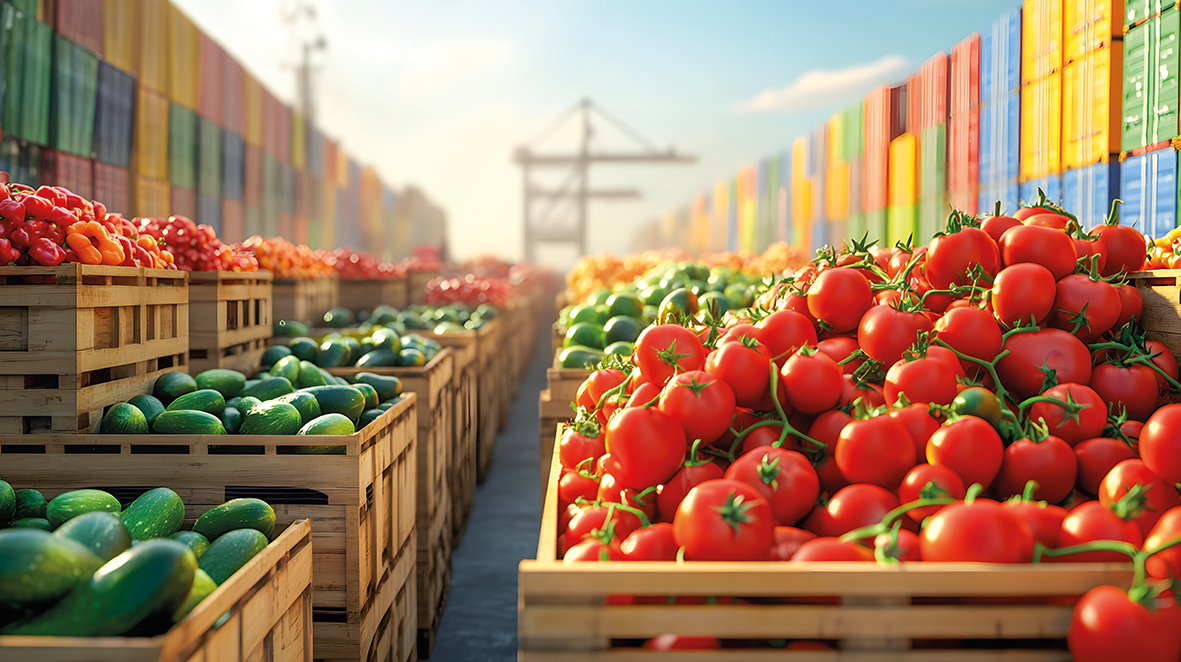

Egypt aims to increase food exports to GCC nations. For this to happen, the government needs to expand its seaports, logistics, and road network to reach Gulf markets.
For Saudi Arabia, the UAE, Qatar, Kuwait, Bahrain and Oman, Iran’s decision to selectively block freight from crossing the Strait of Hormuz is not only hurting their oil exports but, more importantly, food imports.
The World Economic Forum (WEF) estimates “the GCC imports 85% of its food.” Neil Quilliam, associate fellow at Chatham House think tank, noted “over 70% of [these] GCC foodstuffs [are] imported through the Strait of Hormuz.”
Meanwhile, Transport Insight, a freight management company, noted that about 39% of the GCC’s wheat and coarse grain imports come through the Bab al-Mandab Strait, where Yemen’s (Iran-affiliated) Houthi rebels have been attacking select freighters since November 2023.
To avoid a food shortage, Egypt could emerge as a major supplier, with freight crossing from Egypt’s Red Sea ports in the west to Saudi Arabia’s harbors in the east, and from there using land freight to reach the other five GCC states.
The Egyptian side is preparing for such a scenario. “The Ministry of Agriculture and Land Reclamation [is working on] a plan to enhance the access of Egyptian agricultural exports to Arab markets, particularly Gulf countries,” the State Information Service reported in March.
That would require Egypt to significantly accelerate scaling of multimodal transport and logistics infrastructure along the Red Sea. However, several challenges persist, especially in expanding cold storage facilities.
Domestic logistics
Exporting fresh and frozen produce to the Gulf requires fast, efficient transport from Egypt’s farms and processing facilities to Red Sea ports. In Sinai, one land route is the 500-kilometer (310-mile) Arish-Taba cargo highway, which, according to the Ministry of Transport, “passes through the heavy industry areas in Sinai.”
Another important cargo route is the Ferdan-Beir El Abd train line, connecting Ismailiyah with North Sinai via the Ferdan Railway Bridge, which crosses over the Suez Canal. On the peninsula, the road heads north then east to connect with the Arish-Taba road and rail networks.
In April, the government announced tenders for five logistics zones on the peninsula along the Arish-Taba corridor in addition to those existing in Beir El Abd, East Qantara, Gelbana, and Romana in North Sinai. “The push comes as shipping disruptions – including threats around Bab El Mandeb and the closure of the Strait of Hormuz – are pushing shipping agents and freight forwarders to establish alternative overland routes,” two unnamed government officials told local media.
In the Eastern Desert, the government announced in January plans to upgrade roads and rail tracks in the Safaga – Qena – Abu Tartour logistics corridor to attract investment and development.
In February, Kamel El Wazir, Minister of Transport, unveiled plans for a “high-speed electric rail project [that would] connect coastal cities on the Red Sea with the Delta, and would reach East Oweinat and Toshka” in the Western Desert, where more agricultural pockets are located. “It would also connect all crossings linking the east and west banks of the Nile.”
Sea and land
The second piece of Egypt’s Red Sea logistics puzzle is upscaling seaport capacity to handle potential increases in food headed to the Gulf.
In April 2025, the Ministry of Transportation said it would construct a new 52.5-acre maritime cargo and tourist port in Taba, costing EGP 4 billion ($77,000). “This port will noticeably reduce transit time between Egypt and Saudi Arabia as part of a plan to link all of Sinai via the latest maritime and rail channels with neighboring countries,” said the ministry press release.
In September, the Maritime Transport and Logistics Sector, a department under the Ministry of Transport, announced upgrades to four unnamed Red Sea seaports. In October, it highlighted upgrades to Sokhna Port. These include “adding 18 kilometers of berths, [and] 8 million square meters [of new] logistics zones [as well as] a 30-kilometer railway network within the port.”
In January, Red Sea Container Terminal 1 at Sokhna Port came online. In February, the International Finance Corp. (IFC) announced “a partnership with Safaga Terminal Operating Co., owned by UAE‑based AD Ports Group, to expand access to critical port services in Egypt. This investment will improve the efficient movement of agriculture and food products,” among other goods.” The project is projected to cost $115 million.
“The terminal is a central component of the Safaga-Qena-Abu Tartour integrated logistics corridor … to establish the country as a regional hub for transport and transit trade,” the IFC said.
In March, the Ministry of Transport announced it was accepting tender offers to build a new cargo port in Berenice, a Red Sea port 140 kilometers south of Marsa Alam, with a 1.2-kilometer-long berth 17 meters deep, along with logistics and service areas.
In April, the Egyptian Customs Authority rolled out fully digital export procedures, saying, “The new system … fast-tracks exports amid increased international demand for Egyptian goods as the war on Iran continues to disrupt global supply chains.”
The government also aims to build land routes to Gulf markets. In June 2025, several regional media outlets reported the dormant bridge project connecting Egypt (Sharm El Sheikh city) and Saudi Arabia (Ras Alsheikh Hamid city) would be restarted at a cost of $4 billion. “The current proposal includes not only a bridge or a tunnel, but also a high-speed railway line to transport cargo and passengers across the Strait of Tiran,” said Parametric Architecture, a Turkish news outlet.
This bridge means produce could be transported over land almost without stopping until it reaches the Gulf, rather than switching from land to maritime freight and back to land.
Yet these expansions aren’t ambitious enough. “Despite the fast growth of the country’s Red Sea ports, expanding by 6.8% annually, some remain underdeveloped in both capacity and modern infrastructure, which raises logistics costs and limits access to global markets for export-oriented industries in Upper Egypt,” said the IFC.
Hurdle-filled expansion
Cold storage is the most important part of the logistics infrastructure for exporting fresh produce and frozen foods. “Perishable goods are items that have a short shelf life and can spoil easily or even become unsafe if not kept at optimum temperatures,” said SEKO Logistics. “Typically, they require refrigeration or freezing.”
A September report by Ken Research, a consultancy, said almost half of Egypt’s cold storage investments are in refrigerated warehousing and transportation.
Expanding beyond current capacity is challenging despite “increasing demand for perishables, … expansion of e-commerce and an online grocery … and government initiatives for food safety,” noted Ken Research.
The biggest issue is “inadequate infrastructure, [where] Egypt’s cold chain infrastructure is currently underdeveloped with only about 15% of the required cold storage capacity in place,” the Ken Research paper said. “This inadequacy leads to significant losses, estimated at approximately $1.5 billion annually due to spoilage.”
The “lack of efficient transportation networks further exacerbates this issue, making it challenging for businesses to maintain the integrity of perishable goods throughout the supply chain, hindering market growth.”
Another challenge is “high operational costs … associated with cold chain logistics in Egypt. [They] are approximately 25% higher than in neighboring countries,” the report noted. “Factors contributing to these costs include energy expenses, which account for around 40% of total logistics costs, and the need for specialized equipment,” said Ken Research. “These high costs can deter investment in cold chain solutions, limiting the market’s potential for expansion and innovation.”
The key to overcoming these cold-storage challenges is Egypt’s rapid digital transformation. “The future of the cold chain market in Egypt appears promising, driven by increasing investments in infrastructure and technology,” Ken Research noted. “The integration of IoT (Internet of Things) technologies will enhance monitoring and efficiency … The sector is poised for significant transformation, aligning with global trends toward sustainability and efficiency.”