


For decades, the Gulf Cooperation Council (GCC) has been a major investment hub for companies seeking access to Asia, Europe, and Africa. “The smart money is going into the GCC,” Mohamed Yakout, senior analyst at Scope Markets, a trading solutions provider, said in November. “The Gulf is becoming one of the world’s most compelling investment theaters.”
However, the ongoing Middle East conflict that began in February is changing that perception, especially after Iran blocked nearly all freight through the Hormuz Strait, which handles 20% of the world’s oil exports and most of the GCC’s imports, including food and water.
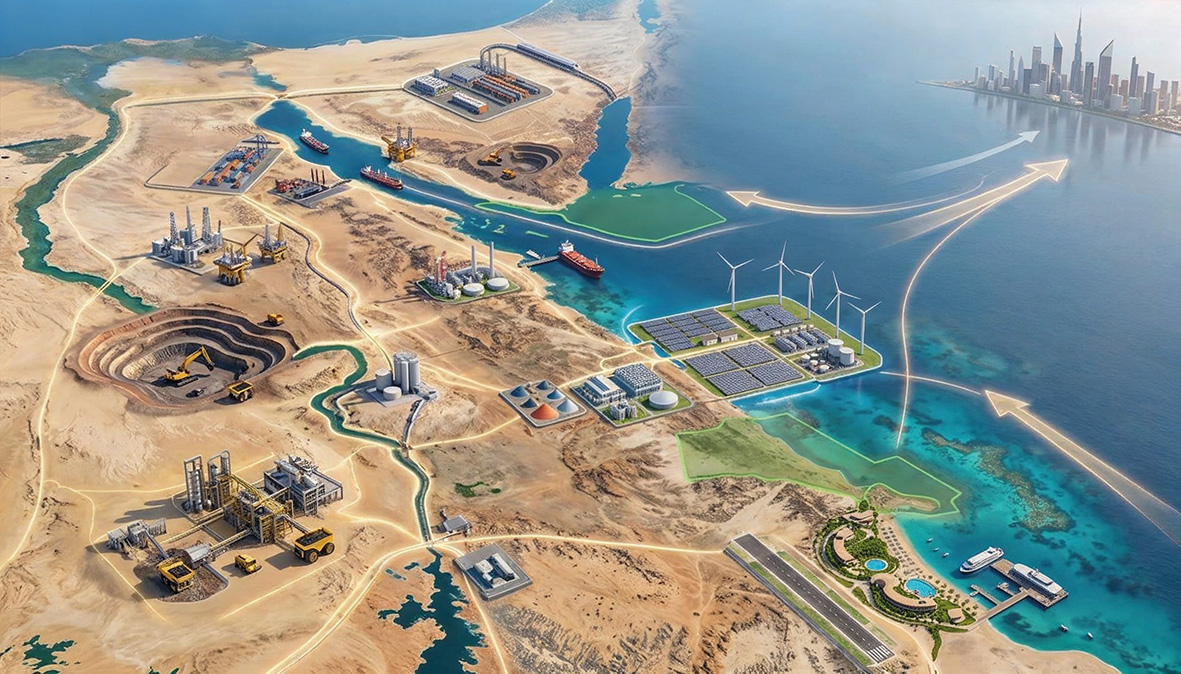
One alternative for investors still seeking a presence in the region is Egypt’s Red Sea coast, Sinai, and Eastern Desert. For one, Egypt is distancing itself from the war and maintaining a stable business environment. Additionally, the country is actively promoting investment in the Red Sea by introducing general and region-specific FDI incentive packages, as well as government-led flagship national projects.
Incentivizing investments
According to research by AmCham Egypt, “Incentives are broadly categorized as general, financial, non-financial and sector-based … including reductions and/or exemptions of taxes, customs duties and administrative fees; expedited project approvals; and relaxed import and export requirements.”
One example is the Golden License for Egypt-based companies operating in renewable energy, oil and gas, public utilities, infrastructure, ports, roads and transportation, ICT, tourism, and certain types of manufacturing and real estate projects.
“This one-stop license encompasses construction licenses, real estate allocation and investment incentives, allowing companies to establish, operate, and manage projects without additional interaction with separate state agencies,” noted AmCham Egypt’s research.
Another perk is that companies can apply to have plot projects classified as a private free economic zone or enter a government-sponsored public free economic zone to access additional incentives, simpler bureaucracy, and sole regulation by the General Authority for Investment and Free Zones.
Special place
In September, the government said it would catalog investment plots in the Eastern Desert and along the Red Sea coast. That redistricting is a precursor to updating allocation mechanisms, incentive packages, and other support measures to accelerate development, according to local media.
So far, most cataloged and price-updated plots have been for tourism investments. These plots benefit from “additional measures in place to fast-track projects and tourism in this area,” according to several local media outlets. The latest is Ras Sukair, which attracted preliminary interest from GCC investors in September.
In October, Badr Abdelatty, Egypt’s foreign minister, announced the Suez and Red Sea Initiative to “strengthen economic integration among countries bordering the Red Sea.” That would include Saudi Arabia, Jordan, Sudan, Eritrea, Djibouti, and Yemen.
Abdelatty said the initiative would involve “a series of year-round programs, capacity-building activities and targeted initiatives,” adding that the outcomes from each round will “feed into the next” cycle of facilitation.

Top sectors
One priority sector in the Red Sea is tourism. In September, U.A.E. real estate developer Emaar Misr committed to building a $1 billion seaside resort, Marassi Red Sea. Its master plan includes 12 hotels with more than 4,000 rooms; an international marina with passport and customs services; and 500 retail and dining outlets.
Also that month, Prime Minister Mostafa Madbouly told the media that the government plans to develop four to five new large coastal areas along the Red Sea. “These sites will feature integrated development projects aimed at revitalizing promising regions,” he said.
“The initiative is modeled after the successful Ras El-Hekma project,” said Madbouly, which the Tahrir Institute for Middle East Policy Studies describes as a strategic co-development partnership between the Egyptian and Emirati governments.
In February, Tatweer Misr announced the $1.06 billion Il Mont Galala Towers and Marina project in Il Galala City, 56 km (35 miles) south of Suez Governorate. The towers will include hotel facilities, residences, and an international marina.
Beyond tourism investments, the Sukari Gold Mine has been operational in the Eastern Desert since 2009. In 2024, Draya, a local think tank, noted the presence of “a project to exploit and manufacture phosphate ore south of the Qena-Safaga road [and] a project to produce glass, crystal, quartz and silicon chips west of Safaga.”
Draya also said many agricultural experiments had been conducted during winter, including “planting 35 acres of sunflowers … raising tilapia fish in agricultural water collection ponds, [and] housing and reconstruction projects.
Overlooked national project?
The Golden Triangle Project is the earliest mega national project in the Eastern Desert. Announced in 2014, it is a mining project bordered by Safaga and Quseir on the Red Sea and by Qena on the Nile.
According to Draya, the project should attract FDI in Upper Egypt, making it “one of the most important national projects within Egypt’s Vision 2030. The project contributes to achieving sustainable development for the Upper Egypt region within the framework of the state’s comprehensive development strategy.”
Currently under construction in the Golden Triangle are the Safaga 2 Terminal and a road connecting Quseir to Marsa Allam (outside the project borders). The latter primarily focuses on tourism.
In January 2025, the CEO of the General Authority for Investment and Free Zones (GAFI) announced discussions with Asia-Potash, an investment firm, to establish an industrial complex in the Golden Triangle for phosphate fertilizer production, expected to be operational in 2027 and valued at $1.6 billion.
A year later, Minister of Petroleum and Mineral Resources Karim Badawi witnessed an MoU signing between the Egyptian Mineral Resources Authority and mining companies Phosphate Misr and New Valley Company for Mineral Resources and Oil Clay, along with China’s Xingfa Group. The agreement aims to “study and evaluate phosphate ore, quartz and silica sands,” according to the State Information Service in January.
How it’s done
The most promising investment region in the Eastern Desert is the Suez Canal Economic Zone (SCZone), established in 2015 when the new Suez Canal opened. In February, Walid Gamal El-Din, SCZone chairperson, said the zone has attracted $15 billion in investments, “70% foreign and 30% domestic.” The main sectors include “textiles, electric batteries, tires and cast iron, along with pharmaceuticals, [and] building materials,” he said.
One reason for the SCZone’s success is “it includes six seaports that serve as a key logistical backbone for trade and industry, reinforcing the zone’s position as a regional hub for manufacturing and re-export activities,” said Gamal El-Din.
Another reason is “the flexibility of its one-stop-shop investor services, the readiness of infrastructure and utilities in line with international standards, and the institutional integration between its industrial zones and affiliated ports,” he told the media.
Lastly, there are “ongoing efforts to complete infrastructure and utility projects across all industrial ports, particularly amid rising investment demand, noting that these measures have strengthened the zone’s standing among global financial and business communities.”
GCC wish list
To unlock the full investment potential of the Red Sea coast and Eastern Desert, the government must recognize the evolving strategies of the GCC’s sovereign wealth funds (SWFs).
In fiscal year 2023/2024, data from the Central Bank of Egypt showed over 85% of FDI in Egypt came from Persian Gulf countries. Meanwhile, a report from the American University in Cairo (AUC) indicated that GCC cross-border investments are primarily made by each country’s SWF.
“The findings show that GCC SWFs prioritize investments in strategic sectors, geographical destinations and the private sector,” the AUC report noted. “These investments align closely with their respective [2030] national development plans [as well as their] respective geopolitical aspirations.”