

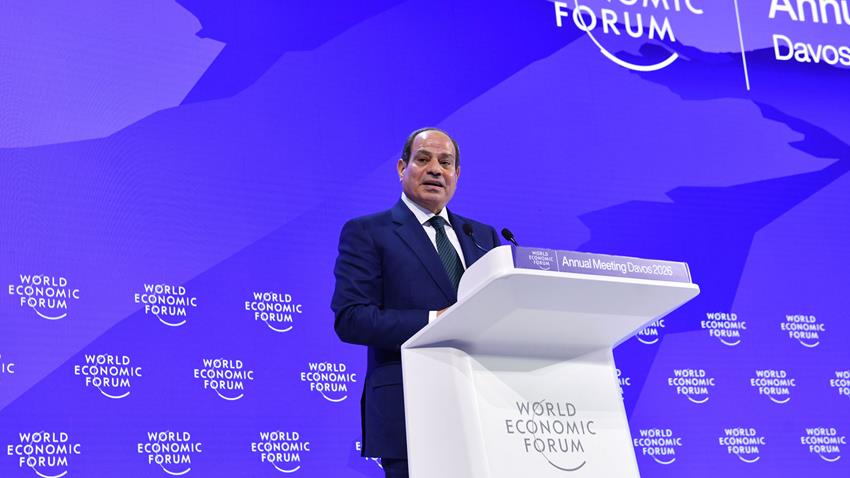

At the World Economic Forum (WEF) in Davos, President Abdel Fattah El-Sisi highlighted Egypt’s reform-driven development model, linking infrastructure, private-sector growth, and human capital to long-term economic resilience and regional stability.
El-Sisi highlighted that Egypt’s investments over the past decade have strengthened both economic fundamentals and the country’s role as a stabilizing force in the region. “The infrastructure per se is in itself a stabilizing factor, because businessmen and institutions are inclined to come to Egypt to contribute,” he said on January 21.
Infrastructure and connectivity as growth drivers
The president outlined Egypt’s focus on building modern infrastructure to attract investment, citing enhanced connectivity between the Red Sea and the Mediterranean, upgraded road and rail networks, ports, airports, and energy systems. These developments, he noted, provide both operational efficiency and confidence for international investors assessing the market.
Private sector central to reform
Expanding the private sector’s role in inclusive growth remains a core reform pillar. Egypt has capped public investment in select sectors and launched a state exit strategy to create space for private capital. “The private sector should be enabled to carry out a key role in achieving inclusive development,” El-Sisi said. He added that these measures have supported improved growth rates, increased private investment, and positive engagement with international financial institutions.
Reform momentum and IMF coordination
El-Sisi noted that Egypt’s fiscal, monetary, and legislative reforms continue in coordination with the International Monetary Fund (IMF). “The last review with the IMF, which was held last month, reiterated the fact that we are on the right track, we as Egypt,” he said, citing first-quarter growth of 5.10%. He stressed that reforms are ongoing and adaptive to ensure a competitive business environment: “We have done a lot of things, but we still have a lot to do in Egypt in order to have a proper incentivizing atmosphere to attract foreign investments.”
Investment opportunities and market access
The president highlighted sectors offering investment potential, including renewable energy, electric vehicles, logistics, pharmaceuticals, ICT, data centers, and AI applications. He also underscored the Suez Canal Economic Zone as a strategic platform for trade and manufacturing, benefiting from Egypt’s network of free trade agreements. “The investor who chooses to work in Egypt will not only benefit from the promising local market, but will open up to broader markets linked with Egypt by FTAs in both the Arab and world economies,” he said.
Human capital and the digital economy
Education and skills development remain critical for Egypt’s adaptation to technological change and the digital economy. With over 30 million students in schools and 4.5 million enrolled in universities, El-Sisi described human capital as a national asset: “We need to make sure that our capital, human capital, is ready to meet the challenges by providing graduates that are knowledgeable, able to meet the new tech era.”
Regional role and outlook
On regional matters, El-Sisi reaffirmed Egypt’s long-standing role as a stabilizing force and mediator, particularly in conflict resolution. “Our overall goal is to provide stability in the region, because the region has been prone to conflict in the last 10 years,” he said. He expressed confidence that economic reform, private investment, and regional cooperation can reinforce peace and development.
For investors, El-Sisi’s message from Davos was clear: Egypt is pressing ahead with reforms, expanding private-sector participation, and positioning itself to capture opportunities in a rapidly changing global landscape.
Enhancing strategic partnership and regional stability
On the sidelines of his participation in the World Economic Forum in Davos, President Abdel Fattah El-Sisi met today with U.S. President Donald Trump. The meeting addressed the distinguished bilateral relations between Egypt and the United States and explored avenues for advancing cooperation across political, economic, and security fields, in addition to exchanging views on key regional and international issues of mutual concern.