


Pricing incentives, vessel redeployments, and renewed service routes suggest a measured return of confidence in the Suez Canal. After years of caution, the reappearance of the world’s largest container ships is beginning to look less like chance and more like calculation.
The Suez Canal Authority (SCA) has signalled a clear strategy. Through press releases in late January and February 2026, it highlighted three converging trends: ultra-large vessels returning, major alliances restoring services, and financial incentives reshaping the economics of the route.
A 15% toll reduction shifts the equation
At the core is Navigational Circular No. 3/2025, offering a 15% toll cut for container ships over 130,000 net tons. Since May, 64 qualifying vessels have transited under this scheme, totalling 9.9 million tons. More broadly, SCA’s flexible pricing framework introduced in 2025 attracted 784 vessels, 36.6 million tons in net tonnage, generating $170.4 million in revenue.
For ultra-large container ships, the numbers are significant. Diverting around the Cape of Good Hope adds thousands of nautical miles, increases fuel costs, and complicates port schedules. A double-digit toll reduction meaningfully narrows this gap, at a time when carriers are factoring in insurance premiums, security, and schedule reliability.
The return of 24,000-TEU-class vessels
The impact is visible. In late January, CMA CGM SEINE, a 250,000-gross-ton ship capable of carrying nearly 24,000 TEUs, completed its first northbound transit. Since December, 15 CMA CGM vessels over 130,000 net tons have used the Canal, contributing to 38 transits under the SCA’s flexible pricing rules.
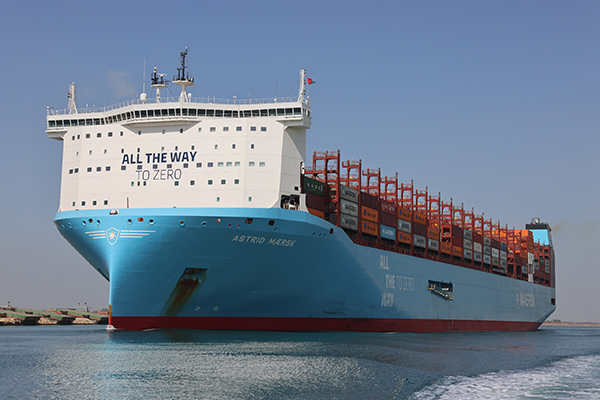
Momentum continued in February with the first Canal transit of ASTRID MAERSK, a 185,000-gross-ton vessel. Its voyage marked the rerouting of the ME-11 service, a Maersk-Hapag-Lloyd partnership, back through the Suez Canal rather than around southern Africa.
Ultra-large container ships are not deployed casually. They represent multi-billion-dollar investments and anchor complex global supply chains. Their return suggests that, for some carriers, the perceived Red Sea risk premium is narrowing relative to the operational and environmental costs of diversion.
Reinforcing confidence beyond pricing
Operational upgrades reinforce this shift. In February, the SCA announced collaboration with Germany’s Siemens to certify a training laboratory at its Innovation and Excellence Center, supporting advanced automation and system upgrades. Though separate from toll policy, these efforts signal a broader commitment to operational resilience.