

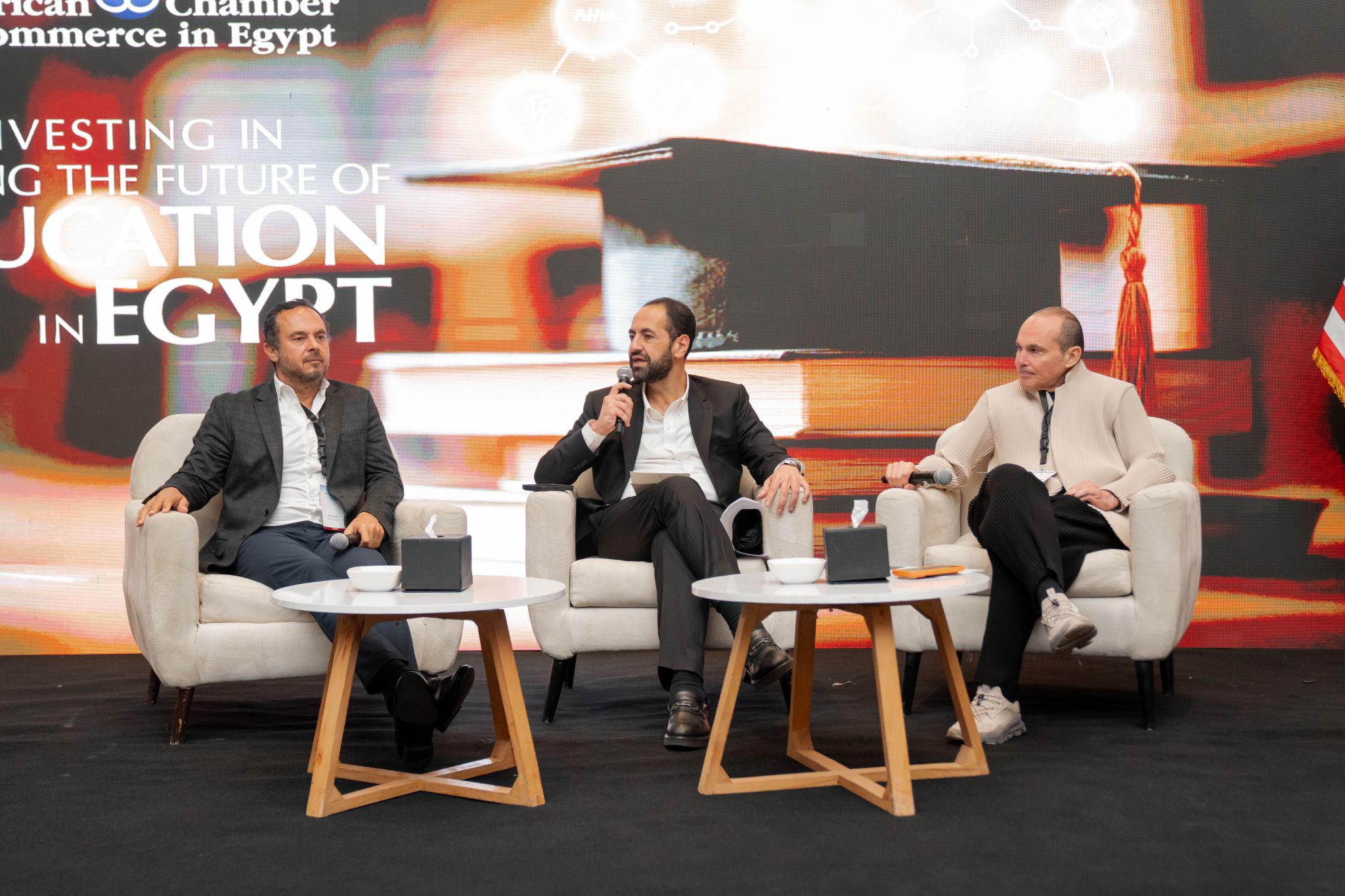

Education investors and business leaders at the American Chamber of Commerce in Egypt education conference said Egypt is approaching a turning point in education reform, driven by artificial intelligence, entrepreneurship, vocational training, and its demographic advantage.
During Session I, “Entrepreneurial Investors Shaking Egypt’s Education Landscape,” speakers argued that traditional memorization-based education models are rapidly becoming obsolete as AI reshapes labor markets and future skill requirements.
The session featured Ahmed Tarek, Chairman, B-Well Holding and Co-founder, Next Era Education; Mohamed Farouk, Chairman & CEO, Mobica Furniture Company; Chairman of NextEra Education; and Co-founder, Learn; and was moderated by Ihab Rizk, Founder & Managing Partner, Morpho Investments and Co-Chair of the Education Committee.
Rizk noted that education investment in Egypt has historically been concentrated among a small group of players, but said new entrepreneurial capital is entering the sector with a stronger focus on innovation, employability, and technology-enabled learning.
The discussion comes as Egypt faces mounting demographic pressure, with a large youth population entering the labor market each year, alongside a persistent mismatch between graduate skills and employer demand, particularly in technical and digital fields. At the same time, rapid advances in artificial intelligence and automation are accelerating the need for continuous reskilling, pushing education systems globally to shift away from memorization-based models toward more adaptive, skills-driven learning approaches.
The discussion comes as Egypt increasingly positions education and workforce development at the center of its long-term economic strategy, particularly as the country’s large and youthful population creates significant opportunities for growth and innovation. According to World Bank estimates, roughly 1.3 million young Egyptians enter the labor market each year, reinforcing the urgency, and potential, of building an education system that is more closely aligned with future economic needs.
At the same time, policymakers and investors are placing growing emphasis on addressing the longstanding gap between graduate skills and employer demand, particularly in technical, vocational, and digital sectors. International Labour Organization (ILO) research has highlighted the importance of modernizing curricula and expanding practical, market-oriented learning pathways to better prepare students for evolving industries.
The shift is becoming even more critical as artificial intelligence, automation, and digital technologies rapidly reshape labor markets worldwide. International institutions including the World Bank have increasingly emphasized that future competitiveness will depend on education systems’ ability to foster adaptability, problem solving, digital literacy, and lifelong learning, areas that are now becoming central to Egypt’s broader education reform agenda.
Human capital as Egypt’s competitive edge
Farouk said his investment approach was shaped by long-term development models, including China, and by a focus on education, technology, and healthcare as core pillars of growth. He argued that Egypt’s opportunity lies in enabling people to build careers locally rather than relying on internal migration to major cities.
Tarek framed education as Egypt’s key differentiator in a globally shifting demographic landscape.
“Education is our hope, our only hope to be different,” he said, adding that strong policy support for education and healthcare could enable “exponential change” in the sector over the next two to three years.
AI is reshaping skills and learning models
Both speakers stressed that artificial intelligence is fundamentally rewriting the rules of education and employment.
Farouk said his early focus on teaching coding evolved with generative AI, shifting first toward prompting skills and ultimately toward continuous learning as a core capability.
“The only thing I used to tell people, you have to learn coding,” he said. “Then I told them you have to learn by prompting, then I didn’t find anything to tell them except you have to continuously learn.”
He warned that job displacement and rapid skill transformation are likely within a few years, making adaptability essential.
Tarek went further, arguing that AI systems will surpass human cognitive abilities in most domains.
“We have no hope to compete with AI agents,” he said. “They will supersede any human being that came in history. And this will happen in the coming two or three years.”
He added that education systems must therefore focus on human capabilities such as judgment, intuition, and contextual awareness.
From memorization to experimental learning
Both investors criticized Egypt’s reliance on rote learning and called for a shift toward applied, experience-based education.
Farouk said students should be trained to think critically, collaborate, and apply knowledge rather than memorize information.
Tarek described his model as “experimental education,” where students are exposed early to real-world environments, internships, and entrepreneurship to help them identify their strengths.
“What we’re trying to do is experimental education,” he said. “Our role in education is not just to feed them with more education and more education, just to enlighten them about what they want.”
He added that exposure to practical experiences often reveals student potential more effectively than traditional instruction.
Teachers and vocational pathways
Teacher development emerged as a key concern, with both speakers emphasizing educators as central to system-wide reform.
“If you talk about education today and keep talking about education, suits, ACs, big ballrooms, amazing hotels, and the teacher takes less than $200, this is crazy,” Tarek said.
Farouk also described teachers as “nation builders,” calling for a shift in how they are trained, supported, and valued.
Both speakers said the greatest gap in the system lies not in infrastructure but in professional development for teachers, administrators, and student support systems.
Tarek argued that investment priorities should shift accordingly, away from physical expansion and toward human capital development within the system.
Vocational education and future jobs
The panel highlighted vocational education as a major opportunity for Egypt, particularly when directly linked to labor market demand.
Farouk said his vocational school model already produces graduates highly sought after by industry, with some receiving engineer-equivalent compensation.
“There are 60 people and I have around four factories. They are all fighting for them,” he said.
He also emphasized that Egypt should retain talent locally by enabling globally competitive remote work opportunities rather than exporting labor.
A shift toward future-facing skills
The session concluded with a shared view that Egypt’s education system must evolve toward adaptability, experimentation, entrepreneurship, and continuous learning.
Speakers argued that future competitiveness will depend less on traditional academic achievement and more on problem-solving, AI literacy, vocational readiness, and human-centered skills that remain resilient in the face of rapid technological change.