

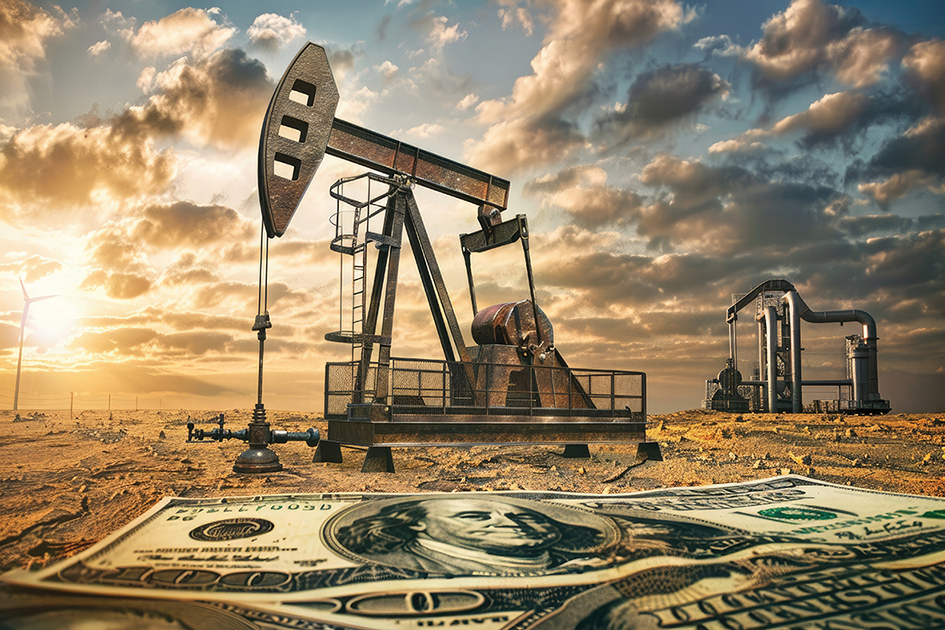


Iran’s partial blockage of the Strait of Hormuz, through which 20% of global oil supplies pass, to gain leverage in the ongoing war with Iran, has driven global Brent oil prices up nearly 80% per barrel to a four-year high.
In response, the United States, the world’s largest oil producer and importer, and third-largest exporter as of 2026, according to data aggregator World Population Review, is taking actions (and floating radical ideas) to stabilize, if not reduce, oil prices.
For developing countries that are net oil importers, the effectiveness of these efforts will be crucial to their respective budget plans and fiscal policies. “With strong political, economic, and military strength … the United States can directly control the rise and fall of oil prices,” noted a briefing from Anbound, a think tank. “In this way, for the global oil supply side, what price the oil will sell at in the future depends on the U.S.”
Add supply, confidence?
On March 11, Brent oil prices had already reached nearly $91 per barrel, a 27.6% increase since the start of the war on Feb. 28. In response, U.S. Secretary of Energy Chris Wright announced he would release 172 million barrels of oil from the Strategic Petroleum Reserve, which holds 415 million barrels, according to a press release. “This will take approximately 120 days to deliver based on planned discharge rates,” Wright said.
Wright also noted that “32 member nations of the International Energy Agency unanimously agreed to [U.S.] President [Donald] Trump’s request to lower energy prices with a coordinated release of 400 million barrels of oil and refined products from their respective reserves.”
However, that could hurt, not restore, market confidence. For one, it will probably be a one-time action. “Of course, there could be (a new release),” Wright said during an interview with CNBC. “I think that’s highly unlikely.” He added that additional production would come from “helping refineries become more efficient.”
The decision isn’t surprising, as the remaining U.S. strategic reserve would be at its lowest level since the early 1980s,” Scott Montgomery, an international studies lecturer at the University of Washington, wrote in The Conversation in March. “This withdrawal will leave the U.S. … in a highly vulnerable position. Additional price increases could well lead to a second call from the International Energy Agency [for another] release.”
To offset that decline, Wright said in late March the United States plans to increase oil production by 200 million barrels by 2027, which is 16.2% higher than the amount released.


Bringing back players
The U.S. administration is also looking to other oil-exporting nations to boost global supplies to offset losses from the partial blockage of the Strait of Hormuz. In March, U.S. Treasury Secretary Scott Bessent said the U.S. government would buy Russian oil on tankers that departed Russia before mid-March.
CBC News reported that based on Bessent’s cutoff time, 124 million barrels of Russian oil are stranded at sea. It also stated those marooned barrels are “equal to about six days’ worth of normal shipments through the Strait of Hormuz.”
Proceeding with that purchase is controversial, as Democrats in the Senate released a letter stating, “The president is … handing [Russian President Vladimir] Putin, his shadow fleet and traders still dealing in sanctioned oil a free pass to increase oil shipments. The new channels for evasion the [U.S.] president is opening, coupled with dramatically higher global energy prices, are giving Putin a huge financial boost and the means to continue his [war with] Ukraine.”
Another controversial announcement was when Bessant told the Fox Business news outlet, in March, the U.S. government may “unsanction” Iranian oil stranded at sea since the start of the war. “It’s about 140 million barrels … That’s 10 days to two weeks of supply that the Iranians had been pushing out that would have all gone to China,” Bessant said. “The Iranian ships have been getting out already, and we’ve let that happen to supply the rest of the world.”
Global worry?
Twelve days after the Middle East conflict began, Brad Sherman, a Democratic congressman from California, highlighted on his website plans to “introduce the ‘No U.S. Oil Exports During Iran War Act’ … aiming to protect American consumers from rising energy costs and economic instability.”
“We must use every available tool to protect the American people,” he said. “This legislation puts American consumers first by ensuring that our energy resources are used to stabilize prices at home, not to maximize profits abroad.”
The bill would not immediately impose an outright export ban, rather “a targeted export ban designed to stabilize domestic energy markets, reduce inflationary pressures and prioritize U.S. supply during a period of international crisis,” said Sherman. “It also includes limited flexibility for cases where certain crude oil cannot be efficiently refined domestically, allowing narrowly tailored export licenses provided that refined products are returned to the United States.”
This bill would expire when “the president certifies that hostilities with Iran have ceased and the Strait of Hormuz is fully reopened to global commerce.”
At first glance, banning exports can work since the United States is a net oil exporter. “By cutting off … millions [of] barrels per day of exports, the resultant glut of supply in the domestic market would disconnect the United States from international markets, and push prices down,” said McKinsey.
So far, the Trump administration continues to “rule out banning oil exports as a way to bring down energy prices amid the escalating [conflict] in Iran,” reported Politico. “Vice President JD Vance, Energy Secretary … Wright and Interior Secretary Doug Burgum tamped down the rumor at a meeting with the board of the American Petroleum Institute, the top trade association for the oil industry.”

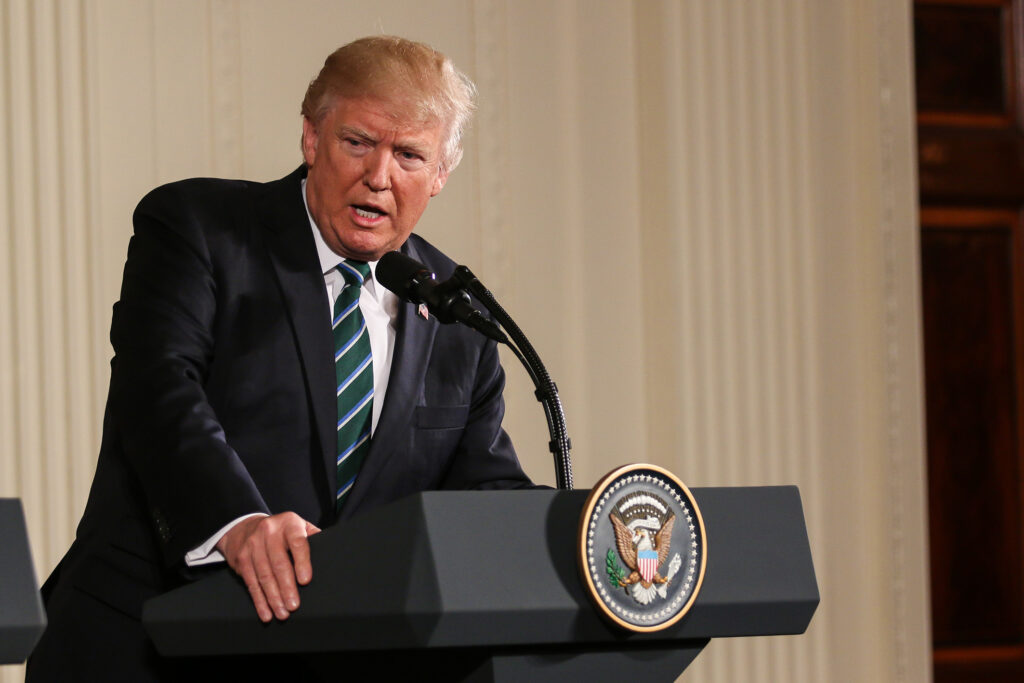
Trump in the room
Throughout Trump’s second term, there have been concerns about his shifting and unpredictable policies. “For decades, U.S. foreign policy has depended on credibility: the belief that Washington would honor its commitments and that its past behavior signaled its future conduct,” said a Foreign Affairs article in 2025.
However, “unlike any U.S. president before him … Trump has abandoned all efforts to make Washington reliable or consistent,” the article continued. “His predecessors had also, at times, made decisions that undermined American credibility. But Trump’s lack of consistency is of an entirely different magnitude and appears to be part of a deliberate strategy. The only pattern is the lack of one.”
Jason Bordoff, founding director of the Center on Global Energy Policy think tank, remarked in a March blog post, “The question [of whether Trump would ban oil exports] is likely to persist if energy prices continue to climb.”
If Trump determines the only way to reduce oil prices domestically is an export ban, Bordoff warns, it could backfire on U.S. consumers and the global economy.
On the domestic front, “forcing more U.S. crude into the domestic market would widen the discount of U.S. benchmark prices (WTI) relative to global prices (Brent), weakening incentives to invest and produce [the former],” he explained.
Meanwhile, “lower [WTI] crude prices would not translate into comparable reductions in gasoline or diesel prices, which are set in global markets,” Brodoff stressed. “Instead, [it] would introduce inefficiencies that could ultimately raise costs.”
He explained the issue is U.S. refineries process only less expensive heavy crude from Mexico and Canada and export the more costly light (sweet) crude, which is domestically produced.
“If U.S. crude exports were curtailed, domestic refiners would be forced to process more light, sweet crude than they are designed to handle,” Bordoff said. “At the same time, foreign refiners would bid up the price of medium and sour crudes that U.S. refiners typically import.”
Ultimately, “U.S. refiners would then face a choice: run suboptimal crude slates – reducing yields and efficiency – or pay more for imported heavier crudes,” he said. “In either case, refining costs would rise.”
Another challenge is the “lack of sufficient downstream capacity to process the lighter components associated with shale crude, limiting the ability to operate at full utilization,” Bordoff said. “The result could be lower refinery throughput, tighter product supply, and upward pressure on gasoline and diesel prices.”
Globally, a shortage of costly, sweet oil from the United States would inevitably push up oil prices in countries that refine it. It could shift demand (and ultimately investment) away from America to countries producing sweet oil, such as Libya, Nigeria, Algeria, and Ghana, as well as others in Europe, South America, and Asia.
Meanwhile, excess heavy oil from Mexico and Canada entering global markets would significantly lower global prices. This would create a dilemma for heavy oil refineries: either accept short-term profit losses and expand capacity to boost revenues through economies of scale, or reduce demand for heavy crude to lower the supply and push prices higher.
“The rest of the world would likely struggle to make up the lost product from the U.S. global refining capacity [that] has been running close to maximum already,” said McKinsey. “Any additional capacity that could be used would necessarily be the least efficient and most expensive.”
Endgame
Ending the war with Iran to reopen the Strait of Hormuz and gradually (yet sustainably) bring oil prices back to their demand-supply levels is crucial, the Federal Reserve of Dallas said in a note published March.
Think tank Axios outlined five possible scenarios that could end the conflict. The first is a “negotiated ceasefire and nuclear deal,” said Axios. “The day before the strikes began, Oman’s mediators said Iran had agreed to never stockpile enriched uranium and called peace ‘within reach.’ It’s unclear how the war might affect future negotiations.”
The second involves the United States replicating “the Venezuela model,” by ousting Iran’s sitting president and “establishing a working relationship with his successor,” Axios said. “However, beyond just geographic [distance], the Iran-Venezuela comparison has significant limits, [as] experts say treating them as equivalent misunderstands the [the former’s] power structure.”
Third is a popular uprising that brings down the regime. Axios said the “potential for collapse is real. [However,] the Iranian opposition has no real unified leader and no organized force on the ground.”
In the fourth scenario, the United States and its allies send special forces to raid Iran’s nuclear stockpile, Axios said. That possibility has been publicly discussed. However, “the mission would require boots on the ground in a country that is still actively” fighting back.
In the last case, Axios said, “Trump declares victory and withdraws, [stressing that] Iran’s missile and drone capabilities have been degraded enough.” That scenario is one “markets have been betting [on], especially as economic pain at home threatens to become a serious political problem for [Trump],” Axios said.
However, that last scenario may be temporary, as “Trump himself warned that allowing the wrong leader to take over would force the U.S. back to war in five years,” Axios noted.
Ultimately, regardless of which scenario materializes, Axios believes “the war in Iran started without much warning. That may be true for the ending, too.”