

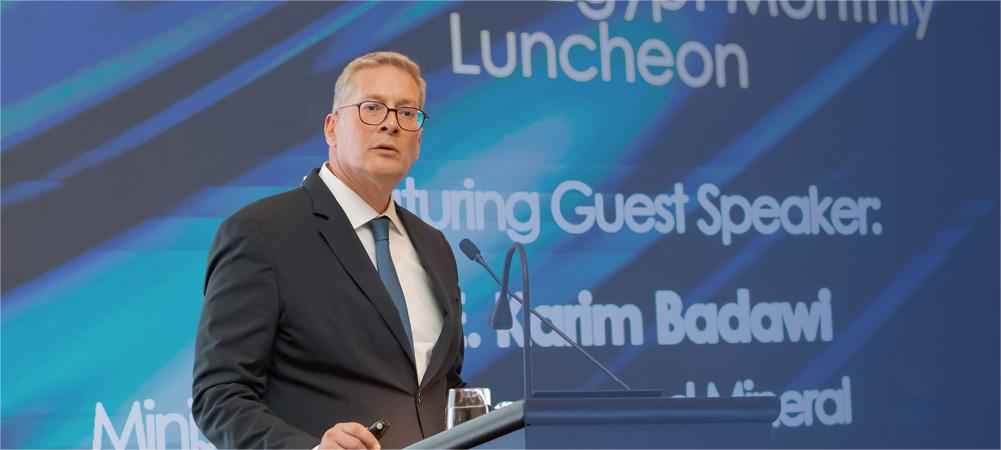


Speaking at the American Chamber of Commerce in Egypt (AmCham) luncheon on February 1, Karim Badawi, Minister of Petroleum and Mineral Resources, returned to conversations that began in mid-2024, when Egypt’s energy sector was under pressure and confidence among partners was being tested. What he outlined was not a list of pledges or a polished roadmap, but a strategic framework built around six pillars that now guide how Egypt is approaching energy, mining and investment — and how these strands are increasingly being aligned.
Energy security before anything else
Badawi made clear that energy security remains the government’s primary objective. Supplying petroleum products to more than 120 million people in Egypt and the surrounding region, he stressed, is not a theoretical ambition but a daily operational responsibility. The focus is therefore not only on volumes, but on system reliability — keeping infrastructure running, avoiding disruptions and ensuring that energy supports economic activity rather than constrains it. In this sense, energy policy is being treated as a public service as much as an industrial one.
Infrastructure is not the problem — underuse is
A recurring theme in the discussion was the underutilisation of Egypt’s existing infrastructure. The country already has refineries, petrochemical complexes and export terminals built over decades, yet many are not operating at full capacity. The current priority is to extract more value from these assets through technological upgrades, efficiency improvements and a shift toward higher-value outputs. Several downstream and refining projects are now moving ahead, many of them structured to attract private investment rather than rely solely on public funding.
Mining steps out of the shadows
Mining, long a marginal contributor to Egypt’s GDP, is now being repositioned as a growth engine. Badawi said the ministry is targeting an increase in the sector’s contribution from less than one percent to around five or six percent in the coming years. While ambitious, the target is underpinned by concrete reforms, including changes to the regulatory framework, restructuring the Egyptian Mineral Resources Authority into an economic entity, and launching Egypt’s first nationwide airborne geophysical survey in decades. The aim is to address a fundamental obstacle: investors cannot commit capital without credible data and predictable rules.
The energy mix is a coordination exercise, not a slogan
On renewables, Badawi adopted a pragmatic tone. Egypt’s target of sourcing 22 percent of its energy from renewables by 2030 is less about climate branding and more about reallocating resources. Every unit of gas not used in power generation can be redirected to petrochemicals, fertilisers or exports, where it generates higher economic value. This strategy, he noted, depends on close coordination between the petroleum and electricity ministries, with integrated planning rather than parallel policies.
People still matter more than geology
Despite the technical detail, Badawi repeatedly emphasised the human dimension. Subsurface potential — whether in oil, gas or minerals — means little without the skills to develop it. Investment in training, safety, environmental standards and operational discipline is seen as central to long-term sustainability. The underlying message was that sustainable production depends as much on people and processes as on resource endowment.
Collaboration as policy, not rhetoric
The sixth pillar, collaboration, cuts across all others. Over the past year, this has translated into concrete steps: reducing arrears to partners, maintaining regular monthly payments, revising upstream incentives and accelerating exploration activity, with a record number of wells planned across Egypt. Regional cooperation, particularly in the Eastern Mediterranean, was also framed as a practical mechanism for unlocking stranded resources and linking supply with demand.
From managing risk to rebuilding confidence
Badawi did not downplay the difficulties of 2024. Financial pressures, delayed payments and declining production placed the sector under significant strain. What has shifted, he argued, is the trajectory. With arrears declining, exploration accelerating, incentives recalibrated and infrastructure more effectively utilised, Egypt is moving from stabilisation toward recovery — rebuilding production, pursuing greater self-sufficiency and gradually reshaping its energy mix.
The key takeaway from the AmCham luncheon was not a single headline announcement, but a sense of momentum. Egypt’s energy strategy, as presented, is no longer focused on short-term firefighting. Instead, it reflects a broader effort to reassemble the system — deliberately, collaboratively and with an emphasis on long-term value rather than quick wins.