



Egypt is rapidly consolidating its position as a regional industrial powerhouse, as a series of major chemical investments in the Sokhna Industrial Zone signals a decisive shift toward high value-added manufacturing, export-led growth, and industrial localization.
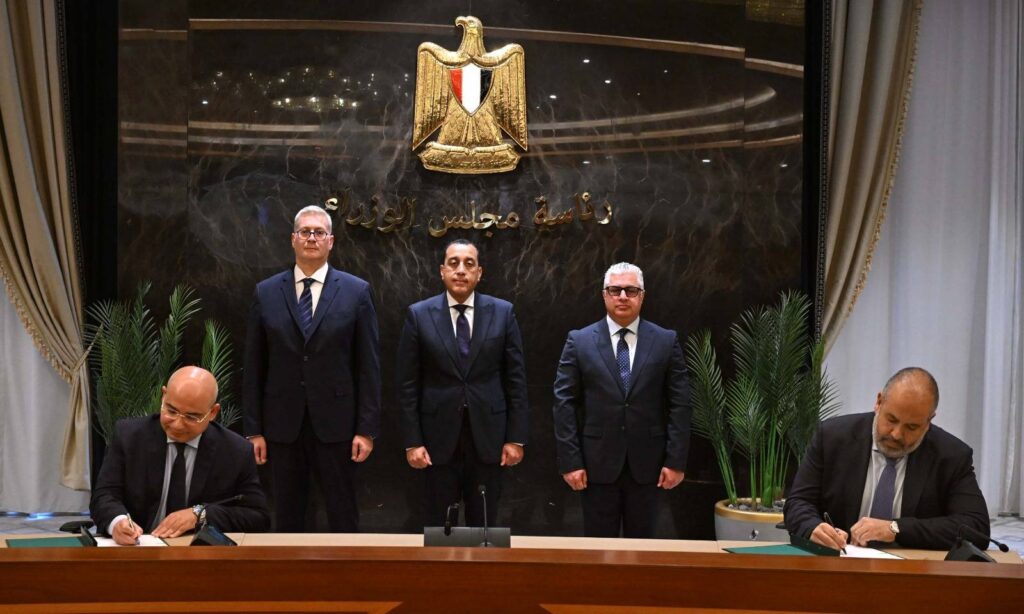
At the center of this momentum, Prime Minister Mostafa Madbouly recently witnessed the signing of a $215 million agreement to establish the Polyserve Fertilizers and Chemicals complex within the integrated Sokhna industrial zone under the umbrella of the Suez Canal Economic Zone (SCZONE).
The project spans 650,000 square meters, with production capacity reaching 3.5 million tons annually and the creation of approximately 500 direct jobs.
The development reflects a broader government strategy focused on attracting private sector investments capable of delivering tangible economic value, particularly projects that reduce import dependency, deepen local manufacturing, and strengthen export competitiveness.
Madbouly emphasized that localizing such industries has a “significant impact on the national economy,” particularly through reducing the import bill and expanding Egypt’s export footprint. His remarks align with a wider policy direction that places industrial depth and global competitiveness at the center of Egypt’s economic transformation.
A cluster of strategic industrial investments
The Polyserve project is not an isolated development. It forms part of a broader wave of industrial expansion in Sokhna, positioning the zone as a fully integrated chemicals and advanced manufacturing hub.
Complementing these large-scale investments, a separate $10 million chemical complex focused on formaldehyde and its derivatives further reinforces the emergence of an integrated industrial ecosystem in Sokhna, supporting both upstream and downstream industries.
For industry leaders, these projects represent more than capital inflows. They signal a structural shift in Egypt’s industrial model.
In an exclusive interview, Mostafa El Gabaly, CEO of Polyserve Fertilizers and Chemicals, highlighted the strategic importance of leveraging Egypt’s natural resources.
“Egypt is one of the few countries with large rock phosphate reserves. The project directly supports Egypt’s strategy to localize high value-added industries by converting raw materials into advanced chemical products, reducing imports and strengthening export capacity.
Over the long term, it will deepen the industrial base, create downstream manufacturing clusters, and cement Egypt’s position as a competitive global hub for fertilizers.”
Export orientation remains a central pillar of the project’s design. El Gabaly noted:
“The targeted annual capacity is 1 million tons. Egypt is a net exporter of fertilizers. We believe that we can export around 70% of the total production after fulfilling the local market’s demands. Our main export markets will be Africa, Latin America, and Europe.”
This export-driven approach directly supports Egypt’s broader ambition to increase foreign currency inflows while strengthening its presence in key global markets.
Sustainability and technology at the core
Beyond scale and output, technological sophistication and environmental compliance are emerging as defining features of these new industrial ventures.
El Gabaly underscored this commitment: “Complying with global environmental standards is a must for us. As all of Polyserve’s ventures, Nile Phosphate will adapt the latest technologies and sustainability practices to ensure the utmost operational efficiency.”
This focus on sustainability aligns with global industry trends and enhances the competitiveness of Egyptian exports in increasingly regulated international markets.
Sokhna emerges as Egypt’s industrial gateway
A critical enabler behind this wave of investment is the strategic positioning and infrastructure of SCZONE. With direct access to global shipping routes through the Suez Canal and integrated port-industrial logistics, Sokhna is rapidly evolving into a preferred destination for export-oriented manufacturing.
El Gabaly highlighted the zone’s competitive advantages: “The SCZONE is one of Egypt’s most attractive investment destinations specially for export oriented manufacturing projects. It’s location is strategic, it offers very good tax and custom breaks and it has excellent infrastructure.”
Echoing this perspective, SCZONE Chairman Walid Gamal El-Din emphasized that the zone’s integrated ports, infrastructure, and skilled labor force provide a comprehensive solution to global supply chain challenges, enabling seamless access to regional and international markets.
Toward a regional industrial hub
Taken together, these developments point to a clear trajectory: Egypt is not merely expanding its industrial base, it is redefining it.
By anchoring investments in high-value chemicals, advanced materials, and export-oriented production, the country is positioning itself as a competitive hub bridging Africa, the Middle East, and global markets.
The Sokhna industrial zone, once viewed primarily as a logistics node, is now emerging as a cornerstone of this transformation, where natural resources, global partnerships, and strategic policy converge to shape the future of Egyptian industry.