



For Egypt, the artificial intelligence (AI) transition isn’t simply about how quickly companies adopt new technology. It is a question of whether the country can equip its workforce with the skills needed to compete in an economy increasingly shaped by AI.
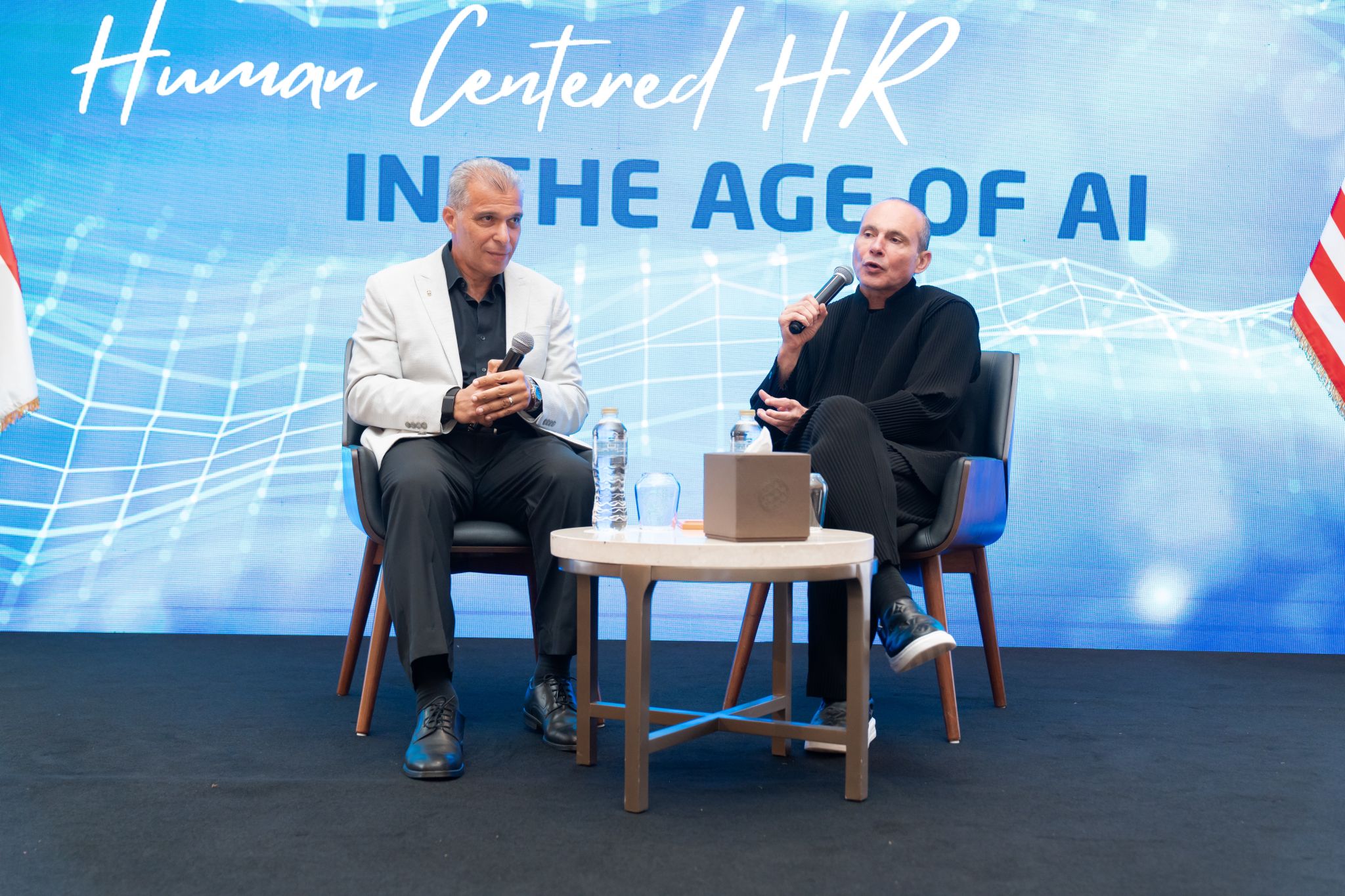
That was a key theme of Session 3, “Human Potential Meets Artificial Intelligence: The Future of Leadership and Talent,” held during the AmCham HR Conference on September 15. The session featured Mohamed Farouk, Chairman and CEO of Mobica Group, in a conversation moderated by Ashraf Bakry, Co-Chair of AmCham’s Industry and Trade Committee and a board member of Oriental Weavers.
The discussion placed Egypt’s workforce and education system at the center of the AI transition, highlighting the opportunity for the country to close longstanding technology gaps while creating new forms of work.
Egypt’s chance to catch up
Farouk argued that Egypt’s previous delays in adopting major technological shifts could make the current AI transition particularly significant.
He pointed to a historic opportunity for Egypt to adopt AI at the same time as leading global markets rather than waiting for technologies to mature elsewhere before catching up.
The comparison, he suggested, is similar to the introduction of personal computers. Employees and businesses that embraced computing developed capabilities that those relying on older ways of working eventually struggled to match.
Egypt now faces a similar choice with AI: accelerate adoption and learning, or risk widening the gap with countries and companies that are moving faster.
For Farouk, however, technology adoption alone will not determine the outcome. The country’s competitive advantage will depend on how quickly Egyptians learn to work with AI and use it to increase their productivity.
“AI will not take our jobs, but it will change our jobs.”
That shift is already visible in professions where AI can significantly increase the amount of work an employee can handle. Farouk used radiology as an example, arguing that technology can enable a specialist to review substantially more scans while retaining a human role in validating the results. As productivity rises, so do the expectations placed on the worker.
Rebuilding the talent pipeline
The implications extend beyond companies to Egypt’s education system.
Farouk argued that businesses should have a greater role in determining which skills young Egyptians are taught, with education increasingly aligned with actual labor-market demand.
Rather than directing students toward a narrow set of traditional professions, he called for greater attention to technical and specialized fields where companies face shortages. He cited a technical education initiative producing graduates in areas including engineering and CNC machining, noting that companies are competing for these graduates and offering higher salaries because of the demand for their skills.
That alignment between education and business needs, he argued, should also change how companies recruit.
“We don’t need someone with experience; we need someone who has the willingness to learn.”
For HR departments, this means placing greater emphasis on cognitive ability, adaptability, and learning potential rather than relying too heavily on conventional CVs. As AI makes it easier for candidates to produce polished applications and presentations, employers will increasingly need ways to identify whether people can actually learn, solve problems, and grow within an organization.
Continuous learning as the new advantage
The panel ultimately framed continuous learning as one of the defining requirements of Egypt’s AI-era workforce.
Farouk argued that employees cannot rely indefinitely on skills acquired early in their careers. New technologies will continue to reshape industries, meaning both new graduates and experienced professionals will need to repeatedly retrain.
“Every day I learn. I can’t stop learning.”
For Egypt, that mindset could become particularly important as AI alters not only existing jobs but also creates entirely new industries and business models. Farouk pointed to the emergence of new opportunities around technologies such as autonomous vehicles, humanoid robotics, and other emerging fields, arguing that the people who benefit will be those capable of learning the skills required to participate in them.
He also highlighted how AI is expanding access to capabilities that were previously expensive or difficult for Egyptian businesses to obtain. At Mobica, for example, AI has helped accelerate market research and identify potential business opportunities across markets including Egypt, Saudi Arabia, and Dubai. What once required lengthy research processes can increasingly be performed faster and at greater scale.
That points to a broader economic opportunity for Egypt. AI could allow local companies and professionals to access sophisticated analysis, expertise, and productivity tools that were once concentrated in larger organizations or more developed markets.
But the benefits will depend on people adapting alongside the technology.
Farouk’s closing message was that AI should not be treated as a short-term corporate trend, but as a transformation that requires action from companies, educators, employees, and policymakers alike.
“Every one of us has a role to play in the transformation.”
For Egypt, the AI race may therefore be less about who has access to the most advanced technology and more about who can build the talent capable of using it. The country’s opportunity lies not simply in adopting AI, but in using the technology to accelerate productivity, modernize its talent pipeline, and prepare its workforce for jobs that are only beginning to emerge.