


UNESCO is adamant that “education is a fundamental human right,” explaining that it “empowers individuals, strengthens communities and fosters inclusive societies.” It “enables individuals to develop the knowledge, skills and confidence needed to participate fully in society.”
This translates into noticeable improvements in living standards and quality of life, especially for those born in underprivileged societies. “Education is one of the most powerful tools for lifting excluded children and adults out of poverty,” noted UNESCO. It also is “a cornerstone of peace, justice and resilience in the face of today’s most pressing global challenges.”
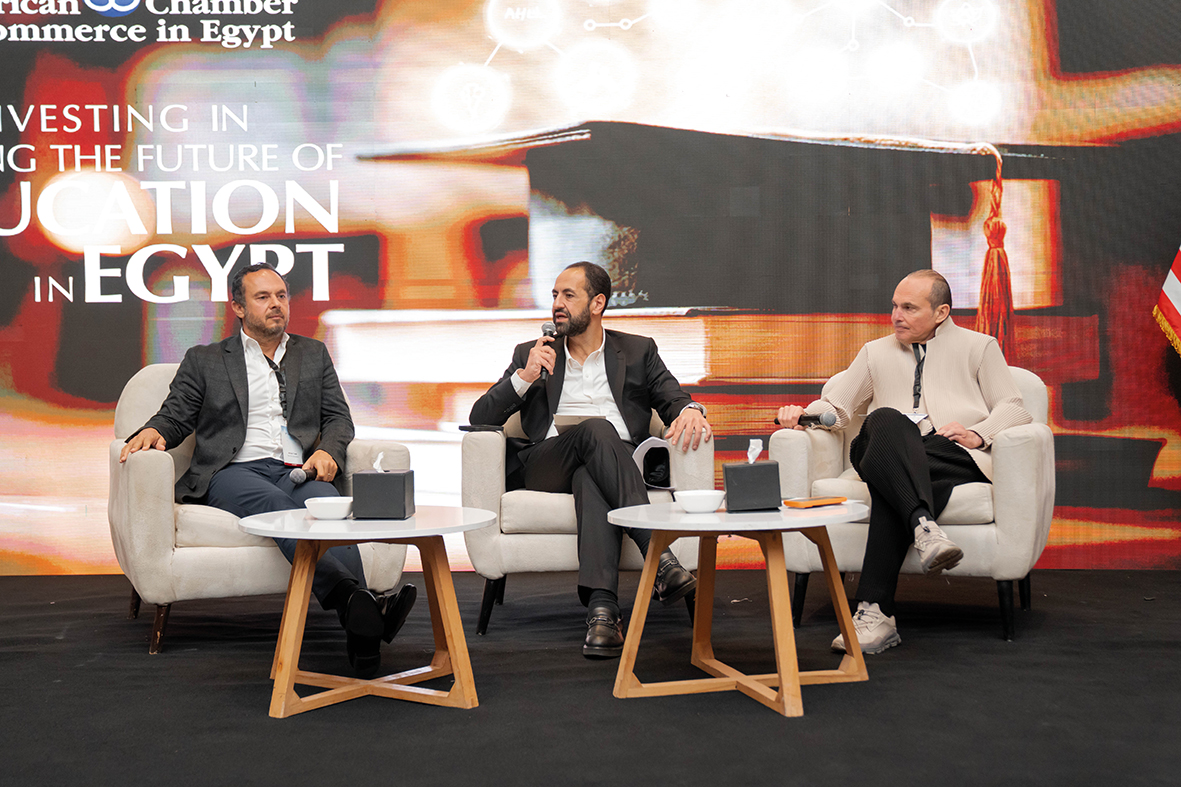
In “lower-middle-income” countries like Egypt (per the World Bank’s classification), education is essential for moving to a higher income tier. “Education is critical in any country, but particularly in Egypt,” Mark Howard, the British Council’s country director for Egypt and cluster lead for North Africa, told attendees at AmCham Egypt’s first education investment conference in May. “Education is the engine that will drive this country’s future, as much as it reflects its past … It’s a very old country with thousands of years of history, but at the same time it’s a very young country, with around 60% of the population under 30.”
Conference speakers stressed that investors in education face challenges unlike those in any other sector, particularly the need to shift their mindset to balance shareholder and societal needs.
Balance sheet
Speakers emphasized that turning a quick profit is not a sustainable business model for investing in education in Egypt. “Education, as a service and even as an industry, is not a medium-term plan, but more of a long-term one.” “Looking at things only from a financial perspective is not always the best view,” said Adel Badr, the Egypt Education Fund’s group CFO for the Middle East and Africa. He added, however, “Looking at things only from a financial perspective is not always the best view.”
This reality requires a particular type of investor “who understands where [education’s] value lies,” said Badr. “We developed our own standard operating model that can carry the [education] product forward. Within this model, we break down the needs of each [education-related] investment and align them with the income segments we aim to serve. This gives us a clearer forecast of requirements and how we plan to fund them.”
However, he stressed, “one product does not fit all, [as] the way you invest in quality for a premium [school facility] differs from how you would approach mid-tier or affordable segments. You understand exactly where your quality measures should be and how to apply them [as well as] benchmarking … learning outcomes against local and international competitors.”
Schools need to periodically revisit operations and business models and modify them to meet their ecosystem’s changing demands. “Part of our success has been ensuring they remain agile and flexible, adapting to changing macro and micro market conditions,” said Badr.
“For companies to successfully invest in education, they need to balance the perspectives of different stakeholders, led by educators, who are the engine behind the success,” he said. From the government’s side, “the education system must protect these investments.”
Trial by accreditation
Howard said that improving and sustaining the education system starts with “quality assurance, by assuring international standards are met.”
In Egypt, schools and universities almost always need accreditation from internationally recognized bodies. “Accreditation has always been seen as the key quality stamp that schools and universities rely on,” said Howard. “However, it’s important … that accreditation systems remain up to date and agile enough to keep pace with how rapidly education is evolving.” The more reputable the certification, the better the perceived quality.
Such certifications are expensive, ultimately raising education costs. “Business and quality are not separate things. Quality has a cost,” he said. “In business, you sometimes ask yourself, ‘Do I want to invest in this, given that it increases my cost base?’ But in education, if you don’t invest sufficiently in quality, your business performance will suffer.
“There is a minimum threshold of quality you must meet, and if you fall below it, sustainable growth simply won’t happen. You can clearly see the difference between education providers that are looking for short-term gains and those that are investing for the long term. The quick win approach doesn’t work in education.”
Howard pointed out that “school leadership sometimes treats accreditation like an exam we simply want to get over with. Accreditation should be viewed as an ongoing process. A strong accreditation system is continuous, not just a moment in time.”
Ultimately, “if you are serious about quality, you should choose the most rigorous accreditation process,” he said. “There are significant differences between accreditation systems, and the more demanding ones tend to drive better outcomes.”
Real-world view
Egypt currently has just two listed companies that advise education facility clients and own schools and universities. Their business models have to fulfill education’s social mandate of quality learning while ensuring growing shareholder value.
Mohamed El Rashidi, CEO and managing director of Taleem Management Services, an EGX-listed consultancy that runs and advises universities, noted his company “started as an investment opportunity in the field of education, driven by strong demand and limited supply and capacity for desired programs.”
To balance the need for quality education with administrative and academic costs, El Rashidi separated operating models. One supports enabling functions, including finance, HR, IT, supply chain, and marketing. The other is academic management.
“This allowed us to establish standardized processes and procedures, achieve strong economies of scale, and benefit from growth across each unit we developed or acquired,” El Rashidi said. “It also created a highly controlled environment that supports governance and ensures compliance with rules and regulations.”
The other listed company is CIRA Education. Ahmed El-Kalla, non-executive director, said it started from day one with a vision: “To bring quality education to the masses.”
That strategy has been key to the company’s success. “One of the core principles was scalability,” said El-Kalla. “At the level of unit economics, the model simply cannot work on a small scale. You need to operate at a large scale from the beginning.”
That decision didn’t align with other private-sector companies. “While others were focused on launching their first school, the question for us was: How do we reach critical mass in Egyptian society? We had this idea of reaching 100,000 students. It is not a scientific target, but kind of ‘north star’ guiding our direction.”
He noted the “hardest” ongoing challenge in scaling operations is “developing the right number of leaders who can take each school, university, or institution to the desired level, while staying true to the original vision and design [of offering quality education].”
This challenge is further complicated by the fact facilities are often hundreds of kilometers away from CIRA Education’s headquarters in Cairo, which complicates quality monitoring and pricing in rural areas. “The only way to manage effectively is to ensure that people deeply understand the founding principles of the institution and remain committed to them,” said El-Kalla.
Ultimately, investors in education need to recognize that rigid goals, no matter how ambitious, won’t ensure a sustainable operation. “Perfection is not the goal. We are doing our best given the constraints,” he said. “There is always room to improve, evolve, and rethink certain aspects as the world changes rapidly, while staying aligned with the core values.”