

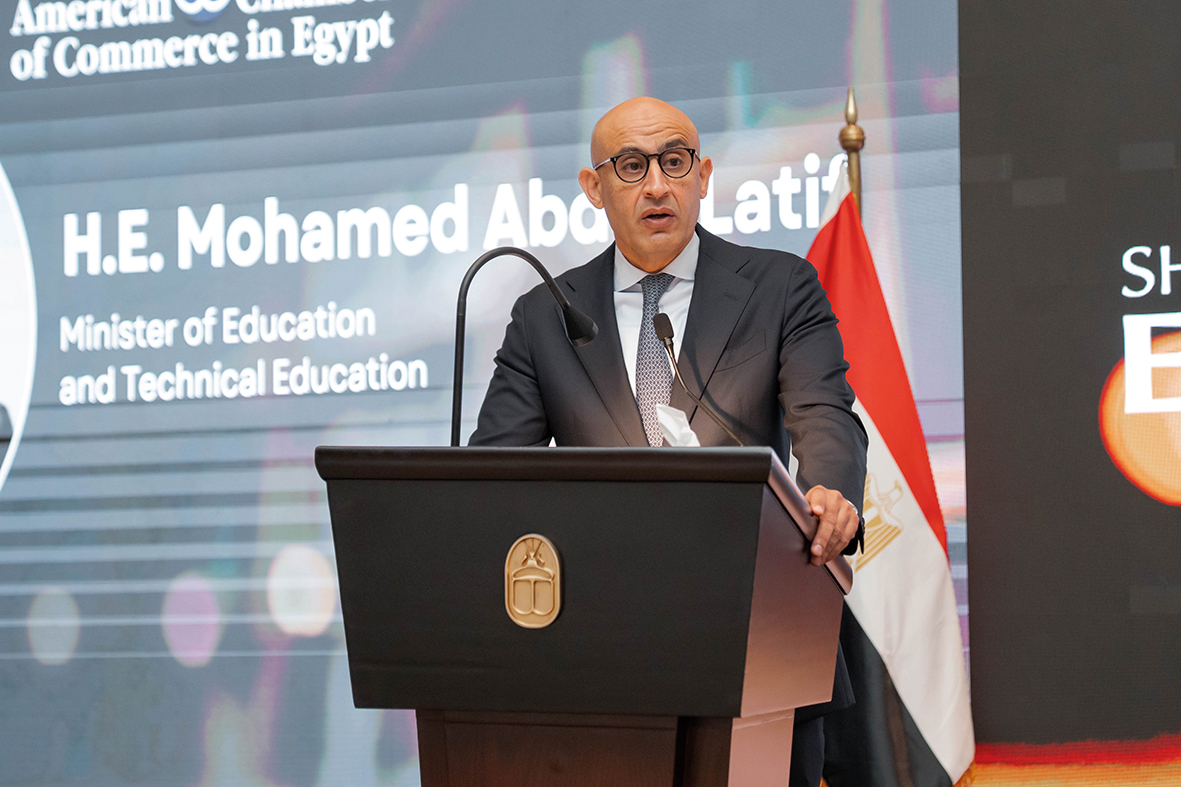


For graduates with little to no work experience, no sponsors, and no entrepreneurial tendencies, securing a first job often depends on the social skills and technical know-how developed during their school and university years.
That can be a problem, as there is often a significant gap between what students learn and what companies need. “Egypt’s youth unemployment [is] high at about 18% to 19%,” Nora Abou El Seoud, CEO of the Education for Employment Foundation, said at AmCham Egypt’s education investment conference in May.
Reforming Egypt’s education system “is not just about addressing a future challenge; it is a current reality affecting millions,” she said. Such changes must answer a key question: Are we preparing young people for existing jobs or for a labor market that is evolving, global, and highly competitive?”
Improving the interlinks
“Today, many employers complain new graduates are not meeting professional expectations,” said Amr Abbas, former assistant minister of foreign affairs. Initiatives must “align with Egypt Vision 2030 and the U.N. Sustainable Development Goals to improve education outcomes and overall quality of life.”
Abbas cited the creation of the Egyptian Center for Training, Employment, and Mobility. Its focus is “transforming theoretical knowledge into practical, applicable skills that help candidates secure jobs,” he said. “The center [should] launch in September, targeting university graduates.”
Shahira Wassef, coordinator of the governance and social development and health of migration portfolio at GIZ, the German government development agency in Egypt, identified “key focus areas” to build work-ready youth.
The first is working with the private sector to identify employment opportunities and forge “strong partnerships between employers and the talent pool in Egypt.” Second is “scaling up … to reach a larger [talent pool] by engaging technical and vocational education early on,” she said.
Last is “sustaining the system,” she stressed. “Labor mobility is not just about migration. It connects with employment strategies, education systems and broader development goals. We must ensure coordination across ministries, institutions and the private sector.”
Meanwhile, the state-owned Education Development Fund (EDF), founded in 2004, created the International Labor Market Observatory (ILMO). “It maps future jobs,” Rasha Sharaf, EDF secretary general, told conference attendees. “It highlights which jobs are declining and which are growing.”
In the short term, the ILMO would support Egypt’s shift to a future-ready competency-based curriculum. In the long term, that enables the export and import of top talent instead of brain drain, Sharaf said.
She emphasized the EDF’s “tailored language programs [that help] candidates [who] struggle with interviews, communication, and practical language (technical and professional).” The fund also offers ICT micro-credentials through partnerships with companies like Cisco that “provide practical, internationally recognized skills,” Sharaf said. “Micro-credentials are a powerful way to focus less on traditional degrees and more on real competencies.”
Structural challenges
Elsewedy Education CEO Mohamed Shawky, who transitioned from fast-moving consumer goods to education, discussed the challenge of fully aligning education with corporate needs.
“Companies are constantly trying to gain market share, innovate faster than competitors, and respond quickly to customer needs,” he said. “The customer is essentially the boss, and if you move slowly, you lose ground.”
Education “centers around assessment, research, and governance. There are approval processes, regulations, and procedures; even launching a new program takes time,” he said. “This makes education move slower than industry. As industry continues to move quickly and education follows more gradually, a gap is created.”
However, he believes “such a gap … can be healthy, as long as it remains manageable and not too large … It reflects progress and evolution. Many technological innovations originated in academia, [where] universities generate ideas, industry scales them, [then academia integrates those solutions” in their curricula.
One example is artificial intelligence, first developed in universities in the 1950s. It was adopted by mainstream tech companies starting with ChatGPT in 2022. “Now academia is trying to catch up by integrating AI into curricula,” noted Shawky.
Another issue was raised by Hala Barakat, director of the AUC Center for Entrepreneurship and Innovation. “While there has been some progress within [Egypt’s] education system … this progress is not embedded in the core academic structure,” she said. “It exists mostly in extracurricular activities, such as programs, competitions, and hackathons. These are valuable, but they remain add-ons rather than being fully integrated into the educational journey.”
Local direct investment
Private-sector involvement is essential to advancing Egypt’s academic and vocational education, according to Mohamed Farouk, chairman and CEO of Mobica Furniture, chairman of NextEra Education (an educational venture), and co-founder of Learn (a startup).
The scope of cooperation is vast, encompassing more than 28 million students in schools and universities. “Egypt is one of the best countries in the world to generate strong outcomes from education,” said Farouk.
Learning priorities for the private sector in 2026 include writing prompts for AI tools, developing code, teaching entrepreneurship and recognizing students “don’t have to spend 14 or 16 years going through traditional education paths. Learning can be compressed, and students can progress much faster. This is exactly the mindset we need: students who understand value, risk and opportunity from a young age … Students who know how to continuously learn.”
He also emphasized the need to develop teaching in traditional subject areas, including physics, biology, and history, as “they will remain essential.”
Farouk also spoke about the importance of tech labs, where students learn about emerging technologies and how to use them from an early age. “We need to identify the jobs that will be difficult for AI to replace, and this can only happen through study, experimentation, and innovation,” he said.
That “identification” will become increasingly critical. “What we’ve seen in the past 40 years is one phase. The next two to three years will be completely different,” said Ahmed Tarek, chairman of B-Well Holding, a healthcare company, and co-founder of Next Era Education. “There will be real disruption in education, and we have to achieve a massive transformation.”
Supporting this transformation is the fact that Egypt is “still raw,” Tarek said. “We did not have a strong education system over the past 50 years, and while that sounds negative, it actually works in our favor now because we’re starting from scratch. We recognize the problem, and that gives us the opportunity to solve it properly.”
Keys to success
Attracting the attention of today’s youth can be difficult. “When a student is truly interested in a subject and passionate about it, engagement is complete,” noted Tarek. “The problem is when students study science and math, they don’t practice it or connect with it. It becomes meaningless for them and they lose direction.”
The solution is upskilling teachers. “Our real challenge is building teacher capacity,” he said. “It’s unreasonable that we talk about transforming education in expensive venues and conferences while teachers are paid less than $200 [a month],” he said. “This must change.”
Such development must happen quickly, as “many jobs will disappear or completely change … in less than five years,” said Farouk. “So we have to be ready to adapt to new roles and new demands.”
Said Barakat of AUC: “The key question is not just whether we are preparing students for jobs or for entrepreneurship. The real question is: Are we teaching students how to think differently: creatively, critically,and in ways that generate real value in a rapidly changing environment?”