



Adopting artificial intelligence (AI) is becoming easier for businesses, but building an organization that can use it effectively requires more than access to new tools. Companies need to identify the right use cases, prepare their data, measure returns, and establish safeguards for responsible deployment.
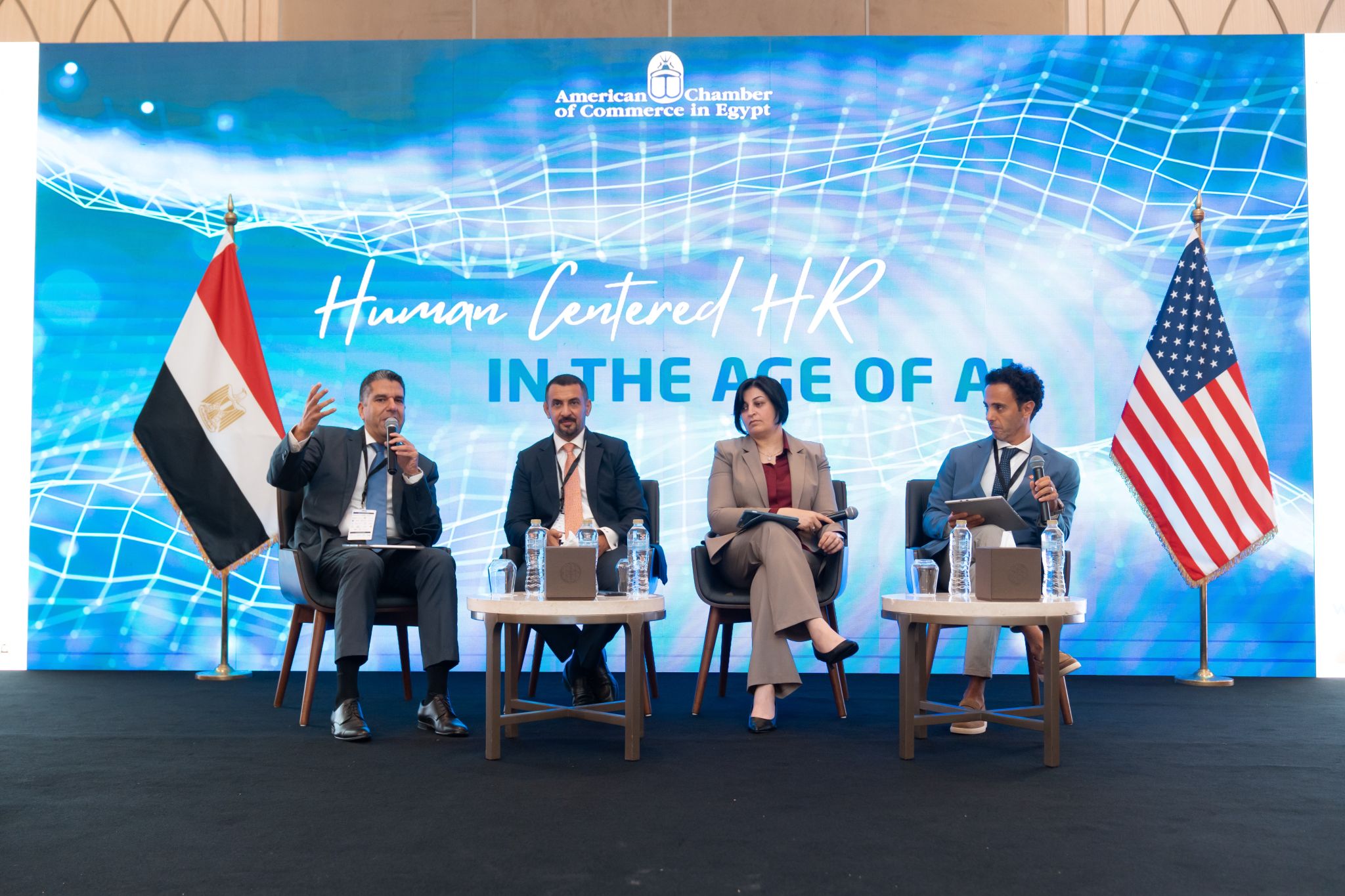
That was the central message of Session 2, “Beyond Automation: Creating an AI-Ready Organization,” at the AmCham HR Conference on September 15. The session brought together Ahmed Salama, CEO and Founder of Talin; Nesreen Sharaby, Chief Architect, Data & AI Technology at IBM Middle East & Africa; and Hesham Nabil Ibrahim, an AI enablement coach, trainer, and consultant with a background in HR and people and culture.
The discussion focused on how organizations can move from individual experimentation with AI to structured, enterprise-wide adoption.
Start with the business problem
Panelists said AI adoption should begin with a business need rather than a specific technology.
“AI is not a technology tool. AI is a business tool,” Salama said.
He argued that companies should first identify the problem they want to solve, whether in recruitment, onboarding, learning and development, or another business function, and then assess whether AI is the appropriate solution.
Use cases should also be prioritized according to potential value, cost, and risk. Salama recommended starting with relatively simple applications that can demonstrate measurable results before moving to more complex deployments.
Sharaby similarly stressed that not every business problem requires AI. Organizations should assess whether a task is repetitive and high-volume, whether the underlying data is structured and usable, and whether its impact can be measured through clear KPIs.
An AI-enabled HR help desk, for example, depends on having policies, processes, and frequently asked questions properly organized before AI can provide reliable responses. Metrics such as response times and time to hire can then be used to assess whether the technology is delivering an improvement.
From experimentation to adoption
The panel also examined the gap between employees using AI individually and organizations deploying it systematically.
A survey conducted during the session found that attendees were primarily using AI for individual productivity tasks, including emails, job advertisements, communications, and documents.
Rather than restricting that experimentation, Sharaby said companies should use it to understand how employees are already applying AI and identify potential use cases for structured pilots. In recruitment, for example, organizations could initially test AI for lower-risk tasks such as candidate screening before expanding into more sensitive applications.
Hesham advocated a similarly targeted approach, urging organizations to begin with a specific task and measurable outcome rather than adopting AI because of market pressure or hype.
“One trigger, one task, one outcome,” he said.
Employee involvement will also be important. Combining leadership direction with employees’ existing familiarity with AI can help companies identify practical applications while ensuring adoption remains aligned with broader business priorities.
Governance remains essential
As organizations scale their use of AI, governance will become increasingly important. Sharaby highlighted data privacy, bias, inaccurate AI-generated outputs, and the need for human oversight as key considerations, particularly in HR.
AI can support research, analysis, and decision-making, but responsibility for sensitive employment decisions should remain with people.
The discussion highlighted a broader shift in how companies should approach AI. As access to the technology becomes increasingly widespread, competitive advantage is likely to depend less on which tools a company uses and more on how effectively it connects them to business priorities.
For HR teams, moving from experimentation to enterprise adoption will require a clear problem to solve, reliable data, measurable outcomes, employee engagement, and governance frameworks that allow AI to scale without removing human accountability.