

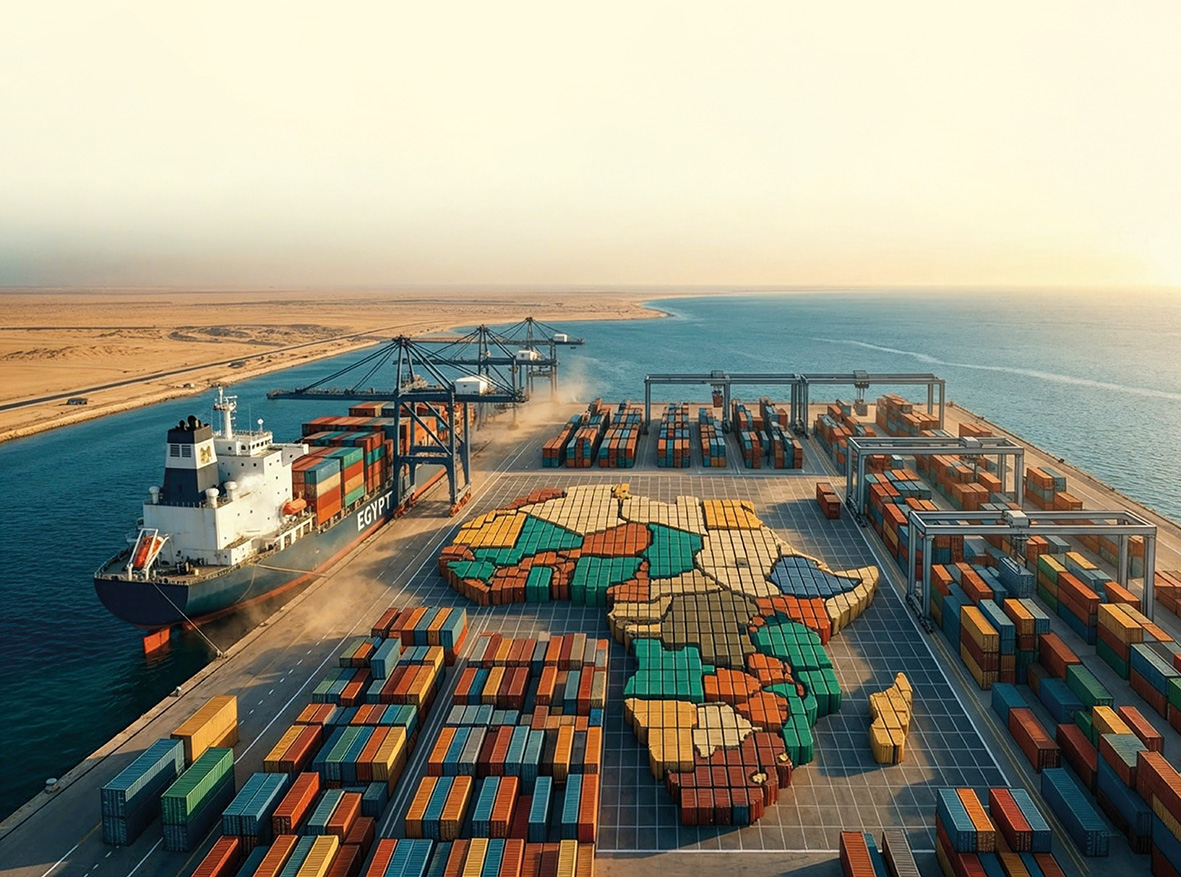


For years, the government has promoted doing business in Sub‑Saharan Africa. With new volatility emerging in the Middle East, Egyptian companies now have even more reason to look south.
Encouraging local companies to trade and invest in Africa has long been a government priority. Last May, Hossam Heiba, then chairman of the General Authority for Investment and Free Zones, said, “The Egyptian government is currently developing sustainable strategies to facilitate investment flows and trade across the continent and to establish integrated partnerships among key African stakeholders. The goal is to boost intra-African investment and trade.”
Meanwhile, the ongoing geopolitical conflict between Iran and GCC nations (Egypt’s second-largest importer and exporter of goods and home to nearly half of Egypt’s FDI in fiscal year 2024/2025) highlights the importance of local companies expanding into African markets.
That shift may become unavoidable for Egyptian companies that rely on the GCC. According to a March note from Fitch Ratings, while “the effect on economic growth [in the GCC] will be temporary … there may be longer-term damage to those parts of the region that position themselves as havens for international businesses and individuals.”
Further complicating the GCC’s situation is that Fitch Ratings’ “base case is subject to particularly high uncertainty. A more prolonged disruption to [the region’s] exports than we assume would likely have more severe negative repercussions.”
Current footprint
The government recognizes that “Egypt’s foreign policy toward Africa has faced serious challenges over the past decade, [despite] the African dimension being one of the central aspects of Egypt’s national security strategy,” according to the State Information Service (SIS) in January.
To improve its limited presence on the continent, the government announced it will work collaborate with the African Union (AU) to “unfreeze activities [as well as] restore Egypt’s leadership role” within the organization, the SIS reported.
Second, the state will “re-establish [its] active role in Africa based on a development partnership. This includes strengthening bilateral political and economic relations; making practical proposals for technical, trade, and investment cooperation; and extending areas of understanding and common interests with the African countries,” the SIS stated.
Finally, the government will “develop an Egyptian water policy with a mixed structure of development and water cooperation with the Nile Basin countries,” according to the SIS. “This will adhere to Egypt’s water rights and focus on common interests and development partnerships benefiting all parties.”
These three efforts will build on Egypt’s previous initiatives across the continent. In November 2021, when Egypt chaired the Common Market for Eastern and Southern Africa (COMESA), it “worked on the activation of the Continental Free Trade Zone Agreement [a free trade agreement comprising all 54 African nations],” the SIS noted.
During its 2024 leadership of the African Union Development Agency (NPEAD), Egypt spearheaded the “launch of the second 10-year plan … of the 2063 Agenda … in February, with implementation starting through regional and national program initiatives.”
Egypt also carried out several NPEAD projects and initiatives in agriculture, industrial transformation, food security, tourism, science, technology, health, environment, and the empowerment of youth and women, the SIS reported.
Also, the country hosts the African Union Centre for Post-Conflict Reconstruction and Development, which is currently working closely with Somalia, South Sudan, and the Sahel region, according to SIS.
Egypt is also home to the African Union’s permanent delegation to the Arab League, African Space Agency, African Center of Excellence for Climate Resilience and Adaptation, the Regional Investment Agency of COMESA, and the African Export and Import Bank.
Building for more integration
In February, Foreign Minister Badr Abdelatty told media the “Egypt-Libya-Chad corridor [a 2,570-kilometer highway] is now a key part of Egypt’s regional strategy.” Other important projects under development include the Cairo-Cape Town route in South Africa, a 10,228-kilometer highway passing through seven other countries. There is also the Lake Victoria-Mediterranean route, which connects 10 nations from Tanzania in the south to Egypt in the north, passing through Sudan.
“These projects … contribute to continental trade integration, strengthen the African Continental Free Trade Area, and advance the African Union’s Agenda 2063 for sustainable development.”
Also on the government’s Africa agenda is the creation of a national investment agency. Its mandate would be to coordinate Egypt’s investments across the continent, Abdelatty said during a March Cabinet meeting.
Also during the gathering, Prime Minister Mostafa Madbouly told the media the government is working on incentive packages. “These packages are meant to motivate investors to increase investment in African markets,” he said, emphasizing Africa’s promising opportunities and its strategic importance for Egypt’s development goals.
According to the meeting’s minutes, increasing Egypt’s presence across the continent “aligns with directives from President Abdel-Fattah El-Sisi to strengthen and expand cooperation frameworks with African Partners during the current phase,” reported state-owned Ahram English.
The $500 billion fund
Securing enough funding for projects has long been Africa’s biggest development challenge. The African Development Bank (ADB) estimates the funding gap at “between about $1.3 trillion and $1.6 trillion [between] 2020 [and] 2030 to implement Africa’s climate action commitments and Nationally Determined Contributions,” covering all of the U.N.’s 17 Sustainable Development Goals (SDGs), according to a 2022 report.
That gap is expected to grow almost exponentially through 2050. “After historical and future carbon emission shares are accounted for, total climate finance due to Africa is estimated [to range from] $4.76 trillion to $4.84 trillion [between] 2022 [and] 2050,” the ADB noted. “This represents annual flows of $163.4 [to] $173 billion.”
To help narrow this projected gap, Egypt launched the “Africa Team” initiative in February. The initiative aims to mobilize the funds needed to finance about 300 continental projects, according to the SIS.
The initiative plans to raise $500 billion mainly to finance projects that “address some of Africa’s most pressing challenges,” including poverty reduction, job creation, and energy and food insecurity,” reported Abyssinia Business Network.
According to Abdelatty, the initiative will support the AU’s Agenda 2063 strategy’s second 10-year plan, which ends in 2033. It focuses on major international and regional changes impacting food, water, and energy security across Africa.
Supporting Team Africa’s efforts will be a planned “NEPAD-affiliated development fund to address financing gaps in a sustainable manner,” reported Ahram English. The government has not yet announced any details about the fund.
Solutions from within
To turn funding pledges into viable projects, African nations need to implement structural reforms and strengthen institutions to improve their business climates and attract FDI, according to a U.N. report from November. Without these reforms, neither government nor private sector investments will reach their full potential in these African countries.
Creating such an environment will require a significant shift in mindset among decision-makers, the report states. This change is crucial to addressing the continent’s development financing gap. “Official development assistance to developing countries averages just 0.32% of developed nations’ GNI, a fraction of the 0.7% target, creating an average annual $75 billion delivery gap to Africa,” the U.N. report explains.
To carry out the necessary reforms and institutional improvements, the U.N.report highlights “three [common] interconnected pillars.” First, “African countries must strengthen their economic governance to control their resources.” Second, “they need to accelerate digitization of state machinery, particularly tax administration.” Lastly, “African countries must rationalize their public financial management strategies by eliminating redundant and costly incentives, which cost 1.8% of GDP in forgone revenues annually.”
“By harnessing their resources and controlling financial flows, African countries can fund their own development,” the paper stressed. “This will help them shift from dependency to ownership and achieve sustainable prosperity.”